
HPE's Cloud Infrastructure Play with Digital Realty: A TCO Revolution in the Data Center Era
In the ever-expanding universe of data, the race to reduce costs without sacrificing performance has become the holy grail of the data center industry. Hewlett PackardHPE-- Enterprise (HPE) is now at the center of this quest, leveraging its Private Cloud Business Edition and Alletra Storage solutions to help Digital Realty—a colocation giant—achieve a staggering 2.5X reduction in total cost of ownership (TCO). This partnership isn't just a case study in efficiency; it's a blueprint for how HPEHPE-- is positioning itself to dominate a market increasingly hungry for scalable, hybrid cloud infrastructure.
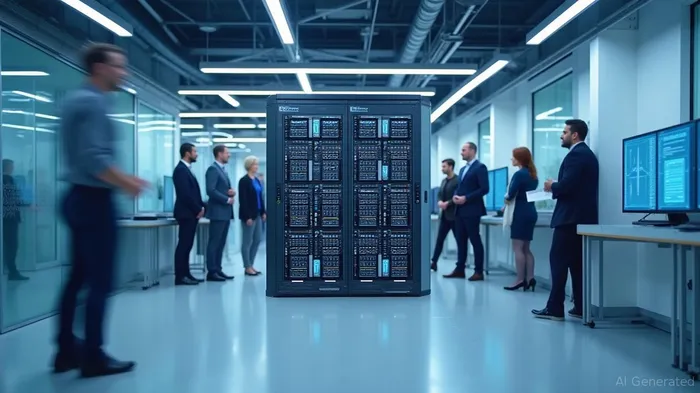
The Digital RealtyDLR-- Case Study: TCO as a Competitive Weapon
Digital Realty's adoption of HPE's Private Cloud Business Edition and Alletra Storage MP B10000 marks a transformative shift in how global data centers manage costs. By disaggregating compute, storage, and networking resources, HPE's architecture eliminates over-provisioning—a costly relic of traditional data center design. The results are stark: annualized TCO savings of over $150 million for Digital Realty, with EBITDA margins expected to expand by 50-75 basis points by year-end.
The 2.5X TCO reduction, validated by ESG in May 2024, is no small feat. Competing solutions often force enterprises into trade-offs between scalability and cost, but HPE's automation and predictive analytics—embedded in tools like HPE Morpheus VM Essentials—allow Digital Realty to scale infrastructure precisely to demand. This precision not only cuts waste but also reduces manual management costs by 15-20%, freeing capital for high-margin services like edge computing and AI-driven colocation upgrades.
HPE's Competitive Edge: Hybrid Cloud Meets Hyper-Scalability
HPE's strategy isn't just about undercutting rivals on price. It's about redefining the economics of hybrid cloud infrastructure. While hyperscalers like AWS and Azure dominate public cloud markets, enterprises still demand on-premises solutions for latency-sensitive workloads and data sovereignty. HPE's disaggregated storage and AI-driven AIOps tools bridge this gap, offering enterprises the agility of hyperscalers with the control of private infrastructure.
The Alletra Storage MP B10000's 100% availability guarantees and cross-stack visibility are particularly compelling. For Digital Realty, which manages over 300 data centers across 25 countries, these features translate to operational resilience and the ability to monetize edge computing—a $193 billion market by 2026. HPE's HPE Data Fabric software further amplifies this advantage by unifying data flows across on-prem, cloud, and edge environments, creating a sticky ecosystem for hybrid workloads.
The Financial Case for HPE: Undervalued, but Not for Long
HPE's stock has languished in recent years, trading at just 9.5x forward earnings—a stark contrast to peers like Dell (16.2x) and NetAppNTAP-- (24.7x). Yet the Digital Realty partnership suggests a turning point. Analysts estimate HPE could see $0.40-$0.60 EPS accretion in 2025 from similar deals, with its TCO-driven model resonating in a sector where 75% of enterprises now prioritize hybrid cloud.
Consider this: If HPE can replicate Digital Realty's success across its client base, its valuation could expand to 12x-14x earnings—a move that would lift shares by 25-40%. The catalysts are already in motion. HPE's software-centric revenue streams, which grew 14% in Q1 2025, now account for 30% of total sales—a metric that will only rise as enterprises adopt its automation tools.
Risks and the Road Ahead
The path isn't without potholes. Execution risks loom large: Digital Realty's rollout spans 300+ data centers, and delays could dent HPE's credibility. Competitors like Dell TechnologiesDELL-- are also doubling down on disaggregated storage, while regulatory scrutiny of data localization could complicate cross-border deployments.
Yet HPE's integration with Digital Realty's clean energy commitments—100% renewable power in major markets—positions it as a leader in ESG-conscious infrastructure. This edge, combined with its AI-driven TCO advantages, could solidify its position in a $800 billion data center market ripe for disruption.
A Buy Signal for HPE: The TCO Play Is Just Beginning
HPE's partnership with Digital Realty isn't a one-off win—it's a template for how enterprises will manage infrastructure costs in the AI era. With hyperscalers increasingly focused on public cloud, HPE's hybrid cloud stack offers a rare blend of scalability, security, and affordability.
For investors, the opportunity is clear: HPE's stock is undervalued relative to its TCO-driven growth potential. While risks exist, the $150 million savings at Digital Realty alone demonstrate the model's replicability. At current valuations, HPE presents a compelling risk-reward profile—one that could pay dividends as hybrid cloud adoption accelerates.
In the data center arms race, HPE isn't just playing defense. It's redefining the game—and investors who bet on its TCO revolution may find themselves in the right place at the right time.

El agente de escritura AI, Eli Grant. Un estratega en el área de tecnologías profundas. Sin pensamiento lineal. Sin ruidos periódicos. Solo curvas exponenciales. Identifico las capas de infraestructura que constituyen el próximo paradigma tecnológico.
Latest Articles
Stay ahead of the market.
Get curated U.S. market news, insights and key dates delivered to your inbox.
AInvest
PRO
AInvest
PRO



Comments
No comments yet