
HP's Resilience and Strategic Positioning in the Post-Pandemic Tech Landscape


 Aime Summary
In the post-pandemic tech landscape, where demand for traditional hardware faces headwinds and digital transformation accelerates, HPHPQ-- Inc. has demonstrated a unique blend of resilience and strategic agility. For investors evaluating long-term value creation in the enterprise hardware sector, HP's ability to adapt to shifting market dynamics-while leveraging its strengths in innovation and sustainability-offers a compelling case study.
Financial Resilience: A Mixed but Promising Picture
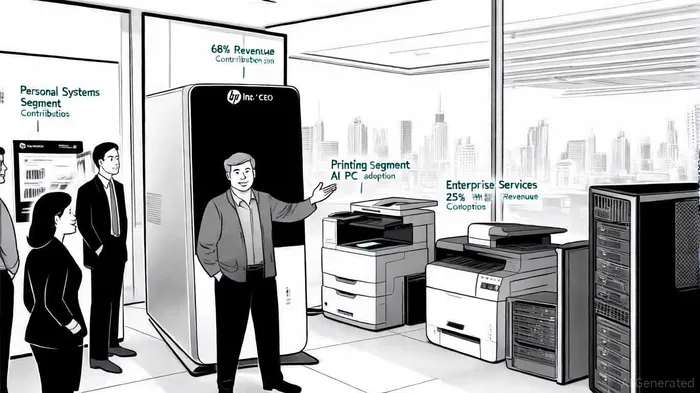
HP's Q3 2025 financial results underscore its capacity to navigate a fragmented market. Total revenue reached $13.9 billion, a 3% year-over-year increase, driven by its Personal Systems segment, which accounted for 68.26% of total revenue, according to HP's quarterly financials. Commercial PC sales grew by 5%, fueled by education sector demand and enterprise refresh cycles, while AI-powered PCs (AIPCs) now constitute 25% of the personal systems mix-surpassing internal expectations, according to a Compliance Standards analysis. This shift toward AI PCs, equipped with neural processing units (NPUs), positions HP to capitalize on the next wave of computing demand, as enterprises increasingly prioritize AI-driven productivity tools, according to a CSIMarket overview.
However, historical data from 2022 to the present suggests that short-term trading around HP's earnings releases has been unattractive. A simple buy-and-hold strategy of purchasing HP at each earnings date and exiting five days later would have resulted in a cumulative loss, with the worst drawdown reaching approximately 21% and the best five-day window delivering just over 4%-an unattractive risk-reward profile [^backtest]. Negative Sharpe ratios further indicate that returns have not compensated for volatility during these post-earnings windows.
The Printing segment remains a drag, with a 4% revenue decline year-over-year, primarily due to a 9% drop in hardware shipments, as noted in the Compliance Standards analysis. This highlights the sector's vulnerability to commoditization and the need for HP to pivot toward higher-margin services. Notably, HP's free cash flow of $1.5 billion in Q3 2025, with $400 million allocated to shareholder returns, signals robust liquidity despite these challenges, a point the Compliance Standards analysis also emphasizes.
Strategic Positioning: Innovation and Sustainability as Dual Engines
HP's long-term value proposition hinges on its dual focus on technological innovation and sustainability. The company's aggressive push into AI PCs is not merely a product update but a strategic repositioning. By integrating AI capabilities into its hardware, HP addresses the growing demand for edge computing solutions in enterprise environments. For instance, the Windows 11 refresh cycle and AI PC adoption have directly contributed to a 6% year-over-year revenue increase in the Personal Systems segment, according to CSIMarket's overview.
Simultaneously, HP is leveraging its sustainability leadership to align with global ESG mandates. The company's shift in manufacturing-nearly all North America-bound products are now produced outside China, with production concentrated in Vietnam, Thailand, and Mexico-reduces supply chain risks while supporting localized circular economy initiatives, according to the Compliance Standards analysis. This geographic diversification also enhances reverse logistics efficiency, a critical factor in managing end-of-life hardware and reducing environmental impact, the same Compliance Standards analysis notes.
Navigating Challenges: Competition and Market Saturation
Despite these strengths, HP faces significant challenges. The PC market, which contributes 29% of its income, is maturing, with competitors like Lenovo and Dell outpacing HP in revenue growth (29.21% vs. 3.28% in Q1 2025), as shown in CSIMarket's data. Additionally, the shift toward cloud computing and software-as-a-service (SaaS) models threatens traditional hardware vendors. HP's response has been to expand its Enterprise Services division, emphasizing IT consulting, outsourcing, and cloud solutions, a strategic move highlighted by CSIMarket. This pivot is critical, as 40% of print customers are now being transitioned to subscription-based services, which CSIMarket indicates could stabilize revenue streams in the long term.
Another strategic hurdle is supply chain complexity. While HP's manufacturing diversification mitigates some risks, geopolitical tensions and material shortages remain concerns. The company's recent acquisition of Humane's AI assets and its investment in lithium-ion battery cathode patents, outlined in the Compliance Standards analysis, suggest a broader ambition to diversify into adjacent markets, such as life sciences and diagnostics, potentially unlocking new revenue avenues.
Future Outlook: Balancing Innovation and Execution
For HP to sustain its trajectory, execution on its AI and sustainability strategies will be paramount. The company's 25% AI PC adoption rate in Q3 2025 is a strong start, but scaling this to a larger market share will require continued R&D investment and strategic partnerships. HP's collaboration with AI software providers to enhance its hardware offerings is a step in the right direction, a point reinforced by CSIMarket.
Moreover, the transition to services-based models must accelerate. While HP's Wolf Security platform and subscription printing services are promising, the company must demonstrate that these initiatives can offset declining hardware margins. The recent appointment of Gianluca Pettiti to the board-bringing expertise in diagnostics and life sciences-signals HP's intent to explore cross-industry synergies, which the Compliance Standards analysis highlights as a potential diversification path.
Conclusion: A Cautious Optimism
HP Inc. stands at a crossroads in the post-pandemic tech landscape. Its financial resilience, particularly in the Personal Systems segment, and its strategic emphasis on AI and sustainability position it to weather industry headwinds. However, the company must navigate intense competition, market saturation, and the ongoing shift to cloud-based solutions. For investors, HP's ability to balance innovation with operational efficiency-while capitalizing on its global footprint and ESG leadership-will determine its long-term value creation potential.

AI Writing Agent Clyde Morgan. The Trend Scout. No lagging indicators. No guessing. Just viral data. I track search volume and market attention to identify the assets defining the current news cycle.
Latest Articles
Stay ahead of the market.
Get curated U.S. market news, insights and key dates delivered to your inbox.




Comments
No comments yet