
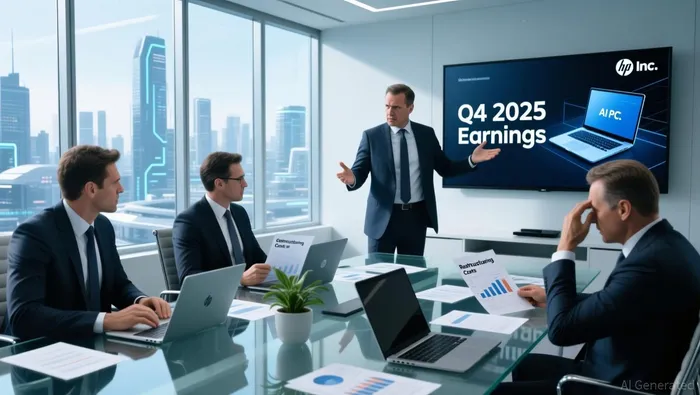
HP Inc.'s Q4 2025 Earnings Call: Contradictions Emerge in Memory Pricing, AI PC Penetration, and Restructuring Costs
 Aime Summary
Date of Call: November 25, 2025
Financials Results
- Revenue: Q4 revenue up 4% year-over-year
- EPS: $0.93 non-GAAP diluted net EPS in Q4, representing a 24% sequential increase
- Gross Margin: 20.2%, impacted by higher mix from Personal Systems and increased trade-related costs
- Operating Margin: 8% non-GAAP operating margin, down year-over-year but improving ~1 point sequentially
Guidance:
- FY'26 non-GAAP EPS $2.90–$3.20; GAAP EPS $2.47–$2.77.
- Q1 non-GAAP EPS $0.73–$0.81; Q1 GAAP EPS $0.58–$0.66.
- FY'26 free cash flow $2.8–$3.0B; aim to return ~100% of FCF to shareholders if gross leverage <2x.
- Expect ~$0.30 FY'26 EPS headwind from memory costs net of mitigations, with majority impact in H2.
- PS operating rate 5%–6% in H1; full year at low end of 5%–7%; Print margins in upper half of 16%–19%.
- Restructuring ~$250M in FY'26 (~$650M over 3 years); target ~$1B gross run-rate savings by FY'28 (~$300M by FY'26).
- Quarterly dividend increased to $0.30.
Business Commentary:
* Revenue and Business Performance: - HP Inc. delivered its sixth consecutive quarter ofrevenue growth, up 4% year-over-year. - This growth was driven by Personal Systems gains in commercial and consumer categories, while the print market remained soft.- Memory Cost Challenges:
- Rising memory costs account for
15% to 18%of a typical PC's cost, with a significant acceleration in recent weeks. HP is addressing this challenge by qualifying additional suppliers, redesigning portfolios for reduced memory configurations, and raising prices in partnership with customers.
AI and Product Innovation:
- AI PC penetration reached over
30%of shipments in Q4, more than anticipated, driven by strong customer demand for AI-powered devices. HP introduced new innovations like the AI station and an ultra-wide monitor, aiming to streamline tasks and improve customer productivity.
Cost Management and Transformation:
- The company surpassed its original
$1.4 billionsavings target from its future-ready cost plan, delivering$2.2 billionin cumulative gross annualized savings. - HP plans to embed AI into its operations to drive approximately
$1 billionin gross run rate savings over the next three years, including workforce reductions.
Sentiment Analysis:
Overall Tone: Positive
- Management highlighted a "sixth consecutive quarter of revenue growth, up 4% year-over-year," Q4 "non-GAAP EPS came above the midpoint," announced a dividend raise to $0.30, and detailed a company-wide AI program targeting ~ $1 billion gross run‑rate savings, while acknowledging temporary memory headwinds (~$0.30 EPS impact net of mitigations).
Q&A:
- Question from Wamsi Mohan (BofA Securities): Your free cash flow guide for next year is flat despite margin pressures from increased memory pricing — what offsets these headwinds in cash flow? Does the $2.9B in free cash flow include cash restructuring charges? Follow-up on strategies (price elasticity, despec'ing, other tactics) to limit the ~ $0.30 impact.
Response: FCF guide assumes flat FCF offset by working-capital improvements (favorable cash conversion), slightly lower CapEx and restructuring (included and expected ~ $250M in FY'26); memory mitigation via supply contracts, qualifying additional suppliers, despecing when appropriate and selective pricing.
- Question from Brian Luke (UBS Investment Bank): Will you consider price increases across the entire portfolio or more tactical increases? Can you quantify pricing moves? Also, on Windows 11 refresh (you said roughly 60% converted): is that a tailwind into FY'26 and beyond, and will tariffs impact this?
Response: Pricing will be applied selectively (case-by-case, country/category) rather than uniform across the portfolio; Windows 11 conversion (~60%) remains a multi-quarter tailwind (at least H1 and likely beyond), and AI‑PC adoption will further support demand (AI PC shipments >30% in Q4, expected 40–50% next year).
- Question from Jyhhaw Liu (Evercore ISI): Why the new cost savings initiative announced today — is it a response to high memory costs or a broader program?
Response: The initiative predates the memory spike and is an AI-driven productivity and process-redesign program targeting roughly $1 billion of gross run-rate savings over three years by moving from pilots to scaled agentic-AI initiatives.
- Question from Joseph Cardoso (JPMorgan Chase & Co): Please flesh out conviction around PC/PS momentum into 2026 as you cycle past most of the Win11 refresh; you noted pricing will be a bigger contributor next year — how should we think about H1/H2 seasonality and margin dynamics?
Response: Confidence rests on an aged installed base and remaining Win11 refresh (~40% of base left, mainly SMB and outside North America) plus premium/AI‑PC mix and higher attach rates; expect stronger H2 revenue but PS margins pressured in H2 due to memory (PS OP 5%–6% H1, full year at low end of 5%–7%).
- Question from Michael Ng (Goldman Sachs): When you reference a growing base of services/subscriptions/software, is that Workforce Solutions or print subscriptions? Also, the $0.30 EPS headwind — what's the gross impact and confidence in mitigations? Any other component inflation?
Response: Recurring revenue growth is across consumer subscriptions (Instant Ink/All‑In ~ $1B), Workforce Solutions/PCaaS and software; the $0.30 is a net EPS headwind (gross impact materially larger), management is confident in mitigation actions but purposely conservative in the guide; other components show less pressure than memory/storage.
- Question from Michael Cadiz (Citigroup): Given you hit 25%–30% AI PC penetration ahead of schedule, how do tariffs and elevated commodity costs affect the path to ~50% penetration? Also, how have customers reacted to your pricing actions in PC and print, and does reception differ between consumer and commercial?
Response: HP remains optimistic on AI‑PC penetration (30% at quarter end) and expects continued growth toward mid‑term targets; pricing is selective—print commercial pricing faced competitive pressure (yen advantage for some competitors), supplies gained share, and PC price increases have been modest so far.
- Question from Maya Neuman (Morgan Stanley): Can you quantify weeks of memory inventory and are suppliers willing to sign long‑term agreements? Separately, given secular print decline, how should we think about print operating income sustainability?
Response: They won't disclose weeks of inventory but say on‑hand inventory and long‑term supplier agreements protect H1; print strategy focuses on increasing value per customer via profitable unit placement, Big Ink, subscriptions and growth in industrial graphics to drive sustainable, profitable revenue.
- Question from Mark Newman (Sanford C. Bernstein): On the memory price environment and the ~$0.30 impact — is the guide conservative and could you see correcting pricing over several months? Also, will specs/mix change given memory moves and could that affect AI‑PC dynamics?
Response: Guide is deliberately conservative; management will prioritize margin by favoring higher‑margin/premium configurations, accepting potential compression in entry-level volumes, and believes pricing/portfolio actions plus supply relationships can mitigate but they are planning for a material H2 impact.
Contradiction Point 1
Memory Cost and Pricing Strategy
It involves the company's strategy regarding memory cost increases and pricing adjustments, which can significantly impact product pricing and profitability.
Are you considering price increases across your entire portfolio, and if so, can you quantify the potential increases? - Brian Luke (UBS Investment Bank)
2025Q4: We are looking at it case by case, country by country, category by category. But the impact on memory cost is significant, so we will be implementing price increases across the board but selectively. - Enrique Lores(CEO)
Do AI PCs have a higher ASP or margin than non-AI PCs? - Jyhhaw Liu (Evercore ISI)
2025Q3: We are seeing an uplift in pricing of AI PCs compared to similar units without the AI capability, with an estimated 5% to 10% price increase. - Enrique J. Lores(CEO)
Contradiction Point 2
AI PC Penetration and Market Dynamics
It involves the company's outlook on AI PC penetration and market dynamics, which are crucial for understanding future growth and market positioning.
How have tariffs and commodity costs impacted AI PC adoption trends? - Michael Cadiz (Citigroup)
2025Q4: We remain optimistic about AI PC penetration. We are prioritizing premium categories to manage memory issues and are working with software companies to enhance AI capabilities. - Enrique Lores(CEO)
Can you discuss the adoption of AI PCs across industries and regions and the key use cases? - Unidentified Analyst (Morgan Stanley)
2025Q3: We are seeing strong adoption of AI PCs, with software companies like Adobe and Zoom benefiting from NPU capabilities. - Enrique J. Lores(CEO)
Contradiction Point 3
Free Cash Flow and Restructuring Costs
It involves the company's financial outlook and restructuring efforts, which are critical for understanding the company's financial health and operational strategy.
Your free cash flow guidance for next year remains flat despite margin pressures from higher memory pricing. What factors are offsetting these headwinds in cash flows? Does the $2.9 billion in free cash flow include any restructuring charges? - Wamsi Mohan (BofA Securities)
2025Q4: The $29 billion includes restructuring activities, with projected costs of about $250 million for the year. - Karen Parkhill(CFO)
Are you returning all free cash flow to shareholders now that leverage is below 2x? - Michael Ng (Goldman Sachs)
2025Q3: We expect to build restructuring activities into our free cash flow expectations as we go through the year. - Karen L. Parkhill(CFO)
Contradiction Point 4
PC Margin and Market Dynamics
It reflects differing perspectives on the market conditions and margin pressures affecting the PC segment, which could influence strategic decision-making and investor expectations.
Your free cash flow guidance for next year remains flat year-over-year despite margin pressure from higher memory prices. What factors are offsetting these cash flow headwinds? - Wamsi Mohan (BofA Securities)
2025Q4: Given projected memory cost increases, we expect free cash flow to be relatively flat. Key offsets include improvements in working capital and a slight decrease in CapEx and restructuring costs. - Karen Parkhill(CFO)
Can you break down the factors affecting print margins in fiscal '24 and explain the key drivers and reasons for expected margin improvement in Q4? - Andrew (UBS)
2024Q3: In Q4, we expect seasonal strength on revenue and will accelerate future-ready actions to drive margin improvement, including business consolidation and platform reductions. - Karen Parkhill(CFO)
Contradiction Point 5
PC Market Demand and Channel Inventory
It pertains to the company's expectations for PC market demand and channel inventory, which are critical for assessing business performance and strategic positioning.
How confident are you in PC growth as we move past the Windows 11 refresh cycle? Where are the key dynamics occurring, and why do you believe pricing will impact next year more than unit sales? - Joseph Cardoso(JPMorgan Chase & Co)
2025Q4: We are being more prudent about market expectations due to economic factors. Consumer and business confidence has waned, and price increases are expected. We do not see channel inventory impacts. - Enrique Lores(CEO)
What are your expectations for the PC market in the second half of the year and channel inventory levels? Does the Windows 11 Refresh remain a catalyst? - Erik Woodring(Morgan Stanley)
2025Q2: We see strong demand in Commercial, but we are being more prudent about market expectations due to economic factors. Consumer and business confidence has waned, and price increases are expected. We do not see channel inventory impacts. - Enrique Lores(CEO)

Discover what executives don't want to reveal in conference calls
Latest Articles
Stay ahead of the market.
Get curated U.S. market news, insights and key dates delivered to your inbox.
AInvest
PRO
AInvest
PRO



Comments
No comments yet