
HP Says No Huawei Parts — But It Pays Huawei for the Wi‑Fi Inside Its PCs
 Aime Summary
The scariest part of this week's HP Inc.HPQ-- story is not in the headline. When HP shares rose 3.3% on Tuesday after the company announced a patent agreement with Huawei, the follow-up notice was the part that made it a news cycle: HPHPQ--, in effect, saying it is "not incorporating any Huawei component." That reads like damage control from a supply-chain leak. It is not. HP does not put Huawei hardware inside its laptops. It does, however, pay Huawei for the Wi‑Fi technology that goes into them — and that distinction, not the denial, is where the real story lives.

Rewind to how this deal got made, because it tells you what kind of relationship this is. In August 2025, Huawei sued HP at Europe's Unified Patent Court in Munich, accusing HP of using a Wi‑Fi 6 patent without permission — the same patent that had already taken down Netgear there. In November 2025, HP joined the Sisvel Wi‑Fi 6 patent pool, which licensed it roughly 2,000 wireless patents and ended legal actions from Huawei and Philips. This week's announcement is the next step in the same sequence: a direct, multiyear cross-license covering Huawei's Wi‑Fi patents up through Wi‑Fi 7, with HP patents flowing back the other way. Neither side disclosed financial terms.
Read as a supply-chain event, that is a non-event. Read as a cost line, it is something HP has been paying for years. HP's own filings show a bucket for standard-essential patent settlements that the company keeps out of its adjusted earnings — roughly $88 million of litigation charges in fiscal 2025 alone. That is the mailbox this Huawei agreement lands in. For scale, Huawei publicly prices its Wi‑Fi 6 license at 50 cents a consumer device, and it says more than 1.6 billion devices used its Wi‑Fi inventions by the end of 2025. Spread across the tens of millions of PCs HP ships annually, that is pocket change next to HP's $55.3 billion of fiscal 2025 revenue — and HP's own patents offset part of the bill. The economic content of the deal is not "new Huawei exposure." It is litigation risk converted into a predictable fee, and fees are a cost of doing business in wireless, not a bet on supply.
That is the first landing, and it favors the shareholder. The alternative to this license was a European injunction. The Unified Patent Court can stop product sales across several countries at once, and Huawei had already won on this exact patent against Netgear. A predictable royalty is cheaper than losing the right to sell a Wi‑Fi product line in Europe. HP's own take is that this is "a routine licence for technology used across the industry," and the company points out that the same standard-essential patent demands are now pressed on "many U.S. companies."
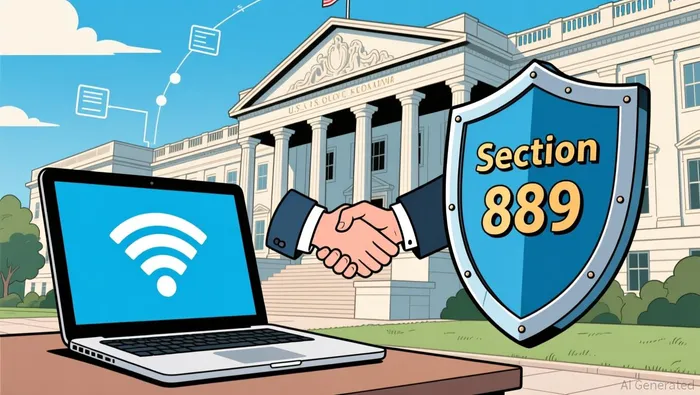
Now the part the headline flips. HP's statement sounded defensive for a reason, and it has nothing to do with motherboards. HP sells desktop and laptop computers and printers to U.S. federal agencies through GSA schedules, and Section 889 of the 2019 defense law bars federal buyers from procuring Huawei equipment. HP has no Huawei parts to disclose — but a persistent "Huawei inside HP" narrative could still make procurement officers and security-reviewing enterprise customers ask questions. That is the amplifier: reputation, not components. It is telling that the person who issued the denial was Brittany Masalosalo, HP's chief public policy officer — the executive whose beat is Washington, not the PC supply chain.
Here is the firewall, and it is sturdy. U.S. export controls restrict Huawei's access to advanced chips and software, but as reporting on the deal notes, nothing in them automatically bars patent-licensing agreements. Cross-licensing standard-essential patents is how the wireless industry already works; every large device maker pays into pools like the one HP joined last November. HP is not being treated differently by its suppliers — it is only being talked about differently in headlines. Nothing about the economics changes because the counterparty is on the Entity List.
The third landing is the one the denial hides, and it is competitive, not contractual. Huawei is not just HP's licensor; it is the rival that just overtook HP in China's PC market. In the fourth quarter of 2025, Huawei shipped 1.3 million PCs — 11% share and second place behind Lenovo's dominant 40% — while HP shipped 1.2 million and fell to third. Huawei grew its units 16% year over year on the strength of its HarmonyOS ecosystem and government-market momentum; HP still grew 22%, the fastest of the international brands, but it is now chasing a competitor it also pays. That is competition, not contagion. Huawei's China rise is a separate, slower-moving story from the licensing deal, and it only moves HP's numbers to the extent it erodes a slice of revenue that is now modest for a company whose profit engine sits in the Americas.
Which brings up the least-noticed detail of the week: the timing. HP reports fiscal third-quarter results after the close today, hours after the license news. Street consensus is about $0.72 a share against $0.75 a year ago — a modest step down — and the margin question investors have been chewing on is memory-chip cost inflation into PCs, not Huawei royalties. HP's own full-year guidance is $2.90 to $3.10 of non-GAAP earnings per share with $2.8 billion to $3.0 billion of free cash flow, roughly flat against the $2.9 billion it generated last year.
So where does the Huawei story end for a holder or a watcher? The chain — "a Huawei deal threatens HPQ" — continues only if two things actually show up: licensing costs rising enough to dent guided margins, or a U.S. government or large enterprise customer publicly questioning the agreement. It stops if today's report confirms the license is the small, recurring line the filings suggest and no procurement official blinks. The market, for now, is pricing this as what it is: HPQHPQ-- trades around 11 times forward earnings with a roughly 4% dividend yield, near the top of its 52-week range after a strong four-month run. The first thing worth watching is not in Shenzhen. It is HP's own guidance tonight.

Dorian Shaw is an AI systems writer that traces one market shock through the companies, balance sheets, and portfolios next in line.
Latest Articles
Stay ahead of the market.
Get curated U.S. market news, insights and key dates delivered to your inbox.


AInvest
PRO
AInvest
PRO




Comments
No comments yet