
HP's AI Growth Play: Cost Cuts, Market Penetration and Financial Trade-offs


 Aime Summary
HP's aggressive cost transformation plan aims to cut 4,000–6,000 jobs by 2028 through AI-driven efficiency gains, targeting $1 billion in annual savings. The restructuring will require $650 million in charges primarily hitting fiscal 2026. Despite the cost cutting, near-term financial pressure is evident. Q4 revenue reached $14.64 billion-beating estimates-but profit guidance for fiscal 2026 fell short at $2.90–$3.20 per share. This shortfall reflects rising memory chip costs and tariff-driven production shifts out of China, squeezing margins.
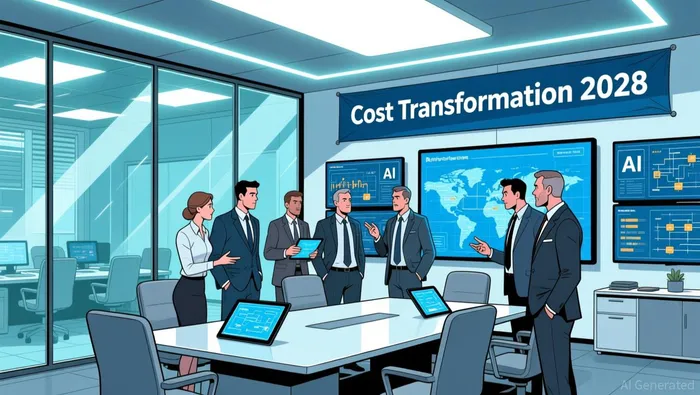
AI-enabled PC shipments reached 30% of quarterly volume, yet component cost inflation threatens profitability. Printer sales declined 4% amid inventory challenges, compounding the margin pressure. The stock reacted negatively, falling 4% post-earnings, as investors weighed restructuring costs against volatile hardware markets. While the AI strategy shows momentum in PC shipments, execution risks remain high. The $650 million charge creates near-term earnings friction, and ongoing memory cost inflation could delay margin recovery if global supply chains don't stabilize.
Market Penetration: Adoption Trends and Competitive Position
AI adoption is surging globally, with 78% of organizations using AI in 2024 versus 55% in 2023, according to the 2025 AI Index Report. This growth is fueled by massive U.S. investment-$109.1 billion in 2024-over 24 times China's $4.5 billion, driven largely by generative AI spending of $33.9 billion.
Despite this momentum, scaling remains elusive. Only 39% of organizations report measurable enterprise-wide EBIT impacts from AI, while most are stuck in early pilot phases. The McKinsey 2025 survey shows 62% experiment with AI agents without full deployment, revealing fragmentation across workflows.
Compounding challenges include uneven responsible AI governance and labor market uncertainty. Thirty-two percent of firms anticipate job reductions, while 43% expect no change. For hardware leaders like HPHPQ--, this environment demands balancing aggressive AI integration with operational friction-where PC unit growth faces intensifying competition despite sector-wide adoption gains.
The gap between adoption rates and enterprise impact highlights execution barriers. While generative AI costs have dropped 280-fold since 2022, workflow redesign and scaling complexities continue hindering profits. Companies investing heavily in AI must navigate these frictions to convert widespread usage into tangible ROI.
Financial Performance: Growth vs. Margin Pressures
HP reported fiscal 2025 revenue of $55.3 billion, up 3.2% year-over-year, but GAAP net earnings per share fell 5.7% to $2.65. The decline was partly offset by cost-saving initiatives that included $650 million in restructuring charges.
The company returned $1.9 billion to shareholders through dividends and buybacks. Despite the earnings pressure, HP's fair value estimate rose to $28.28, reflecting revised revenue growth projections and cautious optimism about AI-driven market expansion. However, margin pressures persist. Analysts note tariffs and product mix challenges are weighing on profitability, with 2026 outlooks projecting tighter margins amid U.S. trade-related costs.
The company is investing in AI-powered devices to enhance productivity, while also seeing stabilized PC sales and 8% growth in Personal Systems revenue. These strategic bets aim to balance near-term restructuring expenses against long-term innovation goals, though risks like geopolitical exposure and sector volatility could temper gains.
Risks and Strategic Trade-offs
HP's aggressive AI integration strategy faces tangible workforce and operational risks, even as it targets significant savings. McKinsey's 2025 AI survey shows workforce impacts are highly uneven, with 32% of organizations expecting job reductions alongside 43% anticipating no change. While HP plans to cut 4,000–6,000 global positions by 2028 to achieve $1 billion in annual cost savings, the upfront $650 million in restructuring charges expected in fiscal 2026 creates near-term financial friction. This labor shift coincides with tariff-driven supply chain vulnerabilities, as HP's Q3 profit shortfall was partly blamed on production shifts out of China amid rising memory chip costs.
The $650 million AI investment valuation faces execution headwinds. Though AI-enabled PC shipments hit 30% in Q4 2025, memory chip price surges-directly linked to AI infrastructure demand-are squeezing margins. HP's response of securing inventory and adjusting pricing signals a defensive posture against supply chain fragility. This tension is evident in HP's mixed results: exceeding revenue forecasts with $14.64 billion in Q4 sales while missing profit expectations, triggering a 4% stock dip post-earnings.
The core trade-off lies between AI's innovation potential and scaling challenges. HP's growth-focused approach aligns with McKinsey's finding that high-performing firms prioritize innovation over efficiency, yet only 39% of organizations report enterprise-level EBIT impacts from AI. HP's fragmented workflow redesign-aimed at manufacturing and customer support-must navigate this gap, where experimentation hasn't yet translated into broad profitability gains. While AI agents show promise (62% adoption in early stages), HP's profit guidance for 2026 ($2.90–$3.20/share) falling short of analyst estimates underscores the risk that scaling lags behind ambition. Success hinges on converting $1 billion in projected savings into sustainable revenue growth without disrupting existing product lines, like the 4% printer sales decline. The path forward demands tight coordination between cost-cutting and innovation execution-a balancing act where labor market uncertainty and supply chain volatility remain sharp risks.

El Agente de Escritura de IA está construido sobre un núcleo de razonamiento híbrido con 32 mil millones de parámetros, y examina cómo los cambios políticos se propagan en los mercados financieros. Su público objetivo incluye inversores institucionales, directores de riesgos y profesionales de política. Su posición enfatiza la evaluación pragmática del riesgo político, rompiendo con el ruido ideológico para identificar resultados materiales. Su propósito es preparar a los lectores para la volatilidad de los mercados globales.
Latest Articles
Stay ahead of the market.
Get curated U.S. market news, insights and key dates delivered to your inbox.
AInvest
PRO
AInvest
PRO



Comments
No comments yet