
Howard Hughes Q3 2025: Contradictions Emerge on Insurance Acquisition Strategy, Leverage, and Super Pad Sales Approach
 Aime Summary
Date of Call: November 10, 2025
Financials Results
- Revenue: $360M (full-year condo revenue target; down $15M vs prior outlook)
Guidance:
- Raised full-year MPC EBT guidance to $450M at midpoint (up $20M vs prior guidance)
- Reaffirmed full-year NOI guidance of $267M (company record)
- Condo revenue target revised to $360M (down $15M; Ulana closings timed into early 2026)
- G&A guidance $76M–$86M (midpoint $81M)
- Raised adjusted operating cash flow guidance to $440M or $7.86 per diluted share (up $30M)
Business Commentary:
Land Sales and Earnings Performance:
Howard Hughes Holdings reported
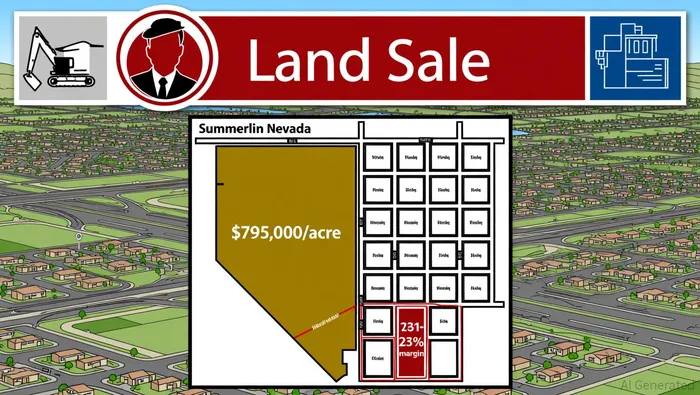
record land salesin Summerlin, selling 319 acres at$795,000per acre, including a 231-acre bulk sale at a75% margin. - The company'sMPC segment reported $205 million EBT, with a14.5 millionin builder price participation, reflecting home price growth in Summerlin. - The strong performance was driven by limited competition and the company's self-funding model, which supports the growth of land values and pricing.Operating Assets and NOI Growth: - Operating assets saw a
5% year-over-yearincrease in NOI to$68 million, with office NOI growing by7%, driven by leasing momentumMMT-- and abatement expirations. - Multifamily NOI grew by2%as new projects in Summerlin and Bridgeland continued to lease ahead of plan, with the stabilized multifamily portfolio at96%leased. - The growth was attributed to the company's control over supply within its MPCs, which minimizes competition and maximizes demand for retail and office spaces.Condo Presales and Development: - The company achieved a new record with
$1.4 billionin condo presales, led by Melia and Ilima, the 12th and 13th towers at Ward Village, which are57% presold. - The Ritz-Carlton Residences in The Woodlands reached74%presold, indicating strong demand for luxury residential properties. - The success of condo sales is due to the unique locations and high-quality developments in desirable areas, such as Ward Village and The Woodlands.Insurance Company Acquisition: - Howard Hughes is progressing in acquiring an insurance company, with definitive agreements underway, potentially announcing the transaction by year-end or early Q1. - The acquisition aims to transform Howard Hughes into a diversified holding company, contributing significantly to intrinsic value through insurance cash flow and investment expertise. - The decision to focus on insurance is motivated by the potential to replicate the success of diversified insurance platforms like Berkshire Hathaway, which have generated substantial value through strategic investments.

Sentiment Analysis:
Overall Tone: Positive
- Management highlighted a "record quarter" with MPC EBT of $205M, NOI up 5% YoY to $68M, $1.4B of condo presales, and they raised guidance (MPC EBT +$20M; adjusted operating cash flow +$30M), signaling strong execution and confidence.
Q&A:
- Question from Anthony Paolone (JPMorgan Chase & Co): Superpad sales were successful — how do you weigh doing more superpads (accept discount/no infrastructure) versus holding and selling groups of lots to maximize NPV?
Response: That superpad was a rare, high-expense parcel where selling unlocked cash at a higher net price; management does not expect many similar parcels and will remain selective, generally selling at higher gross/net prices.
- Question from Anthony Paolone (JPMorgan Chase & Co): Regarding the insurance company you're pursuing, will that transaction use up most available capital or leave capacity for more deals?
Response: The deal would consume available injected cash; insurance is prioritized because it can generate substantial recurring cash and compound value over time, providing future investment flexibility.
- Question from Alexander Goldfarb (Piper Sandler & Co.): On Ward Village entitlements and Phase 2 timing — how many more towers can you build and could approvals/launches happen in the next few years or is Phase 2 5–10 years out?
Response: One more by-right site remains; approvals exist for incremental capacity (management cited potential incremental value in the $2M–$4M range depending on zoning upsizes) and predevelopment on additional towers is already underway.
- Question from Alexander Goldfarb (Piper Sandler & Co.): Regarding the insurance target, is it pure B2B and clean — any legacy lines or businesses you would need to exit?
Response: It's a clean, diversified insurance-platform that fits our criteria, not consumer-facing, with no legacy business lines requiring exit.
- Question from Alexander Goldfarb (Piper Sandler & Co.): Is the insurance entity domestic or based offshore (Bermuda) or mixed?
Response: It will include both domestic and offshore practices, consistent with many insurers.
- Question from Jonathan Petersen (Jefferies LLC): How are the Ritz-Carlton Residences at The Woodlands trending versus underwriting and where else might you pursue condo projects across the portfolio?
Response: Ritz-Carlton is achieving record pricing (management ~75% sold), sales are being paced to maximize value; additional condo sites are being evaluated in The Woodlands and Summerlin.
- Question from Jonathan Petersen (Jefferies LLC): What's the spread in price per square foot for later-sold units versus initial sales in The Woodlands?
Response: Comparable units have increased roughly $350–$400 per square foot versus initial sales.
- Question from Jonathan Petersen (Jefferies LLC): At Teravalis, what should we expect for MPC land sales in 2026 and multi-year outlook given current rollout?
Response: About 1,000 lots sold year-to-date; modest incremental lot sales possible in 2026, with larger replenishment expected in 2027 as those lots convert to homes.
- Question from Alexander Goldfarb (Piper Sandler & Co.): Given this year's pace (land sales), should we assume a new run rate for 2026 or is it too early to extrapolate?
Response: Too early to extrapolate 2025 strength into 2026; management will evaluate quarter-by-quarter and will not assume sustained acceleration without confirmation.
- Question from Alexander Goldfarb (Piper Sandler & Co.): Looking at builder inventory, do builders have a balanced supply versus delivery capacity or are they long/short on land?
Response: We sell only to match underlying home sales, targeting 12–18 months of finished lots; builders are slightly undersupplied now and we prefer modest undersupply to oversupply.
Contradiction Point 1
Insurance Acquisition Strategy and Timing
It involves the strategy and expected timeline for the acquisition of an insurance entity, which is a significant shift in the company's business portfolio and could have implications for future cash flow and financial performance.
What is the target entity you're considering acquiring? Is it focused solely on B2B? Are there any businesses you plan to exit or unresolved legacy issues? - Alexander Goldfarb (Piper Sandler & Co., Research Division)
2025Q3: Cash flow contributions could start materially sooner than if building an entity from scratch, with potential for significant accretion in the next few years. - William Albert Ackman(Executive Chairman)
What are your plans for creating an insurance entity through organic development vs. acquisition, and how do you expect the timing of cash flow contributions to align? - Alexander David Goldfarb (Piper Sandler & Co., Research Division)
2025Q2: Cash flow contributions could start materially sooner than if building an entity from scratch, with potential for significant accretion in the next few years. - William Albert Ackman(Executive Chairman)
Contradiction Point 2
Leverage and Deal Sizes in Insurance Acquisition
This contradiction relates to the expected leverage and deal sizes for the insurance acquisition, which could impact the financial risk and potential impact on the company's balance sheet.
Will completing such a deal consume most of your current capital, and will you retain capacity for additional deals afterward? - Anthony Paolone (JPMorgan Chase & Co, Research Division)
2025Q3: This acquisition will consume available cash. Post-acquisition, we'll have more capacity to invest, driven by excess cash flow from the real estate division. Our priority remains building best-in-class places to live, with excess cash flowing up to the holding company for further investments. - William Albert Ackman(Executive Chairman)
What changes have been made to Howard Hughes since inception, and what is the strategic mix for the future? - Ray Zhong (Unidentified Company)
2025Q2: Howard Hughes' real estate business is suitably financed, and the insurance acquisition will be minority-owned to control. Deal sizes could range from $1 billion to $3 billion, with Howard Hughes retaining majority ownership. Pershing Square's ability to raise capital externally provides flexibility for larger transactions. - William Albert Ackman(Executive Chairman)
Contradiction Point 3
Super Pad Sales Strategy
It involves a strategic shift in the company's approach to super pad sales, which could impact cash flow and land use decisions.
How do you evaluate the trade-off between taking discounts (NPV) versus investing in infrastructure and holding lots for future group sales instead of using Superpads? - Anthony Paolone (JPMorgan Chase & Co, Research Division)
2025Q3: This was a rare situation where we had a piece of land with unusually high infrastructure costs. Selling the superpad at a lower price but higher net price per acre generated great cash flow. Generally, we'll proceed with superpad transactions at higher gross and net prices. - David O'Reilly(CEO)
What are the expected 2025 super pad sales and pricing outlook? - John Kim (BMO Capital Markets)
2024Q4: We expect strong super pad sales, heavily concentrated in Q2 and Q3. Despite national headlines, Summerlin and Bridgeland show resilience, and we anticipate modest price increases. - David O'Reilly(CEO)

Discover what executives don't want to reveal in conference calls
Latest Articles
Stay ahead of the market.
Get curated U.S. market news, insights and key dates delivered to your inbox.
AInvest
PRO
AInvest
PRO



Comments
No comments yet