
U.S. Housing Market Weakness: A Contrarian Lens on Defensive and Cross-Sector Opportunities
 Aime Summary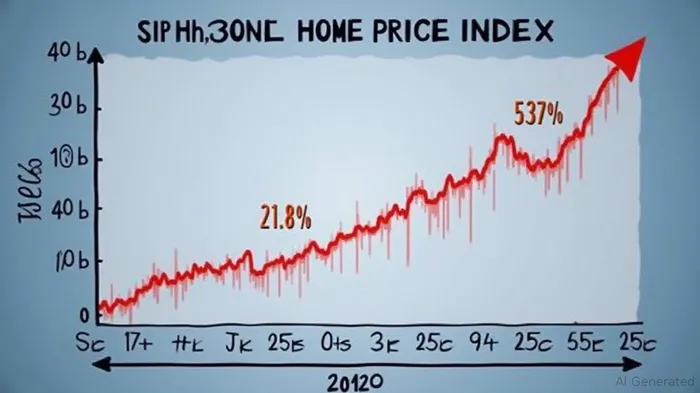
The U.S. housing market, once a cornerstone of economic resilience, is now signaling a shift. The S&P/CS National Home Price Index (HPI) recorded a meager 1.9% annual gain in Q2 2025, the slowest pace since mid-2023. This stagnation reflects a broader recalibration of consumer behavior and construction demand, driven by affordability crises and inventory imbalances. For investors, this presents a dual challenge: avoiding overexposure to vulnerable sectors like Building Materials while identifying contrarian opportunities in industries poised to benefit from a post-housing-market normalization.
The Housing Market's Structural Weakness
The HPI's stagnation masks a volatile trajectory. From June 2024 to June 2025, home prices fell 0.6% in the first half of the period but rebounded 2.5% in the latter half, creating a fragile equilibrium. This volatility is rooted in affordability constraints. At the median home price of $420,000, a 20% down payment requires over a year of median household income, while monthly mortgage payments consume 35% of income. These metrics underscore a market where demand is artificially suppressed by high borrowing costs (6.7% for 30-year mortgages) and a mismatch between supply and demand.
The Building Materials sector, epitomized by companies like Builders FirstSourceBLDR-- (BLDR), is bearing the brunt of this slowdown. BLDR's Q2 2025 revenue fell 5% year-on-year to $4.23 billion, missing analyst estimates by 0.7%. Management cited weak single-family and multi-family housing starts, particularly in Texas and Florida, as key drags. While cost-cutting and productivity gains (e.g., $5 million in savings from supply chain optimizations) have propped up margins, the sector's long-term outlook remains clouded. With single-family starts projected to stay below historical averages and gross margins pressured by competitive pricing, defensive investors should avoid overexposure to this cyclical sector.
Contrarian Opportunities in Passenger Airlines
While the housing market's weakness may seem unrelated to air travel, the broader economic context reveals a compelling case for contrarian airline investments. The U.S. economy's contraction in Q1 2025 and elevated recession risks have dampened consumer confidence, leading to reduced international travel demand. U.S. airlines reported a 11.6% decline in overseas visitor arrivals in March 2025, prompting downward revisions to earnings forecasts. However, this bearish narrative masks a critical asymmetry: airlines are entering this downturn with stronger liquidity than during the 2008 or 2020 crises.

For example, Delta Air LinesDAL-- (DAL) and American AirlinesAAL-- (AAL) have liquidity reserves exceeding $10 billion combined, providing a buffer against short-term shocks. Analysts at J.P. Morgan note that airline stocks historically rebound 40% from troughs during recessions, suggesting the current 30%+ declines in 2025 may represent a buying opportunity. The Federal Reserve's anticipated rate cuts (0.5% by late 2025) could further catalyze a recovery by lowering borrowing costs and boosting consumer spending.
Strategic Positioning: Balancing Risks and Rewards
Investors should adopt a dual strategy: shorting or avoiding Building Materials while selectively allocating to undervalued airlines. The key is to differentiate between cyclical pain and structural resilience. For instance, Spirit Airlines (SAVE), despite a 'CC' credit rating, is executing a $449 million asset sale and pivoting to premium pricing—a high-risk, high-reward play. Conversely, Deutsche Lufthansa (LHA) offers a more measured opportunity, with a 27% surge in adjusted EBIT to €871 million in Q2 2025 and a P/E ratio of 4.9x, 52% below fair value.
The housing market's stagnation also indirectly benefits airlines. As consumers reallocate spending from housing to travel (especially in premium segments), demand for air travel could outperform expectations. This dynamic is already evident in the shift from corporate to leisure travel, with airlines like JetBlueJBLU-- (JBLU) expanding ancillary revenue streams through loyalty programs and premium seating.
Conclusion: Navigating the New Normal
The U.S. housing market's slowdown is not a collapse but a recalibration. For investors, this means avoiding sectors like Building Materials, where demand destruction is entrenched, and seeking contrarian opportunities in airlines, where structural strengths (liquidity, pricing power) may outlast macroeconomic headwinds. By aligning portfolios with these cross-sectoral dynamics, investors can position for both defensive stability and asymmetric upside in an era of economic uncertainty.

Descubre el mundo de las finanzas globales con Epic Events Finance.
Latest Articles
Stay ahead of the market.
Get curated U.S. market news, insights and key dates delivered to your inbox.
AInvest
PRO
AInvest
PRO



Comments
No comments yet