
The Housing Market in Purgatory: Why Real Estate Investors Must Reassess Risk and Strategy
 Aime Summary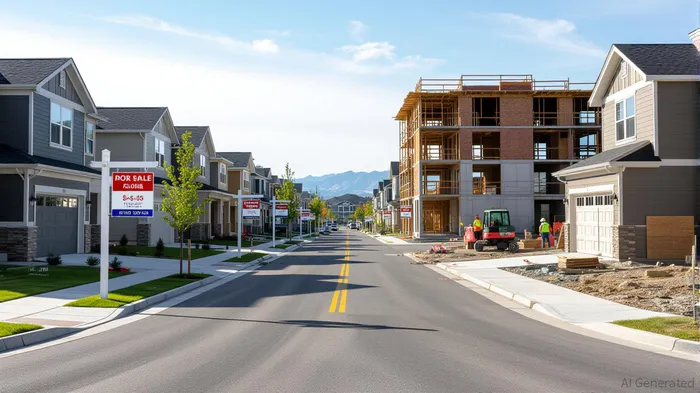
The U.S. housing market is stuck in a limbo between stagnation and transformation. For real estate investors, this "purgatory" state demands a reevaluation of risk and strategy. Structural shifts in demand, affordability crises, and the long-term implications of declining home sales are reshaping the landscape, creating both challenges and opportunities for those who adapt.
Structural Shifts: From Ownership to Renting
The most striking trend is the accelerating shift from owner-occupied to renter-occupied households. Renter growth has outpaced owner-occupied growth for seven consecutive quarters, with renter households rising 2.5% year over year to 46.2 million in Q1 2025, compared to a mere 0.8% increase for owner-occupied units. This divergence is driven by two forces: affordability and demographics.
High mortgage rates—averaging 7% in early 2025—have locked in 69% of existing homeowners with rates below 5%, creating a "lock-in effect" that has suppressed turnover. The Federal Housing Finance Agency estimates this effect prevented 1.72 million home sales between 2022 and 2024. Meanwhile, first-time buyers face a median home price of $407,600, up 50% since 2019, making homeownership increasingly unattainable for younger generations.
The Affordability Crisis: Beyond Mortgage Rates
Affordability is no longer just about mortgage rates. Total homeownership costs—encompassing utilities, insurance, taxes, and maintenance—have surged 18% year over year to an average of $21,400 annually. By contrast, renting a typical single-family home costs $2,296 per month, or about 40% less than the $4,000 monthly cost of ownership. This gap is pushing even aspirational buyers toward renting, particularly in high-cost urban areas.
For investors, this shift implies a reorientation toward multifamily assets, which have become a haven for capital. J.P. Morgan Research notes that public homebuilders now control 35–40% of the market, as private builders struggle with liquidity constraints. Multifamily construction, though still constrained by material costs and labor shortages, is seeing renewed interest due to its alignment with demographic trends.
Long-Term Implications: A Market in Slow Motion
The housing market is not just sluggish—it is structurally reconfiguring. Single-family home starts have declined for six consecutive months, while unsold inventory has nearly quadrupled since 2022. This mismatch between supply and demand is likely to persist through the 2020s, even as mortgage rates are projected to ease to 6.7% by year-end 2025.
The key question for investors is whether to bet on a recovery in single-family housing or pivot to alternative assets. J.P. Morgan forecasts a modest 3% price increase in 2025, with a broader 10–11% rise through 2030. However, regional disparities will matter: the South and Southwest, where supply is catching up to demand, may see faster growth than overpriced coastal markets.
Reassessing Risk: Strategies for a New Normal
Investors must adopt a more nuanced approach to risk. Here are three pillars for adaptation:
Diversify into Multifamily and Commercial Real Estate: With 2.5 million new renter households added annually, multifamily assets offer stable cash flows and lower volatility. Consider REITs like Equity ResidentialEQR-- (EQR) or American TowerAMT-- (AMT), which benefit from urbanization and infrastructure demand.
Factor in Total Cost of Ownership: Traditional metrics like cap rates and absorption rates are no longer sufficient. Investors must account for rising maintenance costs, insurance premiums, and utility expenses—factors that will shape long-term returns.
Leverage ESG and Technology: The push for sustainability and the rise of AI-driven work models are creating opportunities in mixed-use developments, adaptive reuse projects, and energy-efficient properties. For example, converting underutilized office spaces into residential units could capitalize on shifting work patterns.
Conclusion: Navigating the New Housing Paradigm
The housing market's purgatory is not a temporary blip but a structural recalibration. Investors who cling to pre-2020 assumptions risk being left behind. The path forward lies in flexibility: embracing multifamily, hedging against affordability headwinds, and integrating ESG into valuation models.
As the market evolves, so too must strategies. The next chapter of real estate will be written not by those who resist change, but by those who recognize that the old rules no longer apply—and who are ready to act accordingly.

Stay ahead of the market.
Get curated U.S. market news, insights and key dates delivered to your inbox.
AInvest
PRO
AInvest
PRO



Comments
No comments yet