
Housing Market Crossroads: Fed Policy, Mortgage Rates, and the Sectors to Watch
The U.S. housing market is at a pivotal juncture, caught between rising mortgage rates, a cooling sales environment, and the Federal Reserve's balancing act to curb inflation without triggering a broader economic slowdown. Recent data reveals a fragile equilibrium: existing-home sales dipped 0.7% year-over-year in June 2025, while mortgage rates remain elevated at 6.8%, complicating affordability for buyers and sellers alike. 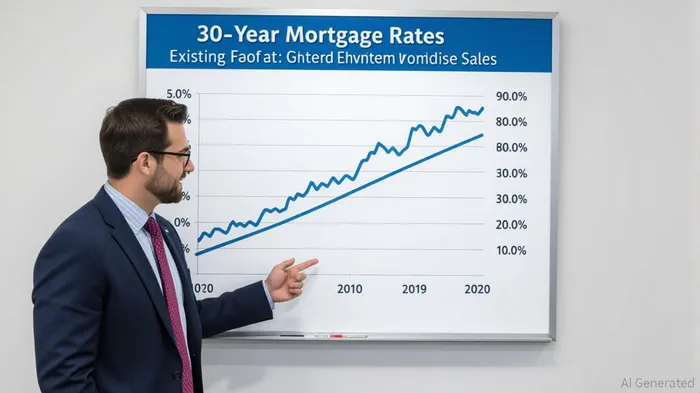 . For investors, this volatility presents opportunities in sectors positioned to capitalize on market shifts—from mortgage REITs benefiting from rate stability to home improvement retailers riding a wave of homeownership inertia.
The Fed's Tightrope: Rate Policy and Housing Demand
The Federal Reserve's aggressive rate hikes since 2022 have pushed the average 30-year fixed mortgage rate to 6.8%, nearly double its 2021 lows. . This has directly dampened housing demand, as affordability constraints have led to a 47% year-over-year surge in sellers delisting properties without finding buyers. While the Fed has paused its tightening cycle since May 2023, its communication on future rate moves remains ambiguous. Policymakers are wary of easing prematurely, fearing a rebound in inflation, yet prolonged high rates risk further weakening home sales and construction.
Regional disparities amplify the dilemma. In the West—a traditional driver of national sales—existing-home purchases fell 6.7% year-over-year in June 2025, while the Northeast and Midwest posted modest gains. This divergence reflects localized economic conditions and supply-demand imbalances, with inventory rising to a 4.6-month supply nationally, up from 3.8 in 2024. For the Fed, this fragmented landscape complicates its “one-size-fits-all” approach to monetary policy.
Sectors to Capitalize on the Shift
1. Mortgage REITs: Playing the Rate Stability Card
Mortgage real estate investment trusts (REITs), such as American Capital Agency (AGNC) and Chimera Investment (CHMI), have historically thrived in high-rate environments. These firms borrow short-term at low rates and invest in long-term mortgages, profiting from the “spread” between borrowing costs and mortgage yields. With the Fed signaling a pause in hikes, these REITs could benefit if rates stabilize or drift lower. . Investors should prioritize REITs with strong liquidity and low leverage, as sudden rate spikes or defaults could pressure their margins.
2. Home Improvement Retailers: The “Stay-put” Trade
As buyers retreat and sellers hold out, homeowners are increasingly opting to renovate rather than move. Home improvement retailers like Home Depot (HD) and Lowe's (LOW) are well-positioned to capture this trend. Both companies have diversified into adjacent markets—e.g., solar installations and professional services—to insulate revenue streams from housing cycles. Their stock performance has also shown resilience during past downturns, with HD's revenue growing 5% annually since 2020. . Investors should look for companies with robust balance sheets and exposure to secular trends like energy efficiency upgrades.
3. Residential Construction: A Wait-and-See Play
Single-family home construction has declined 13% year-over-year in 2025, as developers face rising material costs and uncertain demand. However, a potential Fed rate cut in late 2025 or early 2026 could revive buyer interest, creating a tailwind for builders like DR Horton (DHI) and Lennar (LEN). These firms have been trimming land holdings and focusing on affordable “starter homes” to navigate the slowdown. Investors should pair exposure to these names with a close watch on mortgage rate trajectories and inventory levels.
Risks and the Fed's Uncertain Hand
The biggest risk remains the Fed's path forward. If inflation persists, another rate hike could exacerbate the housing slowdown, while an abrupt cut might reignite speculative buying. Additionally, geopolitical shocks or a global economic slowdown could amplify U.S. housing's fragility. For now, the Fed's “wait-and-see” approach leaves markets guessing, with the next policy decision likely tied to June's inflation data.
Conclusion: Navigating the Crossroads
The housing market's current state—marked by regional divergence and elevated rates—demands a selective investment strategy. Mortgage REITs and home improvement stocks offer asymmetric upside if rates stabilize or decline, while construction plays carry higher risk tied to Fed timing. Investors should avoid overexposure to homebuilders until clearer signals emerge on policy and demand. As the Fed continues its tightrope walk, capitalizing on sector-specific trends may be the surest path to navigating the housing crossroads.
Final Note: Monitor the July 23 release of June's existing-home sales data and the Fed's September policy meeting for key inflection points.

Stay ahead of the market.
Get curated U.S. market news, insights and key dates delivered to your inbox.
AInvest
PRO
AInvest
PRO



Comments
No comments yet