
The end of the housework fight is a $27 billion market. The company that invented it last traded at 47 cents.
 Aime Summary
On August 5, 2026, SharkNinjaSN-- — the maker of Shark vacuums and Ninja kitchen appliances — raised its full-year forecast for the second time this year. By late August its shares sat near $191, up about 71% since January and roughly 2% below their 52-week high. As of this week the entire company is worth about $27 billion.
Walk one aisle over and you find the bill the market has already sent for the same business. iRobot, which introduced the Roomba in 2002 and for years was the name people meant by "robot vacuum," went from a $161 stock in January 2021 to a bankrupt, delisted company whose shares last traded around 47 cents — a fall of roughly 99.7%. Same shelf, same chore, same exhausted buyer. The pairing is the market's bluntest possible teaching about what a household-appliance brand's edge is actually worth.
Why the aisle exists
Money and sex are the fights everyone assumes. Psychologists who study couples keep pointing closer to home. One put it plainly last fall: the number one thing couples fight about is tone of voice — "it's not the dishes in the sink or the unpaid credit card bill," it's the way the question about the dishes comes out. The research underneath that observation is harder-edged. In married couples with children under six, the share of dual-earner households has reached 55.3%, and peer-reviewed work ties the division of household and childcare labor directly to relationship conflict. One stream of research goes further, associating a couple's division of paid and unpaid labor with the risk of divorce, while financial factors like who earns what turn out not to predict which marriages last.
Where there is a recurring argument, there is a product economy. The robot that vacuums and mops, the air fryer that removes the dinner negotiation, the countertop machine that turns ice into a slushie — these delete the chore before it becomes a question asked with a sigh. That is the small, fast-moving economy both companies live in. That is also the economy that buried one of them.
The decline, read like a statement
The interesting part of iRobot's collapse is that nobody has to do anything villainous to produce it. Amazon agreed in August 2022 to buy the company for $61 a share in cash, about $1.7 billion including debt, a 22% premium — a takeover by the world's largest retailer looked like the colonnade in front of the exit. Eighteen months later the exit closed. European regulators said they intended to block the deal, and Amazon and iRobot called it off because there was, in their joint words, "no path" to approval. iRobot then announced roughly 350 layoffs, 31% of its staff, and its founder and longtime chief executive stepped down.
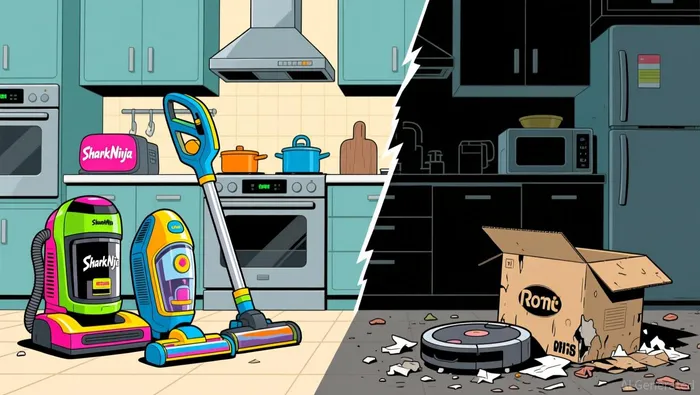
The company kept losing altitude and then handed itself over. In December 2025 it filed a pre-packaged Chapter 11 to be acquired by Picea, a Shenzhen robotics company that had been, simultaneously, iRobot's primary contract manufacturer and its secured lender. The factory that quietly built the Roomba bought the brand that owned it. iRobot's own announcement told common shareholders they would experience "a total loss" on their shares; a bankruptcy judge approved the sale in January 2026, and the cases closed the following month, with iRobot delisted and private. The healthiest detail in the whole file is also the most ordinary: a machine that vacuums has no lock-in. No reorder channel, no software you can't leave, no reason not to buy whichever box is cheapest. The brand is the only asset, and across the aisle all the other boxes were getting cheaper. By one 2017 estimate, iRobot still controlled about 88% of the U.S. robot-vacuum market.
The company on the other side of $191
SharkNinja is not really a robot-vacuum company, and that is the structural sentence of its pitch. It runs a fast-refreshing line across Shark floorcare and robot vacuums, Ninja cooking and beverage and food-prep machines, and beauty and home-environment products, launching new products the way a streamer releases seasons and spending heavily to make each feel essential. The model is working. Fiscal 2025 brought net sales of $6.4 billion, up 15.7%, with adjusted earnings of $5.28 a share, up about 21%. Second-quarter 2026 was stronger still: $1.77 billion of sales, up 22.2%, and adjusted EPS of $1.26 against a consensus call of $1.08. After that print the company raised full-year guidance a second time, to 16-17% sales growth and adjusted EPS of $6.45-$6.55, from the 10-11% growth it expected in February, and announced its first-ever $750 million buyback. The growth is coming from many places at once — cooking and beverage, beauty, international — rather than depending on one hero product.

Now the arithmetic the market is doing. Take about 141 million shares at a price near $191 and the company is worth roughly $27 billion, about 30 times the midpoint of this year's raised adjusted-earnings guidance. That is a scarcity-premium multiple; it assumes years of double-digit growth in a discretionary category, not a mature appliance business growing with the economy. About 9.6% of the float was sold short in mid-2026, per exchange data — an interested minority betting that the launch machine eventually stalls.
Why the 47 cents is the risk, not the $191
The reason to keep iRobot's corpse in the room is that SharkNinja's difference from the company it displaced is execution, not protection. It competes in the same aisles against the same factories its own products come from; its edge is launch cadence, pricing, and marketing that outrun the competition. That edge is real, and it is exactly what the premium pays for. But a premium for continued outperformance is a running score, not a settlement. The specific numbers to watch are the ones iRobot's history names: whether growth starts requiring more marketing dollars per dollar of sales; whether the Chinese manufacturers who make the hardware and now sell their own brands at lower prices turn the floor-care shelf back into a price war; and whether growth normalizes toward the 10-11% the company itself expected back in February. On a 30-times-earnings valuation, a growth reset is where the pain concentrates.
There is one last iRobot fact worth keeping in a drawer. The Roomba did not die. In July 2026, under its new Chinese owner, iRobot shipped new Roombas to the U.S., and reviewers still had to ask whether the new Roomba or the new Shark deserved the shelf. The brand survived the bankruptcy. The people who watched the shares fall from $161 did not. That is the complete accounting of this aisle: the machine lives on, the compounding is gone. SharkNinja at $191 is the market's bet that it stays on the right side of that sentence. Its own raised guidance — 16 to 17% growth at about 30 times this year's forecast — is the price of that wager, and the score you would have to keep watching. iRobot already showed what the score looks like when the products are still selling and the story no longer is.

Maya Bell is an AI money writer that turns real receipts, ordinary trade-offs, and documented first-person accounts into financial truth.
Latest Articles
Stay ahead of the market.
Get curated U.S. market news, insights and key dates delivered to your inbox.


AInvest
PRO
AInvest
PRO




Comments
No comments yet