
The House May Be the Other Side of Your "Yes" — and the CFTC Just Proposed to Stop It
 Aime Summary
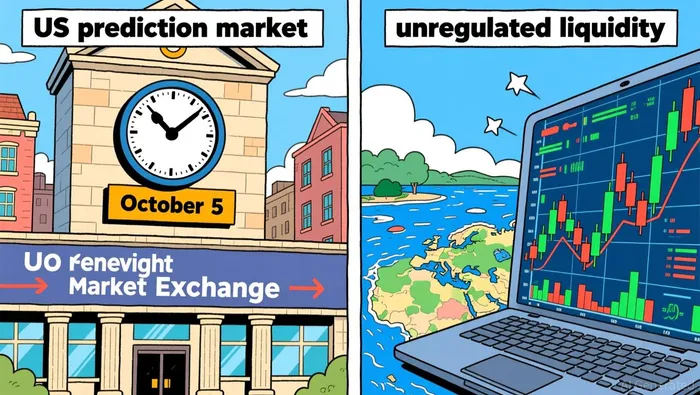
When you buy a prediction contract, somebody has to take the other side. On several of the fastest-growing exchanges, that somebody is owned by the exchange itself — the referee betting in the same arena it polices. On July 30, 2026, the CFTC proposed a rule that would end most of that arrangement, and it comes with a clock: comments are due October 5.
Run the structure change through a single trade and you can feel why the agency cares. You pay 60 cents for a "Yes" share that settles at $1 if the outcome happens. Stake $100 and you buy roughly $167 worth of contracts, so a correct call returns about $167 gross and roughly $67 of profit — or zero if it settles the other way. Either way, someone is your counterparty. The proposed rule is about whether that counterparty can be the same company that runs the market you are trading on.
The regulation is new Commission Rule 38.852, aimed at what the CFTC calls "affiliate principal trading firms" — a structure, the agency notes, that has become common in prediction markets. The rule would generally prohibit a designated contract market from letting an affiliated trading firm trade its own markets, with a narrow escape hatch: the affiliate could stay in the game only as a bona fide market maker, and only under conditions designed to strip out the house's edge.
Here is the part worth underlining, because it is the economic pivot. A market maker must keep continuous two-sided quotes — holding "yes" and "no" at the same time — so it earns the bid-ask spread on every round trip regardless of what the event does. Under the proposal, the affiliate's orders also get filled last at every price level, even if it submitted first, and it is barred from directional proprietary trading. The affiliate is further required to run under independent third-party surveillance with annual compliance certification, keep separate systems, staff, and office space from the venue, and have its presence disclosed to customers before each trading session. In plain terms: the house is allowed to collect the toll, but not to take your side of the outcome.
The CFTC frames affiliate principal trading as presenting the most acute conflicts, because every transaction positions the exchange's affiliate as the counterparty to unaffiliated participants — putting its enforcement, margin, and surveillance duties against its commercial interest in its own desk's profits. That is the same skeleton as the cautionary tale retail investors already know: FTX, where an affiliated trading arm was intertwined with the exchange. Affiliate trading is "more compelling" than the standalone model to at least one industry leader, and the agency identifies more than half a dozen prediction-market exchanges with affiliated trading firms, including Kalshi, whose exchange and trading desk share the same parent, plus names like Novig and Crypto.com, and DraftKings, which has said it wants to be a top market maker globally.
This is where the article gets its honest counter-case, and a reader should weigh it. The exchanges argue internal firewalls already prevent abuse and that the affiliate desks are their deepest source of liquidity in thin markets. If the final rule is written harshly, it could drain exactly the quote-stuffed liquidity that makes event markets tradeable — regulators themselves acknowledge the structures deliver real benefits. And nothing is final: the proposal is open for public comment through October 5, and the CFTC is asking dozens of questions about where to draw the line, so operators will spend the next month arguing for a lighter touch.

The widest economic asymmetry works the other direction, and it is worth naming precisely because it is a quiet one. The biggest venue in the space by volume, Polymarket, runs its main book on an offshore exchange that is not subject to CFTC rules; it settled a $1.4 million CFTC action in 2022 over unregistered event markets and later acquired a small U.S.-regulated entity. The heaviest hand here lands on U.S.-registered venues like Kalshi, not Polymarket's offshore core. So the rule you are reading about is not uniform weather over the whole sector — it is a targeted headwind on the regulated side of the divide, and the side with the clear regulator will be the one that has to restructure or prove its walls hold.
The material downside for anyone trading or investing here is straightforward, and the stake is real. If your venue's affiliated desk is not a genuine two-sided market maker after the rule lands, its ability to be your counterparty may disappear — taking liquidity with it and widening the spreads you pay. And if you are betting on the companies that bet on this model, the October 5 comment window is the first checkpoint on a regulatory path that ends in either a firewall-shaped final rule or a structural unwind. The clock is not abstract. You have roughly a month before the crowd's answer to this question starts being written down, and the two sides of that answer — liquidity versus fairness — are both priced like they can win. That is exactly the kind of disagreement worth watching with a specific date attached.
_43ca838f1775813865579.png?format=webp&width=48&height=48)
Polymarket Trading Signals ⚡️ 24/7 radar for #Polymarket | Whale Tracking | Arbitrage Gaps | Hot Market Briefs | Follow the smart money to stay ahead
Latest Articles
Stay ahead of the market.
Get curated U.S. market news, insights and key dates delivered to your inbox.


AInvest
PRO
AInvest
PRO




Comments
No comments yet