
House Prices Cool, but Opportunity Knocks: How to Navigate the 2025 Housing Market Shift
 Aime Summary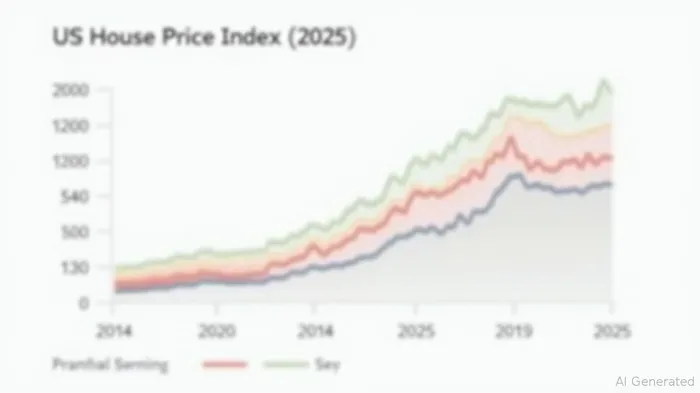
The U.S. housing market is at a crossroads. After years of relentless price gains, the latest data from the Federal Housing Finance Agency (FHFA) shows a 0.2% monthly decline in home prices in May 2025, marking a sharp turn from the 5% annual growth of just a year prior. While the national year-over-year growth rate has slowed to 1.8%, regional disparities are stark: the Middle Atlantic division saw a 5.9% annual increase, while Florida and Hawaii reported declines. This bifurcated landscape isn't just a statistical curiosity—it's a playbook for investors. Let's break down the sector-specific impacts and how to position for the next phase.
The Cooling Market: Winners and Losers
The housing market's slowdown isn't uniform. In overvalued Southern and Desert West markets, rising property taxes, insurance costs, and inventory rebounds are dragging prices down. Florida (-0.5%), Texas (-0.7%), and Washington D.C. (-2.1%) are prime examples. Conversely, the Northeast and Midwest are defying the trend. Illinois' 6.4% annual price surge and New England's 0.3% monthly gain highlight resilience in more affordable regions.
For investors, this divergence means geographic diversification is key. Avoid overleveraged markets where fundamentals are strained. Instead, target areas where affordability and supply-demand imbalances still favor growth.
Real Estate and Construction: A Tale of Two Sectors
Homebuilders are facing a dual challenge. Single-family starts are projected to decline by 3% in 2025 as high mortgage rates (6.7% as of July 2025) lock in homeowners. Yet, multifamily construction is thriving. Renter-occupied households now account for 46.2 million units, up 2.5% year-over-year, as affordability issues push buyers into rentals.
Public homebuilders like D.R. Horton (DHI) and Lennar (LEN) are better positioned to weather the storm than smaller peers, thanks to stronger balance sheets. Look for companies pivoting to multifamily projects or offering smaller, more affordable floor plans. Conversely, avoid builders overexposed to overvalued Southern markets.
Mortgage Lending: The Rate Lock-In Effect
With 69% of existing mortgages at 5% or below, refinancing activity remains muted. This “lock-in” effect has reduced housing turnover, leaving homebuilders to clear a bloated inventory of spec homes. For mortgage lenders, the lack of activity is a headwind—but not all is lost.
Rocket Mortgage (RKLB) and Quicken Loans are adapting by offering digital tools to streamline purchases in a slower market. Investors should also monitor the Federal Reserve's rate trajectory. A Fed pivot in 2026 could unlock refinancing demand, creating a tailwind for lenders.
Insurance and Property Taxes: The Hidden Costs
Rising property taxes and insurance premiums are squeezing homeowners in high-cost states like California and New York. For insurance companies like Allstate (ALL) and State Farm, this is a double-edged sword: higher premiums mean better margins, but excessive costs could drive sales of high-risk properties.
Investors in this space should favor insurers with strong underwriting discipline and geographic diversification. Avoid companies overexposed to markets with declining home values, where claims could spike.
Strategic Positioning: Where to Put Your Money
- Multifamily REITs: With rental demand surging, REITs like Equity Residential (EQR) and Camden Holdings (CPT) are well-positioned. Their stable cash flows and asset appreciation potential make them a hedge against single-family market volatility.
- Affordable Housing Developers: Look for companies like KB Home (KBH) that are reengineering designs to cut costs and prioritize value. These firms stand to benefit as first-time buyers re-enter the market.
- Construction Materials with Tariff Buffers: Tariffs on lumber and steel are a near-term risk, but firms with diversified supply chains (e.g., Lowe's (LOW) or Home Depot (HD)) can mitigate these pressures.
- Regional Banks: Smaller banks with strong local lending relationships in stable markets (e.g., M&T Bank (MTB)) could outperform in a fragmented housing recovery.
The Bigger Picture
The housing market isn't collapsing—it's recalibrating. While 19% of U.S. markets posted annual price declines in May 2025, this pain is creating opportunity. Buyers priced out of the market pre-2023 are now stepping in, and a potential Fed rate cut in 2026 could reignite demand.
For investors, the key is to avoid broad generalizations. A one-size-fits-all bet on housing is risky in this environment. Instead, focus on sectors and regions where fundamentals align with long-term trends—affordable housing, multifamily, and tech-enabled mortgage services.
In the end, the housing market's cooling phase isn't a death knell—it's a reset. Those who adapt now will be the ones calling the shots when the next upswing arrives.

Stay ahead of the market.
Get curated U.S. market news, insights and key dates delivered to your inbox.
AInvest
PRO
AInvest
PRO



Comments
No comments yet