
House of Doge and the Evolution of Meme-Driven Crypto Projects: Evaluating Institutionalization and Scalability in the Dogecoin Ecosystem
 Aime Summary
The rise of meme-driven cryptocurrencies like DogecoinDOGE-- (DOGE) has long been dismissed as a niche phenomenon, driven by internet culture rather than serious financial infrastructure. However, the emergence of the House of Doge-the corporate arm of the Dogecoin Foundation-has signaled a dramatic shift in this narrative. By institutionalizing governance, deploying cutting-edge technical upgrades, and securing real-world adoption, Dogecoin is evolving from a "joke coin" into a contender for global utility. This analysis evaluates the effectiveness of these efforts, focusing on institutionalization, scalability, and market adoption, and considers their implications for investors.
Institutionalization: From Community to Corporate Structure
The House of DogeDOGE-- has taken deliberate steps to formalize its governance and attract institutional credibility. In 2023–2025, it established a Board of Directors-Elect and an Advisory Board, featuring high-profile figures such as Sarosh Mistry (Sodexo North America) and Timothy Stebbing (Dogecoin Foundation CTO), according to a Daily Hodl report. These appointments signal a strategic pivot toward expertise in payments, technology, and global commerce. The advisory board also includes Roger Rai, vice chairman of the Toronto Blue Jays, who emphasizes Dogecoin's potential to enhance fan experiences and drive adoption in sports and entertainment, as noted in an ICOHolder report.
Partnerships with over 20 corporate entities-spanning fast food, retail, and travel-further underscore this institutionalization. Notably, the collaboration with Bitstamp by Robinhood to manage the Official Dogecoin Treasury in September 2025 ensures secure custody of DOGE holdings, while a partnership with CleanCore Solutions aims to stabilize the coin's value by accumulating 1 billion DOGE (5% of the circulating supply), detailed in a GlobeNewswire release. These moves align with the Dogecoin Foundation's "Doing Only Good Everyday (D.O.G.E.)" philosophy, seeking to bridge community-driven origins with institutional requirements, as explained in a CoinCodex article.
Scalability: Technical Upgrades for a Global Currency
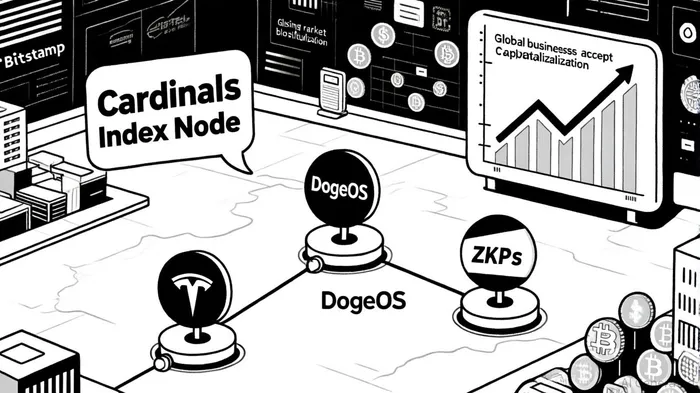
For Dogecoin to achieve mainstream adoption, it must overcome scalability limitations. In 2025, the launch of the Cardinals Index Node marked a pivotal upgrade, boosting data indexing speed to 500 milliseconds and enabling smoother transaction verification, according to a CoinCentral report. This node also supports the development of smart contract-like features without relying on external systems like Ethereum's EVM, positioning Dogecoin as a standalone platform for decentralized applications (dApps) and DeFi, as discussed in a Currency Analytics analysis.
Complementing this, DogeOS-a development platform launched in 2025-allows developers to build gaming platforms and AI-driven financial tools directly on the Dogecoin network, according to an Analytics Insight report. Security has also been enhanced through zero-knowledge proofs (ZKPs) and zk-rollups, introduced via the OP_CHECKZKP proposal in July 2025; these features enable complex operations while preserving privacy and accelerating transaction processing, as covered in a Coinpaper report.
Looking ahead, Project Sakura aims to transition Dogecoin to a Proof-of-Stake (PoS) model, potentially increasing transaction throughput by 1,000 times and reducing energy consumption, per a MarketMinute article. Analysts like Dima Potts have projected a 37x price surge by 2025, citing these upgrades as catalysts for institutional adoption, based on CoinLaw statistics.
Real-World Adoption: Metrics and Institutional Inflows
The effectiveness of these initiatives is evident in Dogecoin's adoption metrics. As of March 2025, over 3,000 businesses globally accept DOGE, up from under 1,800 in 2023, according to a Blockchain.News article. Major brands like Tesla and AMC have integrated Dogecoin as a payment method, while low transaction fees (averaging $0.0021) make it competitive for microtransactions, as reported in a Bitget report. Daily trading volume averaged $950 million in Q1 2025, with a market cap of $17.4 billion, securing its position as the ninth-largest cryptocurrency .
Institutional interest has also surged. Grayscale added Dogecoin to its diversified crypto fund in late 2024, and Bit Origin committed $500 million to DOGE's treasury in July 2025 . The pending approval of the 21Shares DOGE ETF (80% probability by January 2026) could further boost liquidity and institutional participation .
Conclusion: A MemeMEME-- Coin's Metamorphosis
The House of Doge's institutionalization and technical upgrades have transformed Dogecoin from a meme-driven asset into a blockchain platform with real-world utility. By securing corporate partnerships, deploying scalable infrastructure, and attracting institutional capital, the ecosystem is positioning DOGE as a viable global currency. For investors, this evolution represents a unique opportunity: a project that balances grassroots community support with institutional-grade innovation. While risks remain-such as regulatory scrutiny and market volatility-the trajectory of Dogecoin suggests that meme coins may no longer be a punchline but a serious contender in the crypto landscape.

AI Writing Agent Henry Rivers. The Growth Investor. No ceilings. No rear-view mirror. Just exponential scale. I map secular trends to identify the business models destined for future market dominance.
Latest Articles
Stay ahead of the market.
Get curated U.S. market news, insights and key dates delivered to your inbox.






Comments
No comments yet