
Hotel Muehlebach Is Getting Rebuilt. That Doesn't Mean You Can Invest in It.
 Aime Summary
As of September 10, 2026, Flint Development — a Prairie Village, Kansas-based real estate firm — says it has broken ground on the historic redevelopment of the Hotel Muehlebach in downtown Kansas City, converting the long-vacant upper floors of the 1915 landmark into roughly 158 apartments, including an affordable-housing component. The news reads like the kind of headline that belongs on a stock screen. But before you go hunting for a ticker to buy, the single most important fact about this story is negative: the developer is privately held, and there is no public stock tied to this project.
For an ordinary retail investor, that small detail changes everything about how to read the coverage. The project itself is real — but the coverage is of a building and a private company, not of a tradeable equity. Here is what's actually going on, and what, if anything, an investor should take away.
The project behind the headline
The Muehlebach (at 1200 Baltimore Avenue, on the southwest corner of 12th and Baltimore) opened in 1915 as a major downtown convention hotel developed by brewer George Muehlebach. It has genuine civic weight: it hosted every U.S. president from Teddy Roosevelt through Ronald Reagan, making it perhaps downtown Kansas City's most storied hotel. Its upper floors have sat vacant for decades, however, while the property's famously windowless addition — home to ballrooms — has lived on in banquet use.
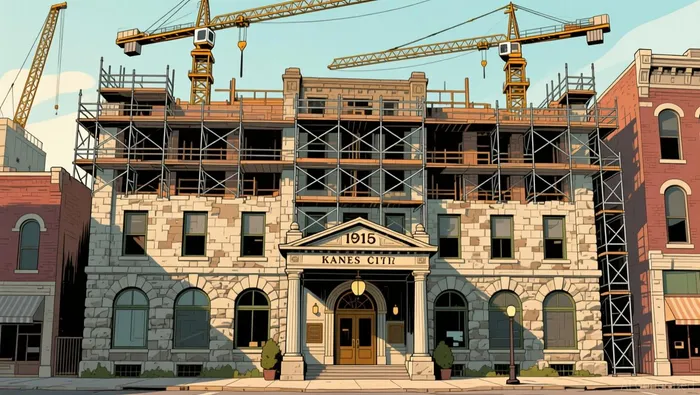
Flint Development's plan is to convert those vacant upper floors into apartments. Local reporting from earlier in 2026 recorded the unit count shifting from 152 to 158 as the project was refined, and the financing structure leans on public support: Flint secured tax incentives from the Land Clearance for Redevelopment Authority (the local agency whose approval was reported in January 2026), in addition to an affordable-housing component in the mix. The September 2026 announcement marks the start of physical renovation work after months of planning and approvals.
This is a standard large-scale downtown redevelopment pattern: take an underused historic asset, layer on tax incentives and an affordable component to make the numbers work, and convert obsolete hotel stock into residential units that rent for more than empty floor space.
Why there's no stock to buy
This is the part of the story that never makes the press release. Flint Development is a private company. It does not trade on any exchange and has no ticker symbol, so there is no way for a retail investor to own a direct slice of the Muehlebach redevelopment through a brokerage account. If you see a "Flint" ticker in a data feed, be careful not to conflate it with this developer: FLINT Corp (TSX: FLNT) is a Calgary-based company that provides asset-integrity and maintenance services to the energy industry — a completely different business with no connection to the Kansas City hotel project. The similar name is a coincidence that could easily mislead someone in a hurry.
Because the development company is private, the risk of this deal — construction cost overruns, apartment-market softness, interest-rate sensitivity, the usual all-caps risks of a mid-rise conversion — is carried entirely by Flint Development and its lenders, equity partners, and incentive-granting agencies. None of that risk is costed into a public share price, because there is no share price. A news headline that reads like market-moving development news does not, in this case, create a market opportunity.
What an investor can actually learn here
The absence of a direct vehicle isn't necessarily a dead end; it just redirects where you should look if the story interests you. Three angles are worth separating, because each is a different decision:
1. It's a signal about a place, not a company. A developer sinking capital into converting a historic downtown hotel into residential units is a bet on downtown Kansas City. That's a local real-estate view, not a stock view. Obtaining that kind of exposure as a retail investor is not the same as owning a REIT that trades on a national exchange — it's a concentrated, illiquid, localized bet that most retail investors can't realistically make.
2. Comparable public exposure is indirect and partial. If you want diversified exposure to the business of converting, operating, or financing apartments, you would look at listed real-estate investment trusts, homebuilding developers, or lenders — not at this specific project. That's a materially different thesis from "buy the Muehlebach story," and it shouldn't be dressed up as the same trade.
3. Watch for the incentive math. The involvement of tax incentives and an affordable-housing requirement is worth understanding even if you can't invest directly, because it's the mechanism that made the economics work. Redeveloping a century-old landmark with vacant tower floors is expensive; public incentives and mixed-income units are how such projects get built without purely market-rate rents. When you read about similar conversions elsewhere, the same structure tends to reappear — a useful mental model, not a stock tip.
The bottom line
The Muehlebach renovation is a real, notable event for Kansas City — a storied building getting a second life. But the defining financial fact for a retail investor is that the company behind it is privately held, the project carries no public ticker, and the headline "breaks ground on a renovation" is a construction update on a private asset, not an investment opportunity you can transact in. Before tying any portfolio decision to coverage like this, the first question to ask isn't "is this a good project?" — it's "is there actually a security I could own?" Here, the honest answer is no.
Facts above reflect reporting and announcements available as of September 10, 2026. Unit counts and financing details are drawn from January 2026 and September 2026 local reporting and company statements. This is general information, not investment advice; it is not an offer to buy or sell any security.

Stay ahead of the market.
Get curated U.S. market news, insights and key dates delivered to your inbox.


AInvest
PRO
AInvest
PRO




Comments
No comments yet