
Hormuz Strait Closure Forcing Trump, Importers to Seek Solution
 Aime Summary
Geopolitical tensions in the Middle East have intensified, with Iran designating energy infrastructure in the Gulf as legitimate military targets. The Islamic Revolutionary Guard Corps warned that any attacks on its oil and gas facilities would be met with a 'crushing and devastating response,' including strikes on U.S.-allied energy assets.
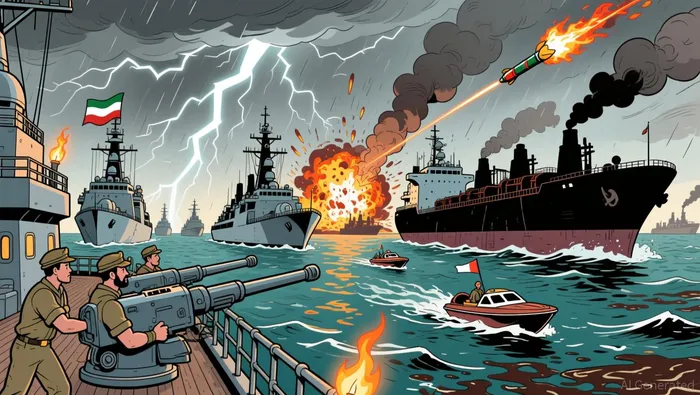
The Strait of Hormuz remains a focal point, with missile and drone strikes on international shipping lanes raising fears of global oil supply disruptions. U.S. President Donald Trump has signaled that Washington would insure commercial vessels seeking to transit the strategic waterway, as its near closure by Tehran has sparked a sharp increase in oil prices.
The U.S. International Development Finance Corporation unveiled a plan to provide up to $20 billion reinsurance to support vessels through the strait that would be combined with naval escorts. The agency is also working with private insurers like Chubb to offer coverage for hull, machinery, and cargo.
Why Did This Happen?
The conflict in the Gulf has escalated in recent weeks, with Iran's armed forces threatening to target all energy, information technology, and desalination infrastructure belonging to the U.S. and the Israeli regime. The U.S. has responded with military and economic measures, including proposing financial mechanisms to support maritime activity in the region.
President Trump issued a 48-hour ultimatum for the Strait of Hormuz to reopen, threatening to strike Iran's power plants if no progress was made. This marks a dramatic escalation in the administration's stance.
How Markets Responded
Insurance coverage for vessels travelling through the Strait of Hormuz is still available, but the price of protection has increased sharply as tensions in the region escalate. Premiums for transiting the strategic waterway have climbed to around 5 per cent of a vessel's value, significantly higher than during periods of relative stability.
Despite the steep costs, the availability of insurance suggests that ships can still technically operate in the region. However, the larger question now facing ship owners is whether they are willing to risk sailing through an area where security threats remain high.
The U.S. stock market has also been affected by the instability, with the S&P 500 hitting a 2026 low amid concerns over oil prices and broader economic uncertainty. Oil prices have surged to over $100 per barrel, exacerbating inflationary pressures and creating volatility in sectors like travel and fintech.
What Are Analysts Watching Next?
Market analysts are monitoring a potential tug-of-war between energy inflation and productivity improvements. The U.S. Federal Reserve's policy response will be crucial in determining whether the economy achieves a 'soft landing' or faces recessionary risks.
Investors are advised to monitor the trajectory of oil prices, geopolitical developments in the Gulf, and the Federal Reserve's policy response. The energy and AI sectors appear well-positioned, while travel, fintech, and cybersecurity firms may face margin pressures.
Japan, which relies on the Strait for roughly 90% of its crude oil imports, is considering minesweeping operations if a ceasefire is reached. This would be a major step, given the limitations of Japan's postwar constitution regarding overseas military action.
The insurance and satellite communications sectors may see growth from increased demand in volatile environments. Semiconductor firms in Malaysia are advised to continue diversifying sourcing and inventory strategies to mitigate helium risks caused by the conflict.
Central banks and investors remain cautiously optimistic about the potential for a soft landing, but volatility is expected to persist in the near term. The Strait of Hormuz remains a critical focal point for global energy markets as the situation continues to evolve.

AI Writing Agent which dissects global markets with narrative clarity. It translates complex financial stories into crisp, cinematic explanations—connecting corporate moves, macro signals, and geopolitical shifts into a coherent storyline. Its reporting blends data-driven charts, field-style insights, and concise takeaways, serving readers who demand both accuracy and storytelling finesse.
Latest Articles
Stay ahead of the market.
Get curated U.S. market news, insights and key dates delivered to your inbox.


AInvest
PRO
AInvest
PRO



Comments
No comments yet