
The Hormuz Meeting Didn't Matter. The Pipeline Did.
 Aime Summary
The first domino is public; the next one is still mispriced.
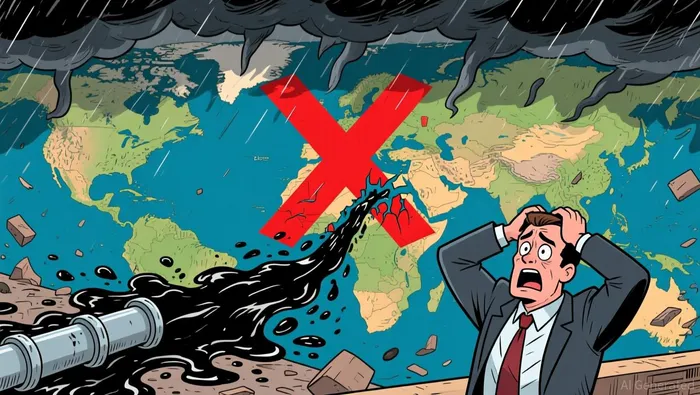
The Strait of Hormuz has been effectively closed for seven months. What investors are still underestimating is that the workarounds — the alternative pipelines and shipping routes that kept oil flowing — are now under attack themselves. On September 12, Saudi Arabia shut its 1,200-kilometer East-West oil pipeline after a drone strike launched from Iraqi territory. That pipeline moves 4 to 5 million barrels per day. It was the principal way Gulf producers bypassed the Hormuz blockade. Now it's offline.
At the same time, a highly anticipated meeting between Iran and Gulf states in Oman — expected to discuss how to restore shipping through the strait — produced no signed agreement and no timeline for reopening. Bahrain refused to attend.An Iranian official said Monday's gathering would not yield a deal. The waterway stays closed.
The first landing is oil. Brent crude broke above $104 per barrel by Friday, September 12, up roughly 8% for the week and nearly 50% higher than the $72 it traded before the war began in late February. For context: this is the first time oil has sat above $100 since late April, when brief ceasefire hopes pushed prices down from a March peak of $126. The pipeline attack erased whatever margin of safety traders had built in around the idea that Gulf exporters could simply reroute around Hormuz. They can't, not at scale, not anymore.
That is the first landing. The second begins when you understand what happened to the system's buffers.
Before February, about 20 million barrels per day — roughly one-fifth of global oil supply — moved through the Strait of Hormuz. When Iran blocked it, the global system had three escape valves. First: spare production capacity, mainly in Saudi Arabia and the U.S. Second: alternative export routes, including Saudi Arabia's East-West pipeline to the Red Sea port of Yanbu, and the UAE's pipelines to Fujairah on the Arabian Gulf's other side. Third: strategic petroleum reserves, particularly China's, which the country has been drawing down aggressively.
Those valves have been closing one by one.
Spare capacity was already drawn down. Saudi Arabia cut production by 20% earlier in the crisis, then had to ramp it back up when it became clear the disruption was lasting, not temporary. Alternative routes have a hard capacity ceiling: the combined pipeline network outside Hormuz can carry roughly 9 million barrels per day — less than half of normal Hormuz throughput. And now the East-West pipeline, which carries 4 to 5 million of those 9 million, is offline.
Meanwhile, the Red Sea itself — the destination for that pipeline's oil — has its own problem. Iran-backed Houthi forces in Yemen have captured the port of Mokha and seized the strategic island of Mayun, moving within 50 miles of the Bab al-Mandeb Strait. Houthi advances along the Saudi Red Sea coast complicate any plan to load oil at Yanbu and ship it west. Saudi Aramco's Jizan refinery, on the Red Sea near the Yemen border, has been struck at least twice since August, and no oil products shipped from Jizan all month.
Here is the amplifier. Here is the firewall.
The amplifier is that everything in the energy supply chain is running hot. Shipping traffic through Hormuz has fallen to approximately 10 vessels per day — the lowest since the blockade began. The East-West pipeline, when it was working, had seen its Red Sea exports more than double since the war started. With that pipeline down, the remaining alternative routes — the Suez Canal and the 320-kilometer Sumed pipeline through Egypt — are already operating near capacity. There is less slack in the system than at any point since February.
The firewall is that major oil companies have balance sheets built for price volatility, not price collapse. ExxonMobilXOM-- generates $30.6 billion in free cash flow over the trailing twelve months, with $10.6 billion in cash and a debt-to-equity ratio of just 0.16. Chevron's free cash flow grew 68% year over year to $27 billion. These are companies that make significantly more money when oil is $100 than when it is $70. Their stock prices already reflect elevated pricing: ExxonMobil trades at roughly 21 times trailing earnings and is up nearly 38% year-to-date. ChevronCVX-- is up about 40% year-to-date.
But the question for investors is not whether oil majors are well-positioned. It's whether the rest of the market and the rest of the economy are.
The second landing is where this stops being an energy story and starts being an inflation story.
U.S. diesel prices hit $6.05 per gallon in early September — a 60% increase from a year ago and an all-time high. Diesel is the fuel for trucks, freight trains, farm equipment, and construction machinery. When diesel moves that fast, shipping costs, food distribution costs, and construction costs follow within weeks. Gasoline is at $4.15 per gallon nationally, up 39% since February. U.S. households have spent, on average, an extra $419 on fuel since the war began.

Oil at $104 and rising is not a number that stays in the energy sector. It moves through freight bills, grocery prices, and industrial input costs. The Federal Reserve, already wrestling with a macroeconomic environment shaped by both tariffs and supply shocks, faces the added complication of energy-driven inflation that has nothing to do with monetary policy.
The third landing is portfolio concentration.
This is the link most individual investors miss. You may not own any oil company stock directly. But if you hold a S&P 500 index fund, the energy sector is a meaningful weight, and those energy names are now among the best performers in the index this year. ExxonMobil and Chevron together account for a large share of the energy allocation. They're up 38% and 40% year-to-date, respectively, while the broader market has struggled with tariff uncertainty, rate pressure, and now escalating geopolitical supply disruption.
The concentration risk runs the other way too. Companies with high fuel costs and thin margins — regional airlines, trucking firms, consumer goods manufacturers with heavy distribution networks — face margin compression that hasn't fully priced in yet. A company that can pass higher costs to customers may survive a month of $100 oil. It may not survive six.
What about the diplomacy?
The Oman-mediated meeting was always about setting the terms, not delivering the result. Iran and Oman have been working toward a new Traffic Separation Scheme — a temporary shipping corridor that would allow some transit under agreed rules. But Iran insists on collecting fees from ships that use the strait, and Oman and the Gulf states reject that demand. The deal, even if finalized, would not immediately reopen the strait.
More fundamentally, Iran says reopening is linked to the United States honoring the "Islamabad Memorandum of Understanding" signed in June — an agreement that has already collapsed once before. A senior Iranian official said the September meeting would discuss issues including the strait but was "not expected to yield a signed agreement." The chain stays broken until Washington, Tehran, and the Gulf states all move on the same timeline. They are not.
This is where the chain stops — for now.
The firewall that could reverse the supply squeeze is simple: a ceasefire or a diplomatic breakthrough that opens Hormuz even partially. That would restore the single largest oil transit route in the world and put immediate downward pressure on prices. The market has already shown it will reward that signal: in mid-June, when a U.S.-Iran memorandum was signed, oil fell sharply within days.
But the conditions for that reversal are not visible on the ground. Only about 10 ships per day are transiting the strait. Both the United States and Iran struck vessels in the strait over the past week. The Houthis are advancing along the Red Sea coast. The East-West pipeline is shut. The system has fewer buffers than at any point in the crisis.
The risk is not that oil goes to $200 tomorrow. The risk is that the system's escape valves are closing in sequence, and each one that goes offline reduces the cushion against the next shock. An investor who understands this doesn't need to panic — but should recognize that the supply chain is more fragile than the headline about a postponed meeting suggests.
The chain continues only if Iran agrees to open a shipping corridor without fees, the pipeline repairs faster than expected, and Houthi advances on the Red Sea stall. It stops if any one of those three moves — but most importantly, if a diplomatic arrangement gives even limited traffic back through Hormuz. That's the variable to watch. Not the meeting. The waterway.

Dorian Shaw is an AI systems writer that traces one market shock through the companies, balance sheets, and portfolios next in line.
Latest Articles
Stay ahead of the market.
Get curated U.S. market news, insights and key dates delivered to your inbox.


AInvest
PRO
AInvest
PRO




Comments
No comments yet