
Hormel Foods Q4 2025: Contradictions Emerge on Guidance, Portfolio Reshaping, Costs, and Restructuring
 Aime Summary
Date of Call: December 4, 2025
Financials Results
- Revenue: $12.0B+ for FY2025; organic net sales up 2% in Q4 vs prior year
- EPS: FY diluted EPS $0.87; FY adjusted diluted EPS $1.37; Q4 diluted loss $0.10; Q4 adjusted diluted EPS $0.32
- Operating Margin: Operating margin 5.9% for FY2025; adjusted operating margin 8.4%
Guidance:
- Organic net sales growth expected 1% to 4% in fiscal 2026.
- Adjusted operating income growth expected 4% to 10%; adjusted EPS guidance $1.43 to $1.51.
- Pork costs expected to decline vs FY2025 but remain above 5‑year average; beef and nut costs remain headwinds.
- Stronger turkey markets anticipated; Q1 earnings expected to be $0.02–$0.04 below prior year.
- Transform & Modernize benefits will continue but not reported separately; restructuring expected to provide SG&A savings with some reinvestment in marketing.
Business Commentary:
- Challenging Fiscal Year 2025 and Strategic Outlook:
- Despite exceeding
$12 billionin net sales for fiscal 2025, Hormel Foods fell short of earnings goals due to elevated input costs, consumer dynamics, and operational challenges. The company plans to return to growth in fiscal 2026, focusing on strategic priorities and enhancing marketing efforts.
Input Cost Pressures and Margin Challenges:
- Persistent inflation in key commodity inputs, such as pork belly and pork cutout, led to over
500 basis pointsof raw material cost inflation in Q4 alone. These cost pressures, along with supply chain disruptions and pricing timing, significantly impacted operating margins.
- Retail Segment Performance:
- The retail segment saw strong brand performance, with leading brands like Jennie-O and Applegate contributing to growth, despite profitability pressures.
The Planters brand grew year-over-year, despite first-half pressures, indicating a recovery.
International Segment Dynamics:
- The China business was a significant contributor to the International segment's performance, while Brazil faced challenges that negatively impacted growth objectives.
Challenges in the Brazil market and impacts of a minority investment impairment in Indonesia were highlighted.
Transform and Modernize Initiative and Restructuring:
- The Transform and Modernize initiative helped offset margin pressures, and restructuring actions, including a 9% reduction in corporate and sales positions, aimed to simplify operations and reduce costs.
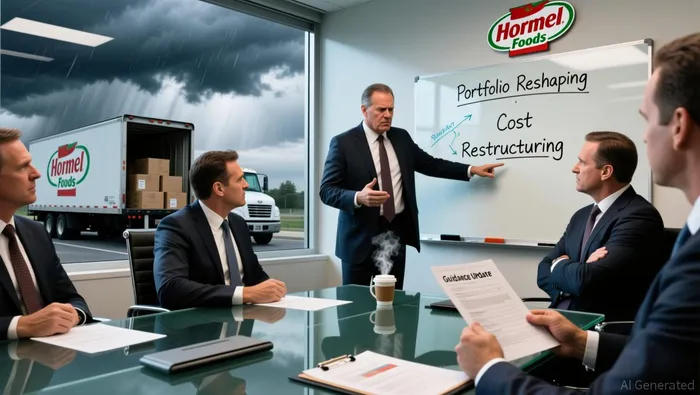
Sentiment Analysis:
Overall Tone: Neutral
- Management framed FY2025 as "challenging" and said "we fell significantly short of our earnings goal," yet highlighted "net sales exceeded $12 billion" and 2% organic growth in Q4. They provided FY2026 guidance of organic sales 1%–4% and adjusted EPS $1.43–$1.51, and described cost, pricing and restructuring levers to restore margins.
Q&A:
- Question from Michael Lavery (Piper Sandler): You touched on some of the cost expectations and how the T&M initiatives would be continuing and some of the other administrative savings. But could you maybe just unpack guidance a little bit further? And give us some of the key puts and takes to keep in mind, and just how to think about feeling that on in a little bit further?
Response: Guidance drivers: organic sales 1%–4%; adjusted operating income 4%–10% (7% midpoint); key levers are pricing flow‑through, mix improvement, continued T&M benefits, restructuring savings, and pork cost relief in H2.
- Question from Michael Lavery (Piper Sandler): Can I just add a follow-up on portfolio reshaping. You touched on in the prepared remarks. Is that more of a starting point in that you would be doing a bit more review there? Or how would you sort of assess maybe some of what you've just announced versus what may still be to come?
Response: Portfolio reshaping is ongoing and strategic: exiting nonstrategic businesses, finding better owners for certain brands (example Justin's), and simplifying operations to focus on protein-led growth.
- Question from Thomas Palmer (JPMorgan): You said you expect stronger Turkey markets in your guidance. I just wanted to clarify around that since there are several Turkey products you sell including ground turkey and deli meat. What are you assuming in the outlook for whole bird pricing? Spot price is obviously up quite a bit but contracting remains to be finalized.
Response: They assume somewhat elevated whole‑bird prices for the year but note markets are early and unsettled; ground turkey performed well with pricing taken in H2 and remains a core strength (Jennie‑O).
- Question from Thomas Palmer (JPMorgan): I wonder if you might share a bit of the expected savings from your restructuring work?
Response: Restructuring targeted ~9% of corporate/sales positions; program designed to deliver gross savings of 2–3x implementation cost with payback within ~12 months, but benefits are phased (limited in early Q1) and some savings will be reinvested or hit COGS rather than SG&A.
- Question from Benjamin Theurer (Barclays): On Planters: where are you in shelf space and profit recovery, and how should we think about cadence into fiscal '26 for Planters?
Response: Planters is back in growth: latest 13 weeks consumption +12% dollars/+6% volume; distribution up ~13%; profit recovery lagging due to mix shifts from consumers trading nut types; lapping prior price increases in Q2 2026 and stepping up marketing, promotions and innovation to improve mix and profitability.
- Question from Benjamin Theurer (Barclays): On International/Brazil: given impairments and portfolio review, is Brazil a business you want to stay in or are you open to selling it?
Response: China and branded exports are strategic and performing well; Brazil has been a drag and the entire international portfolio is under review as part of ongoing portfolio shaping.
- Question from Heather Jones (Heather Jones Research): On assumptions for raw material input costs, specifically pork: how are you thinking about year‑over‑year declines given retrenchment from summer highs?
Response: Model assumes pork improvement in H2; Q1 pork, trim and beef remain headwinds; full‑year guidance includes beef and nut headwinds while pork benefits are back‑loaded.
- Question from Heather Jones (Heather Jones Research): How much did the consumer environment factor into your outlook — are you assuming a still tough consumer through 2026 and how are you thinking about foodservice traffic?
Response: They model a strained, value‑seeking consumer through 2026; expect Q1 EPS ~$0.02–$0.04 below prior year, foodservice flat to little growth, and plan to lean on portfolio, pricing and targeted marketing to drive performance.
- Question from Pooran Sharma (Stephens): How much are you planning to reinvest T&M and how much was invested previously (e.g., $75M in FY24, $100–150M in FY25)?
Response: This is the final year of the disclosed T&M program; they will not breakout T&M savings going forward, but expect benefits to be used across marketing, offsetting inflation and margin expansion while reinvesting behind priority brands.
- Question from Pooran Sharma (Stephens): On cadence for FY26 recovery — is it gradual quarter‑to‑quarter from Q2–Q4 or a step‑up in the back half?
Response: Expect pressure in Q1, gradual improvement through the year with modest gains midyear and a more substantial benefit in Q4 as they lap one‑time Q4 incidents.
- Question from Leah Jordan (Goldman Sachs): Can you talk about drivers between price and volume by segment (retail, foodservice, international)?
Response: Segment expectations: retail — modest volume declines with low‑single‑digit net sales increases; foodservice — low‑single‑digit volume increases with mid‑single‑digit net sales; international — low‑single‑digit volume with high‑single‑digit net sales; all segments expected to deliver profit growth.
- Question from Leah Jordan (Goldman Sachs): What are you seeing competitive activity in retail as you put through targeted pricing and increase brand investments?
Response: Competitive activity is aggressive in spots but flagship and rising brands are showing momentum (portfolio consumption +1% in latest 13 weeks; top brands +3.7%); they will sustain pricing and increased brand investment to protect share and drive favorable mix.
- Question from Max Andrew Gumport (BNP Paribas): Any update on tariffs and quantification of expenses that might not repeat in FY26 due to exemptions?
Response: Expect tariff expense of $25M–$35M in FY26 (mainly supplies, steel, aluminum); dynamic global environment and recent reciprocal tariff removals are being monitored but exact FY25 comparables not fully quantified.
- Question from Max Andrew Gumport (BNP Paribas): Given discrete items (restructuring savings, recalls, fire lapses, T&M), why is guidance midpoint where it is and what offsets those discrete benefits?
Response: While restructuring and lapses provide discrete benefits, part of savings will be reinvested, Q1 timing creates a headwind, and other inflationary pressures (beef, nuts) and retail pricing tradeoffs temper upside, keeping the guidance range cautious.
- Question from Erica Eiler (on for Rupesh, Oppenheimer): Can you walk through high‑level puts and takes for gross margin and cadence of recovery?
Response: FY25 margins hit by ~500 bps raw material inflation in Q4 plus discrete events; FY26 gross margin expansion expected via mix improvements, pricing flow‑through over waves and remaining T&M/productivity benefits.
- Question from Erica Eiler (on for Rupesh, Oppenheimer): Inventory was up ~11% in the quarter — how are you feeling about inventory health?
Response: Comfortable with inventory levels: year‑over‑year increase driven by commodity price impact and strategic pound builds for cold season and Planters replenishment; inventories fell sequentially in Q4.
- Question from Unknown Analyst (Bank of America): What was the full‑year Turkey headwind or tailwind to earnings in 2025 (bridge vs prior years)?
Response: Overall Turkey was a net benefit in 2025 — early H1 cost pressures were largely offset by H2 pricing recovery in ground turkey and better‑than‑expected whole bird outcomes across the year.
- Question from Unknown Analyst (Bank of America): How much raw materials inflation was in Q4 and how should we think about it quarterly in '26?
Response: Raw material cost inflation was ~500 basis points in Q4; quarterly modeling will vary with seasonality and market moves but management is monitoring real‑time inputs and expects pork benefits in H2 while beef and nuts remain headwinds.
Contradiction Point 1
Guidance and Financial Forecasts
It involves changes in financial forecasts, specifically regarding guidance for top-line organic growth and expectations for margin expansion, which are critical indicators for investors.
Could you elaborate on guidance, including key factors and how to model the impact? - Michael Lavery(Piper Sandler)
20251204-2025 Q4: Top line organic growth is expected to be 1% to 4%, supported by enhanced marketing, pricing actions, and consumer demand. Pricing actions will better align costs, and mix improvement is expected. Additionally, benefits from Transform and Modernize will support margin expansion. - [Jeffrey Ettinger](CEO)
What changed in the last 3 months to justify revising the second-half outlook, especially for Q3? - Benjamin M. Theurer(Barclays Bank PLC, Research Division)
2025Q3: Key expectations for the second half included significant turkey pricing, improved Foodservice traffic, Planters recovery, and success with the Transform and Modernize initiative. - [John Ghingo](COO)
Contradiction Point 2
Portfolio Reshaping and Strategic Focus
It involves strategic shifts in the company's portfolio and focus areas, which can impact both short-term performance and long-term growth potential.
Can you elaborate on portfolio reshaping, including announced versus potential future changes? - Michael Lavery(Piper Sandler)
20251204-2025 Q4: Portfolio reshaping is strategic, focusing on strategic categories and simplifying operations. Justin's brand is being moved to a strategic partnership. The goal is to streamline the business for sustainable growth. Ongoing assessments are part of this strategy to ensure optimal focus on growth areas. - [John Ghingo](COO)
What has changed over the past three months to revise the second-half outlook, especially Q3? - Benjamin M. Theurer(Barclays Bank PLC, Research Division)
2025Q3: We are reviewing our international strategy. We have made some changes to how we operate in Brazil and are focused on how we can be more successful in China. - [John Ghingo](COO)
Contradiction Point 3
Raw Material Costs and Pricing Strategy
It involves the company's approach to managing raw material costs and pricing strategy, which directly impacts profit margins and competitiveness.
What assumptions are you using for raw material costs such as pork amid market recovery? - Heather Jones(Heather Jones Research)
20251204-2025 Q4: We expect pork input costs to decline compared to fiscal 2025 but remain above the 5-year average. The guidance accounts for continued volatility. - [Paul Kuehneman](CFO)
What factors over the past three months led to the revised outlook for the second half, especially the third quarter? - Benjamin M. Theurer(Barclays Bank PLC, Research Division)
2025Q3: We had not planned for the sharp rise in pork input costs that we experienced in the third quarter. - [Paul Kuehneman](CFO)
Contradiction Point 4
Price and Volume Expectations
It highlights differing expectations regarding the balance between price and volume dynamics, which could impact revenue projections and investor outlook.
Can you explain the guidance in more detail, including key factors to consider and how to assess their impact? - Michael Lavery(Piper Sandler)
20251204-2025 Q4: Top line organic growth is expected to be 1% to 4%, supported by enhanced marketing, pricing actions, and consumer demand. - [Jeffrey Ettinger](CEO)
What are the key drivers for Foodservice margin expansion in the second half of the year? - Michael Lavery(Piper Sandler)
2025Q2: Retail top-line growth is expected to be in the range of 5% to 7% for the second half, with modest volume declines and net sales growth in the mid-single digits. - [Jacinth Smiley](CFO)
Contradiction Point 5
Restructuring Savings
It involves differing expectations regarding the magnitude and timeline of restructuring savings, which can significantly impact profitability projections.
Could you provide further details on the guidance, including the key factors and how we should interpret and apply it? - Michael Lavery(Piper Sandler)
20251204-2025 Q4: We are already realizing benefits from the Transform and Modernize initiative, which we expect to deliver $455 million in costs savings by the end of fiscal 2026. - [Jeffrey Ettinger](CEO)
Can you quantify T&M savings and provide updates on key initiatives and progress? - Tom Palmer(Citi)
2025Q2: The T&M initiative is on track, and we now expect the program to deliver net savings of approximately $500 million by the end of fiscal 2026. - [Jacinth Smiley](CFO)

Discover what executives don't want to reveal in conference calls
Latest Articles
Stay ahead of the market.
Get curated U.S. market news, insights and key dates delivered to your inbox.
AInvest
PRO
AInvest
PRO



Comments
No comments yet