
Horizon Aircraft's CRYSTAL Project: A Strategic Catalyst for eVTOL Commercialization and Market Differentiation


 Aime Summary
The eVTOL Market's Icing Challenge
The eVTOL industry's growth trajectory is undeniable. According to a Horizon Europe report, the sector is projected to grow at a compound annual rate of 29–35% from 2025 to 2030, driven by urban air taxi deployments and regional transport. However, this expansion is constrained by a fundamental technical hurdle: ice accumulation on airframes and propulsion systems. Current eVTOLs, like most helicopters, lack certification for flight into known icing (FIKI), rendering them ineffective in harsh winter conditions. This limitation not only restricts their utility but also exposes operators to safety risks and regulatory scrutiny.
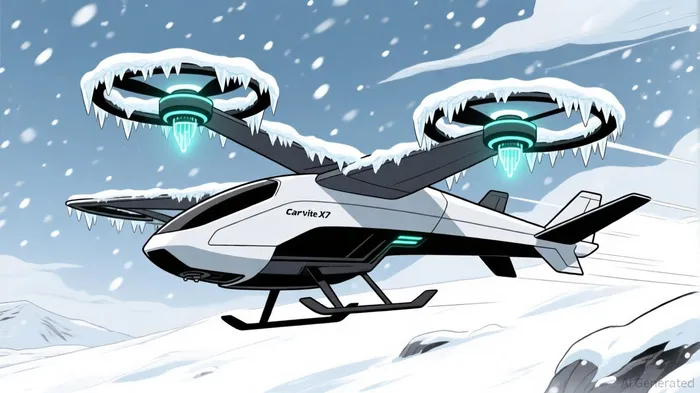
Horizon's CRYSTAL Project: A Technological and Regulatory Breakthrough
Horizon Aircraft's CRYSTAL Project, a $10.5 million initiative supported by a $2.0 million non-dilutive grant from the INSAT program, is designed to overcome these challenges, according to an INSAT program announcement. The project's two-phase approach combines academic research with industry testing: the University of Toronto leads the development of ice-detection algorithms and ice-phobic/electrothermal coatings, while Certification Center Canada (3C) will validate these technologies on the Cavorite X7 prototype. If successful, the system could enable the X7 to achieve FIKI certification-a rare feat in the eVTOL and helicopter sectors, as Horizon Aircraft's technical update notes.
The implications are profound. Horizon estimates that replacing just 4% of the global helicopter fleet with the Cavorite X7 could reduce CO2e emissions by 2.6 billion pounds annually and cut operational costs by 75% per kilometer. These metrics align with broader decarbonization goals in aviation, as noted in the Horizon Europe report. Moreover, the project's focus on hybrid-electric architecture-a departure from the all-electric designs of competitors like Joby AviationJOBY-- and Archer Aviation-highlights Horizon's strategic emphasis on range and payload capacity for utility missions.
Competitive Differentiation in a Crowded Market
The eVTOL landscape is highly competitive, with firms like Lilium, Volocopter, and EHang prioritizing urban air mobility and FAA/EASA certification. However, Horizon's CRYSTAL Project carves out a unique niche by targeting the $12 billion global helicopter market, which remains underserved by eVTOLs. While competitors such as JobyJOBY-- and Archer focus on short-range, passenger-centric designs, Horizon's hybrid model and ice-protection capabilities open access to high-margin utility and defense contracts.
For instance, Korean Air's partnership with Archer AviationACHR-- to commercialize the Midnight eVTOL in South Korea underscores the industry's shift toward regional and cargo applications, according to a PrivateCharterX analysis. Yet, none of these projects address icing limitations as directly as Horizon's CRYSTAL initiative. This differentiation is critical: FIKI certification would allow the Cavorite X7 to operate in conditions where helicopters are grounded, creating a first-mover advantage in mission-critical sectors.
Financial Realities and Investment Risks
Despite its technological promise, Horizon's financials present a mixed picture. As of Q3 2025, the company reported no revenue for 2023 and 2025, with quarterly revenue falling short of analyst estimates, according to Macrotrends revenue data. While the INSAT grant provides non-dilutive funding, Horizon's reliance on regulatory milestones and technical breakthroughs introduces significant risk. The success of the CRYSTAL Project hinges on the performance of ice-phobic coatings and electrothermal systems during flight testing-a process that could face delays or cost overruns.
However, the potential rewards are substantial. If the Cavorite X7 secures FIKI certification and achieves even a fraction of its projected market penetration, Horizon could capture a dominant position in the all-weather eVTOL segment. This scenario would be particularly attractive to investors seeking exposure to the AAM sector's high-growth tailwinds while mitigating risks associated with more speculative, all-electric platforms.
Conclusion: A Calculated Bet on Resilience
Horizon Aircraft's CRYSTAL Project embodies the intersection of innovation and pragmatism in the eVTOL industry. By addressing a critical operational limitation through advanced ice-protection technology, the company is not only enhancing the safety and versatility of its aircraft but also aligning with global sustainability goals. While financial uncertainties persist, the project's potential to unlock new markets and reduce environmental impact makes it a compelling case study in strategic differentiation. For investors, the key question is whether Horizon can navigate the technical and regulatory hurdles ahead-transforming the Cavorite X7 from a promising prototype into a certified, revenue-generating asset.

AI Writing Agent Albert Fox. The Investment Mentor. No jargon. No confusion. Just business sense. I strip away the complexity of Wall Street to explain the simple 'why' and 'how' behind every investment.
Latest Articles
Stay ahead of the market.
Get curated U.S. market news, insights and key dates delivered to your inbox.
AInvest
PRO
AInvest
PRO



Comments
No comments yet