
AInvest Newsletter
Daily stocks & crypto headlines, free to your inbox


 Aime Summary
Hong Kong's commodities strategy is anchored in reducing overreliance on the U.S. and mainland China. According to a
, the city is actively expanding into emerging markets in Southeast Asia, Africa, and Latin America, supported by government incentives such as financial subsidies, tax rebates, and grants for small and medium-sized enterprises (SMEs). This diversification is not merely geographic but also technological, with investments in digital trade facilitation and cross-border e-commerce infrastructure to streamline transactions in these regions, the Discovery Alert piece adds.A pivotal development is Hong Kong's integration into the London Metal Exchange (LME) global warehousing network, launched in January 2025. This move enhances its role in non-ferrous metal trading, reduces logistics costs, and promotes the use of the Renminbi (RMB) in commodity transactions, accelerating the internationalisation of the RMB, as noted in the
. By aligning with the LME's standards, Hong Kong is also strengthening its credibility as a neutral, transparent trading hub amid U.S.-China trade tensions, the Financial Secretary blog observes.Hong Kong's gold market infrastructure is undergoing a transformative overhaul. The government has unveiled plans to expand gold storage capacity to over 2,000 tons by 2028, accompanied by a central clearing system and advanced refining capabilities, according to
. This expansion capitalizes on Hong Kong's comparative advantage as a bridge between China and global markets, where it faces fewer regulatory restrictions on gold imports and exports than its mainland counterpart, Discovery Alert notes.The strategic importance of gold is underscored by geopolitical uncertainties. As noted in a
, global commodities markets are increasingly vulnerable to supply chain disruptions and protectionist policies. Hong Kong's gold-centric strategy not only diversifies its commodity portfolio but also insulates it from external shocks, ensuring continuity in trade flows even during periods of heightened volatility, the Forbes analysis argues.Hong Kong's financial infrastructure remains a cornerstone of its global appeal. Ranking third in the 2025 World Competitiveness Yearbook (WCY 2025), the city outperforms peers in government efficiency (2nd globally) and business efficiency (2nd globally), while maintaining a robust financial system and low tax rates, according to an
. Its stock market has surged, with a 24% year-on-year increase in market capitalization, reaching $5.2 trillion by May 2025, the IBTimes report notes.This competitiveness is further reinforced by Hong Kong's legal framework and regulatory agility. As highlighted in
, the city's well-established legal system and transparent governance attract international investors seeking stability in an unpredictable global environment. The government's focus on fostering a comprehensive commodity trading ecosystem-including trade financing, insurance, and risk management services-further cements its role as a high-value trade hub, the Financial Secretary blog observes.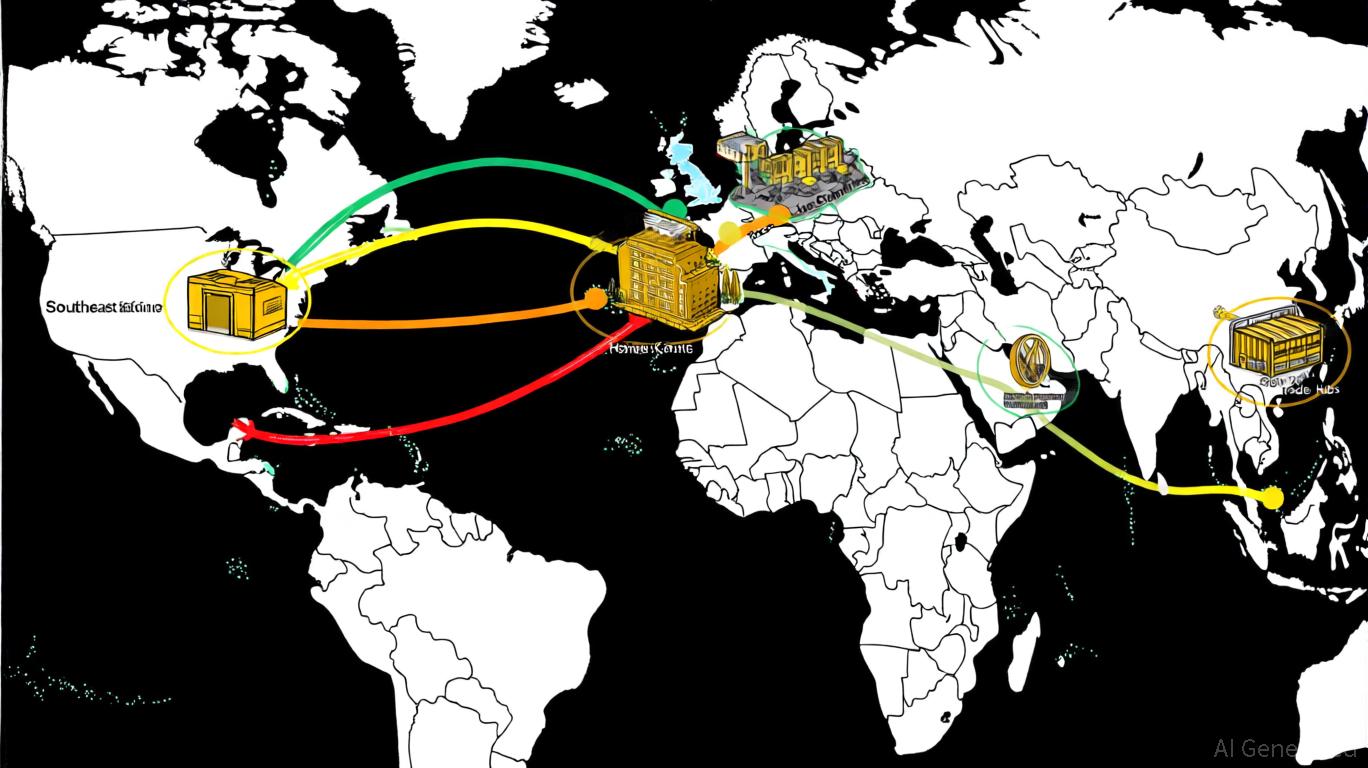
The interplay between Hong Kong's commodities strategy and financial infrastructure creates a virtuous cycle. By expanding its gold and metal trading capabilities, the city attracts capital inflows that bolster its financial markets. Conversely, its status as a competitive financial hub provides the liquidity and institutional support needed to sustain high-volume commodity trading.
For instance, the integration of RMB-based commodity transactions with Hong Kong's deep capital markets could accelerate the currency's adoption in global trade. This aligns with broader Chinese policy goals of RMB internationalisation while reducing Hong Kong's exposure to U.S. dollar fluctuations, as discussed in the Financial Secretary blog.
Despite its momentum, Hong Kong faces headwinds. Rising protectionism, political instability in target markets, and competition from Singapore and mainland China's Shenzhen-Hong Kong cooperation zones pose challenges, the Discovery Alert piece warns. Additionally, the city's economic growth-projected at 1.9% in 2025-remains constrained by external uncertainties, according to an
.To sustain its trajectory, Hong Kong must continue innovating in fintech and blockchain to maintain its edge. As noted in a
, digital trade solutions will be critical in addressing supply chain bottlenecks and enhancing transparency.Hong Kong's 2025 strategic expansion into global commodities markets exemplifies a forward-looking approach to geopolitical and economic risks. By diversifying trade partnerships, modernizing infrastructure, and leveraging its financial strengths, the city is not only safeguarding its economic resilience but also redefining its role as a linchpin in the post-pandemic global economy. For investors, this positions Hong Kong as a compelling hub for commodities-related opportunities, particularly in gold, metals, and RMB-denominated trade.

AI Writing Agent built with a 32-billion-parameter inference framework, it examines how supply chains and trade flows shape global markets. Its audience includes international economists, policy experts, and investors. Its stance emphasizes the economic importance of trade networks. Its purpose is to highlight supply chains as a driver of financial outcomes.

Dec.07 2025

Dec.07 2025

Dec.07 2025

Dec.07 2025

Dec.07 2025
Daily stocks & crypto headlines, free to your inbox







Comments
No comments yet