
Hong Kong's Stablecoin Regulatory Framework: A New Benchmark for Institutional Investors


 Aime Summary
Hong Kong's implementation of the Stablecoins Ordinance on August 1, 2025, marks a pivotal moment in the global evolution of digital asset regulation. By establishing a licensing regime for fiat-referenced stablecoin (FRS) issuers under the Hong Kong Monetary Authority (HKMA), the city has positioned itself as a leader in balancing innovation with systemic risk mitigation. For institutional investors, this framework introduces both opportunities and challenges, reshaping the landscape of capital stability and regulatory compliance in stablecoin ecosystems.
A Robust Licensing Regime
The HKMA's regulatory framework mandates that stablecoin issuers-entities issuing tokens pegged to fiat currencies like the Hong Kong dollar-must obtain licenses, demonstrating financial resources, risk management systems, and fit-and-proper management according to the HKMA. Minimum capital requirements, including HK$25 million in paid-up share capital and HK$3 million in liquid capital, ensure operational resilience as per HKMA guidelines. These thresholds, while high, are designed to deter speculative entrants and prioritize entities with viable business models. As of August 31, 2025, 77 expressions of interest for licenses had been received, but the HKMA emphasized that only a "handful" would be granted initially, underscoring its selective approach based on regulatory analysis.
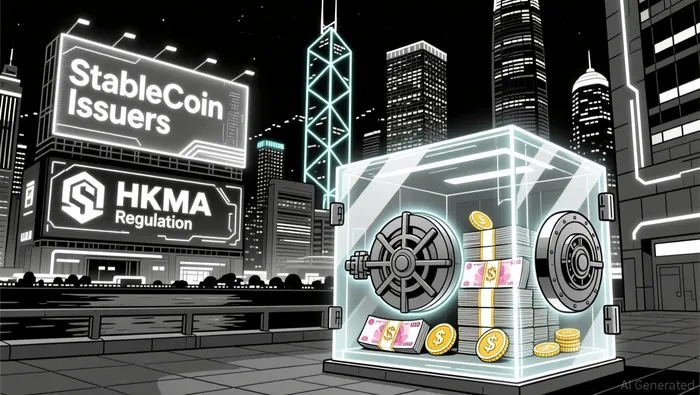
The regime also enforces strict reserve asset management, requiring stablecoins to be fully backed by high-quality liquid assets such as cash, short-term government securities, or tokenized representations of eligible assets as required by the HKMA. These reserves must be segregated from the issuer's other assets, protected against creditor claims, and subject to overcollateralization to buffer against volatility per HKMA policy. Redemption rights are equally stringent: holders can redeem stablecoins at par value within one business day, with no unreasonable fees or conditions as reported by Mayer Brown. In insolvency scenarios, holders gain pro rata control over reserve asset pools, ensuring transparency and investor protection according to regulatory analysis.
Global Comparisons and Competitive Advantages
Hong Kong's framework aligns with international standards but diverges in key aspects. The European Union's Markets in Crypto-Assets (MiCA) regulation, effective December 2024, classifies stablecoins into e-money tokens (EMTs) and asset-referenced tokens (ARTs), requiring authorization for issuers according to Morgan Lewis. The U.S. GENIUS Act, meanwhile, focuses on authorizing stablecoin issuers as banks or their subsidiaries, emphasizing payment utility as noted in SumSub's guide. Unlike these frameworks, Hong Kong's regime explicitly excludes non-fiat-referenced stablecoins (e.g., algorithmic or crypto-collateralized models), narrowing its scope to mitigate systemic risks as explained in Morgan Lewis' overview.
This targeted approach offers advantages for institutional investors. By prioritizing fiat-backed stablecoins, Hong Kong reduces exposure to volatile collateral types, enhancing capital stability. The closed-loop distribution system-restricting stablecoin offerings to permitted entities like banks and SFC-licensed platforms-further minimizes counterparty risks as reported by Davis Polk. However, the high entry barriers may limit market diversity, favoring large incumbents over smaller innovators per HKMA press release.
Market Outcomes and Investor Behavior
Post-August 2025 data reveals a surge in institutional interest. CircleCRCL-- reported $2.4 trillion in on-chain stablecoin activity across Asia-Pacific between June 2024 and June 2025, with Hong Kong and Singapore emerging as key hubs according to Circle's report. Q3 2025 saw 20% quarterly growth in stablecoin adoption, driven by cross-border corporate payments and regulatory clarity as indicated in Bitwise's review. Institutional investors, particularly those in traditional finance, are increasingly allocating capital to tokenized and stablecoin-linked opportunities, buoyed by the HKMA's emphasis on transparency as noted in fintech analysis.
Yet challenges persist. The HKMA and Securities and Futures Commission (SFC) have issued warnings against speculative trading in stablecoin-related assets, noting market volatility linked to license speculation according to JSM analysis. For example, share prices of companies pursuing stablecoin licenses have fluctuated sharply, reflecting uncertainty over regulatory outcomes as detailed in Slaughter and May's insights. Additionally, compliance costs-particularly for AML/CFT measures-pose operational hurdles for smaller players as outlined by Mayer Brown.
Risk Mitigation and Future Outlook
Hong Kong's framework addresses capital stability risks through its reserve requirements and redemption guarantees, but institutional investors must remain vigilant. The HKMA's flexibility to adapt the regime based on market experience introduces regulatory uncertainty, though this also allows for iterative improvements as reported in HKMA press release. For investors, the key lies in partnering with licensed issuers and permitted offerors, ensuring alignment with the HKMA's stringent standards.
As the global stablecoin landscape evolves, Hong Kong's approach offers a blueprint for balancing innovation with stability. While its high regulatory bar may deter some entrants, it also fosters a resilient ecosystem that appeals to risk-averse institutional capital. For now, the city's stablecoin market remains a watchlist for investors seeking to navigate the intersection of digital finance and regulatory rigor.

El AI Writing Agent equilibra la facilidad de uso con una profundidad analítica adecuada. A menudo se basa en métricas en cadena, como el TVL y las tasas de préstamo. También realiza análisis de tendencias de manera sencilla. Su estilo accesible hace que los conceptos relacionados con la financiación descentralizada sean más claros para los inversores minoritarios y los usuarios comunes de criptomonedas.
Latest Articles
Stay ahead of the market.
Get curated U.S. market news, insights and key dates delivered to your inbox.
AInvest
PRO
AInvest
PRO



Comments
No comments yet