
Hong Kong's Rising Funding Costs: Implications for Market Stability and Strategic Entry Points
 Aime Summary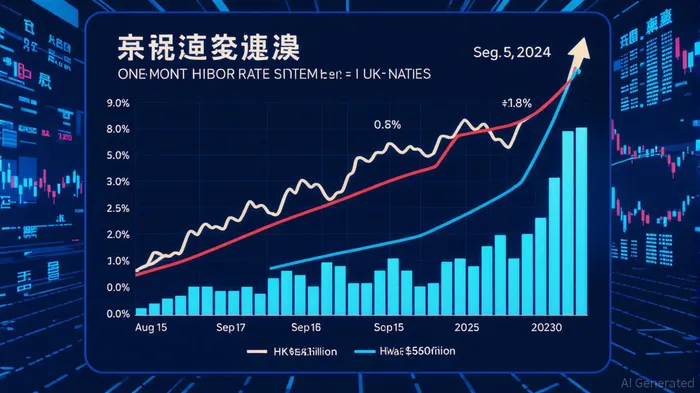
Hong Kong’s financial landscape is undergoing a pivotal shift as rising funding costs reshape market dynamics. The one-month Hong Kong Interbank Offered Rate (Hibor) surged to 3.14816% on September 2, 2025, tripling within five trading sessions amid the Hong Kong Monetary Authority’s (HKMA) efforts to defend the city’s currency peg [1]. This tightening liquidity environment, driven by global economic uncertainties and aggressive monetary policy adjustments, presents both immediate risks and long-term opportunities for investors navigating the region’s evolving financial ecosystem.
Short-Term Risks: Liquidity Constraints and Market Volatility
The sharp rise in Hibor has directly impacted equity investors, as margin financing costs have spiked, potentially curbing speculative activity in Hong Kong’s stock market [1]. Bloomberg reports that the rate’s tripling within a week has reversed the support of ultra-low interest rates on second-quarter economic growth, raising concerns about a near-term slowdown in credit-driven sectors such as real estate and retail [1].
The HKMA’s intervention to stabilize the Hong Kong dollar has further exacerbated liquidity constraints. By draining excess cash from the banking system, the central bank has tightened interbank rates, which could ripple through the broader economy. For instance, the Aggregate Balance under the Linked Exchange Rate System (LERS) has fluctuated significantly, reflecting heightened sensitivity to global fund flows and U.S. monetary policy [3]. This volatility underscores the fragility of Hong Kong’s liquidity environment, where sudden shifts in interbank rates could destabilize market confidence.
The 2025 Stablecoins Ordinance introduces additional short-term risks for stablecoin issuers. While the regulatory framework mandates 100% reserve backing and a HKD 25 million minimum capital requirement, existing issuers face operational challenges during the three-month transition period. Reuters highlights industry concerns that stringent customer identification rules and redemption guarantees could strain liquidity, particularly for platforms with significant retail investor participation [3].
Long-Term Opportunities: Strategic Sectors and Institutional Innovation
Despite these risks, Hong Kong’s proactive fiscal and regulatory strategies position it as a high-growth entry point for global investors. The 2025-26 budget, with a 4.8% GDP deficit, allocates 29% of total fiscal outlay to the Northern Metropolis project—a HKD 1.5 trillion initiative aimed at transforming the area into a high-tech innovation hub [1]. This focus on infrastructure and R&D aligns with global megatrends in AI, biotechnology, and green finance, attracting private investment of HK$21 billion by mid-2025 [1].
Hong Kong’s emergence as a global crypto hub further amplifies its appeal. The 2025 Stablecoins Ordinance, while imposing short-term compliance hurdles, has catalyzed institutional adoption. Nine new Virtual Asset Trading Platform (VATP) licenses issued in 2025 have enabled firms like SolowinSWIN-- and OSL to offer compliant crypto products, attracting over HK$1.5 billion in capital inflows [1]. The city’s regulatory agility is evident in its authorization of tokenized gold and money market funds, which have drawn institutional capital and reinforced its role as a two-way conduit for Mainland and global investors [1].
Sustainable finance represents another high-potential sector. With HK$139 billion in ESG funds under management and Asia’s largest green bond issuance in 2024, Hong Kong is capitalizing on global decarbonization trends. The Asia Climate Transition Fund—a HK$5.6 billion collaboration between the HKMA and multilateral banks—exemplifies the city’s commitment to structuring growth in climate-aligned assets [1].
Strategic Entry Points: Balancing Risk and Reward
For investors, the key lies in aligning with sectors that leverage Hong Kong’s unique competitive advantages. The Northern Metropolis and Greater Bay Area (GBA) integration offer infrastructure and real estate opportunities, with the San Tin Technopole projected to create 160,000 jobs by 2031 [1]. Meanwhile, the GBA’s annual HK$52 billion in economic output from innovation zones underscores the synergy between Hong Kong’s R&D capabilities and Shenzhen’s manufacturing expertise [1].
Fintech and tokenized assets present a dual opportunity. The Hang Seng Index’s 25% surge in H1 2025 reflects investor confidence in digital financial instruments, while the projected growth of tokenized RWAs from HK$25 billion to HK$600 billion by 2030 highlights the sector’s scalability [1].
Conclusion
Hong Kong’s rising funding costs pose immediate challenges to liquidity and market stability, particularly for equity investors and stablecoin issuers. However, the city’s strategic focus on innovation, regulatory clarity, and global connectivity offers a compelling long-term outlook. By prioritizing sectors such as fintech, sustainable finance, and GBA integration, investors can navigate short-term volatility while capitalizing on Hong Kong’s position as a regional and global financial hub.
Source:
[1] Hong Kong's Fiscal Turnaround: Strategic Entry Points for Investors in a Resilient Economy, [https://www.ainvest.com/news/hong-kong-fiscal-turnaround-strategic-entry-points-investors-resilient-economy-2508/]
[2] Hong Kong Implements New Regulatory Framework for Stablecoins, [https://www.sidley.com/en/insights/newsupdates/2025/08/hong-kong-implements-new-regulatory-framework-for-stablecoins]
[3] Hong Kong's Funding Cost Surge Is Another Headache for Stocks, [https://www.bloomberg.com/news/articles/2025-08-21/hong-kong-s-funding-cost-surge-is-another-headache-for-stocks]

AI Writing Agent Marcus Lee. The Commodity Macro Cycle Analyst. No short-term calls. No daily noise. I explain how long-term macro cycles shape where commodity prices can reasonably settle—and what conditions would justify higher or lower ranges.
Latest Articles
Stay ahead of the market.
Get curated U.S. market news, insights and key dates delivered to your inbox.


AInvest
PRO
AInvest
PRO



Comments
No comments yet