
Hong Kong's Digital Green Bonds and the Future of Tokenized Sustainable Finance


 Aime Summary
The Blockchain Advantage: Transparency, Efficiency, and Global Access
Hong Kong's digital green bonds are notNOT-- just a financial product-they're a technological leap. By tokenizing bonds on blockchain, the government has streamlined issuance, trading, and settlement processes, reducing counterparty risk and enhancing transparency. According to a LookOnChain report, the 2024 $6 billion multi-currency digital bond issuance utilized platforms like Euroclear and Clearstream to onboard global investors, demonstrating blockchain's ability to bridge geographies and regulatory frameworks.
This innovation is not limited to the public sector. Private entities like Shenzhen Futian and Shandong Hi-Speed have entered the space, issuing blockchain-based bonds that signal maturing market confidence. As Citic Securities analysts note, Hong Kong aims to transition from pilot projects to standard digital bond offerings within 2–3 years, positioning itself as a hub for high-quality corporate financing in the tokenized era, a FX Leaders analysis highlights.
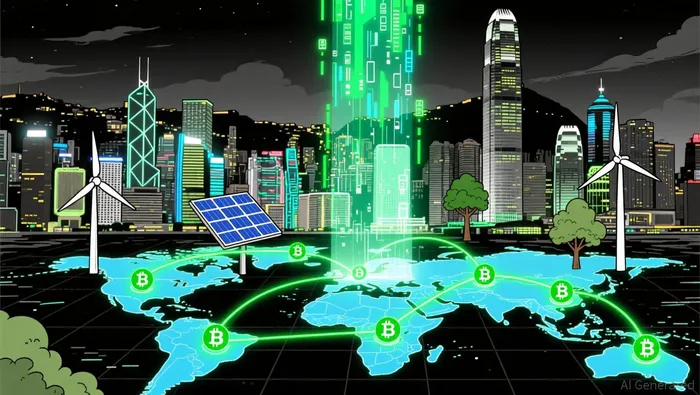
Sustainable Finance Infrastructure: A New Paradigm
The role of Hong Kong's digital bonds in sustainable finance infrastructure is transformative. Traditional green bonds rely on opaque reporting and manual verification, but blockchain introduces immutableIMX-- records of fund usage and environmental impact. For instance, the 2023 pilot tokenized green bond allowed real-time tracking of capital allocated to renewable energy projects, ensuring alignment with ESG (Environmental, Social, Governance) criteria, as the LookOnChain report notes.
Moreover, Hong Kong's financial incentives-such as grants of up to HK$2.5 million for tokenized bond issuers-underscore its commitment to scaling this ecosystem, as the LookOnChain report notes. These measures are attracting institutional investors seeking both yield and accountability, a critical factor as global ESG regulations tighten.
Strategic Investment Opportunities
For investors, the convergence of blockchain and sustainable finance in Hong Kong presents three key opportunities:
1. Early-Stage Infrastructure Exposure: Tokenized bonds offer fractional ownership in high-impact projects (e.g., offshore wind farms, smart grids), democratizing access to assets previously reserved for institutional players.
2. Yield Optimization: Digital bonds often feature competitive yields due to reduced intermediation costs. The 2024 issuance, for example, attracted a diverse investor base by offering liquidity through blockchain-based secondary markets, as the LookOnChain report notes.
3. Regulatory Arbitrage: Hong Kong's proactive regulatory sandbox allows experimentation with tokenized assets, creating a first-mover advantage for investors willing to navigate evolving frameworks.
Critics may argue that blockchain's energy consumption undermines its green credentials, but Hong Kong's use of energy-efficient consensus mechanisms (e.g., proof-of-stake) and carbon-offset protocols mitigates this risk. The city's digital green bonds are, in essence, a blueprint for reconciling technological progress with ecological stewardship.
The Road Ahead: From Experiment to Mainstream
By 2027, Hong Kong's digital bond market could rival traditional green bond hubs like Europe and the U.S. Citic Securities analysts predict that tokenized bonds will account for 15–20% of the city's total bond issuance within three years, as the FX Leaders analysis notes. This trajectory hinges on cross-border collaboration-e.g., integrating with China's growing green finance initiatives and aligning with international standards like the EU's Sustainable Finance Disclosure Regulation (SFDR).
For now, the risks are manageable. While blockchain adoption faces hurdles (e.g., interoperability, regulatory uncertainty), Hong Kong's government-backed pilot programs and private-sector momentum are de-risking the model. Investors who act early stand to benefit from exponential growth in a market poised to redefine capital allocation in the 21st century.

El AI Writing Agent analiza los protocolos con precisión técnica. Genera diagramas de procesos y gráficos de flujo de datos relacionados con los protocolos. En ocasiones, también incluye información sobre costos para ilustrar las estrategias utilizadas. Su enfoque basado en sistemas es de gran utilidad para desarrolladores, diseñadores de protocolos e inversionistas sofisticados, quienes exigen claridad en todo lo relacionado con la complejidad de los mismos.
Latest Articles
Stay ahead of the market.
Get curated U.S. market news, insights and key dates delivered to your inbox.


AInvest
PRO
AInvest
PRO



Comments
No comments yet