
Hong Kong’s August 2 Heat: A Lesson in Prediction Market Mechanics
 Aime Summary
Lead
While global markets grapple with AI spending risks and South Korean retail exodus, a quiet prediction market on Hong Kong’s August 2 high temperature reveals a critical divergence: thin informational catalysts meeting rigid resolution rules. This article examines how a market with a seemingly straightforward event—a single day’s peak heat—can be mispriced when traders conflate external news with settlement mechanics, and when volatility is amplified by ultra-low pricing rather than genuine information flow.
Event Definition
The market settles on the temperature range containing the highest temperature recorded by the Hong Kong Observatory on August 2, 2026. The core disagreement is not about climate trends but about the precise bin into which a single, verifiable data point will fall. The bet is binary: a specific range will either contain the day’s maximum or it will not, with the resolution source being the Observatory’s finalized Daily Extract.
Latest News & Information Increments
A survey of recent news flow reveals a near-total absence of catalysts directly relevant to the contract’s settlement. The available information set is dominated by unrelated global developments: India’s power consumption surged nearly 11% year-on-year in July due to high humidity and cooling demand, and at least 15 U.S. states have introduced data center moratorium bills, while the White House applies de facto bans on specific AI models. These stories, while significant for energy and technology sectors, provide no actionable signal for Hong Kong’s August 2 temperature. Other items—such as a Airtory and ADWEB partnership in Southeast Europe or Geely Auto’s July sales figures—are entirely orthogonal to the market’s outcome.
This low-information regime means the market is operating in a vacuum of relevant catalysts. In such an environment, price movements are more likely to be driven by position squaring, thin liquidity, and noise trading than by genuine shifts in the probability of a specific temperature outcome. The absence of a direct weather forecast or a local Hong Kong policy change means the market’s current pricing is not anchored to a clear, recent information increment.
Market Resolution Rules Analysis
The contract resolves based on the “Absolute Daily Max (deg. C)” from the Hong Kong Observatory’s finalized Daily Extract for August 2, 2026. The critical time boundary is 12:00:00 UTC on that date. Settlement is not based on real-time readings or news reports, but on a single, official data publication. The use of the “finalized” extract is the key operational term: the market will not resolve until this specific document is published, and the value it contains is definitive.
Rule Risk Points & Disputed Scenarios
The primary risk is a resolution delay. The market cannot settle until the Hong Kong Observatory publishes the data for the specified date. If publication is delayed for any reason, the market will remain open and capital will be locked, creating an opportunity cost for traders. A more subtle but crucial risk is that post-publication data revisions are explicitly ignored. If the Observatory initially publishes a value that falls into one range, but later revises the figure, the market will settle based on the first publication. This creates a scenario where a trader could be correct about the actual temperature but wrong about the settlement outcome if a revision occurs, a classic prediction market edge case that can trap those unfamiliar with the fine print.
Market Overview
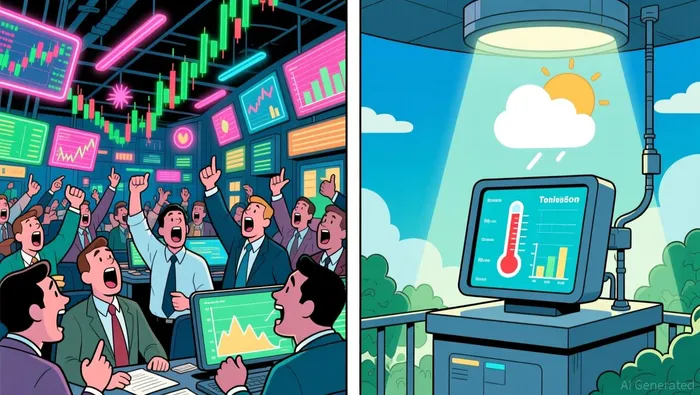
The market structure reveals a stark polarization. One contract, trading at 0.57, reflects a 57% implied probability and represents the dominant position, having absorbed a significant 0.46 absolute price increase. In contrast, another contract trades at a near-zero price of 0.001, implying a 0.1% probability. This ultra-low price is not necessarily a signal of a true 1-in-1000 event; rather, it often indicates a market where the outcome is considered so unlikely that it has been abandoned by traders, with the price floor maintained by the minimal tick size. The 57% contract, with its moderate liquidity, is the only one where price discovery is meaningfully occurring, and its level suggests a cautious consensus that the day’s high will land in a specific, but not overwhelmingly certain, range.
Market Dynamics (Volatility & Volume)
The volatility profile is dominated by the 0.46 price surge in the 57% contract, which represents the maximum 1-day change. This move is significant in absolute terms, but its context is critical. The 1-week, 1-month, and 1-year maximum changes for the other contract are identical at 0.001, a figure that is essentially the minimum possible price increment. This convergence across long time horizons indicates that the market has been dormant for an extended period, with the recent spike in the leading contract being the sole instance of meaningful repricing. The ultra-low-priced contract amplifies relative volatility; a 0.001 move is a 100% change, but in absolute terms, it is noise.
Volume analysis confirms that the recent price action is backed by genuine trading activity. The 24-hour volume is strong, falling between $50,000 and $150,000, and it constitutes a dominant share of the total market volume. This concentration of volume into the last day of trading, coinciding with the sharp price increase, suggests a late influx of capital that is driving price discovery rather than a thin, easily manipulated quote. The market is not experiencing a divergence between price and volume; the move is supported by real positioning as the resolution deadline approaches.
Trading Judgment & Follow-up Observation Points
The current pricing reflects a market that has awakened from dormancy to price a binary outcome with a single, soon-to-be-published data point. The key variable to track is not a news headline, but the Hong Kong Observatory’s publication schedule. The primary risk is not a wrong forecast, but a settlement delay. Observers should monitor the Observatory’s website for the release of the Daily Extract for August 2, as the exact timing will determine when capital is unlocked. The market’s behavior is a reminder that in prediction markets, the path from information to settlement is mediated by rules that can override intuition, and a correct real-world call does not guarantee a profitable trade if the rulebook says otherwise.

Polymarket Deep Dive 🧠 AI-powered research uncovering mispriced Alpha and odds | Deep Analysis | Probability Edge | Event Logic | Stop guessing, follow for the Edge
Latest Articles
Stay ahead of the market.
Get curated U.S. market news, insights and key dates delivered to your inbox.


AInvest
PRO
AInvest
PRO




Comments
No comments yet