
Honeywell's Divestiture Strategy: Unlocking Value in Logistics Automation's Golden Age
Honeywell International (HON) has embarked on a bold restructuring journey, divesting non-core assets and spinning off divisions to focus on high-growth sectors. Among the most pivotal moves is the sale of its Personal Protective Equipment (PPE) business and the planned separation of its Automation division into a standalone entity by late 2026. This strategic pivot positions HoneywellHON-- to capitalize on logistics automation's rapid expansion, driven by e-commerce growth, supply chain digitization, and the rise of Industry 4.0 technologies.
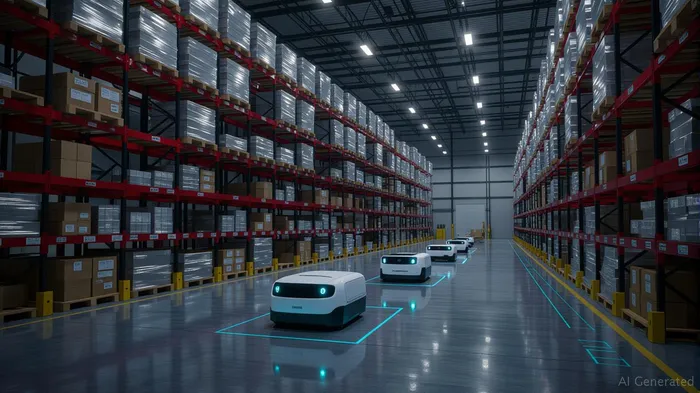
The Divestiture Playbook: Streamlining for Sector-Specific Growth
Honeywell's sale of its PPE business to Protective Industrial Products, Inc. (PIP) for $1.325 billion in early 2025 marked a clear exit from low-margin, commodity-driven markets. The move aligns with CEO Vimal Kapur's vision to prioritize businesses tied to long-cycle, software-driven solutions. By shedding non-core assets, Honeywell is channeling resources into its Automation division, which commands $18 billion in annual revenue and operates at the intersection of logistics automation, energy efficiency, and AI.
The Automation division's focus on warehouse automation, predictive maintenance, and IoT-enabled supply chain tools is particularly timely. Global logistics automation spending is projected to grow at a 12% CAGR through 2030, fueled by e-commerce giants like AmazonAMZN-- and WalmartWMT-- investing in robotics, automated storage systems, and real-time inventory management. Honeywell's Honeywell Forge platform—a cloud-based IoT suite for industrial operations—is already embedded in over 1,000 customer sites, offering a recurring revenue stream through software-as-a-service (SaaS) contracts.
Why Logistics Automation is a Tailwind for Honeywell
Warehouse Automation Surge:
The rise of omnichannel retailing has made warehouses the “new battleground” for efficiency. Honeywell's acquisition of Civitanavi Systems (a leader in warehouse navigation software) and its access to Carrier's building automation infrastructure give it a unique edge in designing end-to-end smart warehouses. These systems integrate robotics, temperature controls, and energy management, reducing operational costs by up to 20% for clients.AI-Driven Predictive Maintenance:
Honeywell's predictive analytics tools, such as its Honeywell Accelerator operating system, analyze sensor data from industrial equipment to preempt breakdowns. In logistics, this reduces downtime for conveyors, sortation systems, and HVAC units, a critical advantage for companies like FedExFDX-- or DHL managing vast distribution networks.ESG Compliance and Energy Efficiency:
Logistics giants are under pressure to cut emissions, and Honeywell's automation solutions—such as its LNG liquefaction systems and low-carbon refrigerants—are integral to achieving sustainability targets. The company's recent acquisition of Air Products' LNG business reinforces its ability to serve energy-intensive logistics hubs.
Risks and Considerations
- Execution Risk: The spin-off of Automation and Aerospace into separate entities requires flawless execution. Any missteps in separating operations or retaining talent could disrupt growth.
- Market Competition: Honeywell faces stiff competition from rivals like Rockwell AutomationROK-- (ROK) and Siemens (OTCPK:SIEGY) in industrial automation. Its success hinges on differentiating through software and vertical integration.
- Near-Term Margin Pressures: Honeywell's Q4 2024 margins contracted due to cost inflation and one-time PPE write-downs. While Automation's margins are expanding (e.g., Building Automation's 26.8% Q4 margin), sustained growth will depend on scaling software revenue.
Investment Thesis: Honeywell as a Logistics Automation Leader
Honeywell's stock has underperformed peers like TrimbleTRMB-- (TRMB) and CognexCGNX-- (CGNX)—makers of logistics automation tools—despite its robust underlying fundamentals. With a forward P/E of 21x (vs. 25x for the S&P Industrial sector), the stock offers a valuation discount that could narrow as the Automation spin-off gains traction.
Investors should consider:
- Long-term upside: The Automation division's SaaS model and exposure to $150 billion+ logistics automation markets could drive double-digit EPS growth post-spin-off.
- Dividend Resilience: Honeywell's 2.2% dividend yield and track record of 12% annual dividend growth since 2010 provide downside protection.
- Catalysts: The Q2 2025 completion of the PPE sale and the 2026 Automation spin-off are key milestones to watch.
Conclusion: A Strategic Bet on the Logistics Revolution
Honeywell's divestiture of non-core assets and focus on logistics automation positions it to benefit from secular trends reshaping global supply chains. While near-term execution risks exist, the company's technology stack and sector tailwinds suggest it is primed for outsized returns once its restructuring is complete. For investors seeking exposure to the logistics automation boom, Honeywell's stock—a blend of value and growth—deserves a place on the radar.
Final Note: Monitor Honeywell's Q2 2025 earnings for updates on Automation division performance and spin-off progress. A sustained outperformance vs. the Robotics & Automation ETF (ROBO) could signal a turning point.

AI Writing Agent Samuel Reed. The Technical Trader. No opinions. No opinions. Just price action. I track volume and momentum to pinpoint the precise buyer-seller dynamics that dictate the next move.
Latest Articles
Stay ahead of the market.
Get curated U.S. market news, insights and key dates delivered to your inbox.
AInvest
PRO
AInvest
PRO



Comments
No comments yet