
The Honest’s 2026 Q2 Call: SG&A Timing, Diapers’ Role, and Growth Drivers Clash
 Aime Summary
Date of Call: Aug 5, 2026
Financials Results
- Revenue: $83.3 million, a decrease of 10.9% YOY (organic revenue increased 6.7%)
- Gross Margin: Reported gross margin 48.4%, adjusted gross margin 50.1% (improved 970 basis points YOY; underlying adjusted gross margin 43.8%, up 340 basis points YOY)
Guidance:
- Reported revenue range of $319 to $325 million (includes ~$10M apparel liquidation benefit).
- Organic revenue growth of 5% to 7% (up from 4% to 6%).
- Adjusted gross margins expected in the mid-40s (up from low 40s).
- Adjusted EBITDA of $23 to $25 million (up from $20 to $23 million).
- New apparel licensing agreement immaterial to 2026 results.
Business Commentary:
Strong Revenue Growth and Profit Margins:
- The Honest Company achieved
strong organic revenue growth of nearly 7%in Q2 2026, withunderlying adjusted gross margins of 43.8%andunderlying adjusted EBITDA margins of 9.8%. - This growth was driven by ongoing structural improvements to the business and a commitment to operational excellence, leading to the raising of their full-year outlook.
Wipes and Personal Care Performance:
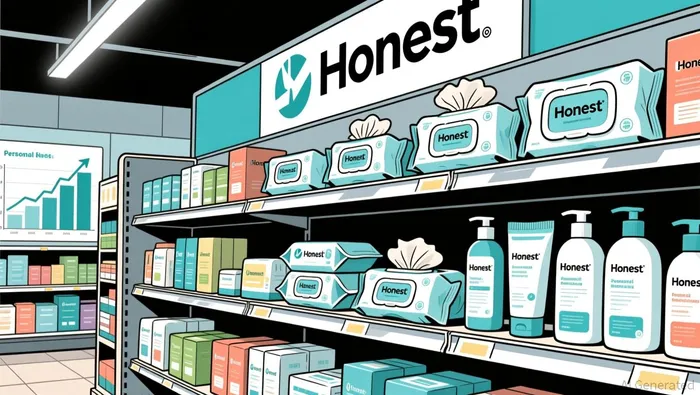
- The total WIPES portfolio delivered
consumption growth of 26%versus a comparative category growth of2%, while the personal care portfolio grew19%, outpacing the category's5%growth rate. - The growth was attributed to the broad appeal of Honest products across different household types and effective marketing strategies, including campaigns targeting adult consumers.
Household Penetration and Consumer Appeal:
- The company's
household penetration improved 100 basis pointsto8.1%, with nearly two-thirds of that growth coming from households with no kids. - This growth is driven by the resonance of the Honest standard and the broad appeal of the brand across various household types, supported by strategic marketing efforts.
Operational Efficiency and Cost Management:
- Total operating expenses decreased by
$4.1 millionto$30.8 million, reflecting progress in rightsizing SG&A, while marketing spend was strategically increased by nearly20%. - This was done to capitalize on momentum in wipes and personal care and to drive household penetration, alongside investments in operational capabilities for scaling.
Sentiment Analysis:
Overall Tone: Positive
- Management highlighted "strong organic revenue growth of nearly 7%" and "highest profit margins in the history of the Honest Company." They are "raising our full year outlook" due to "sound first half execution" and are "energized about the strength of the Honest brand." The tone is optimistic about momentum and strategic positioning.
Q&A:
- Question from Aaron Gray (Alliance Global Partners): Just on the guidance, quick clarification on the profit guidance assuming the tariff is not included, and color on marketing spend and ROI in the back half.
Response: Adjusted gross margin includes tariff refund and apparel liquidation impacts; underlying performance is stronger in H2. Marketing will step up for wipes/personal care to drive household penetration, with broader investments in scaling capabilities.
- Question from Aaron Gray (Alliance Global Partners): Second question on licensing apparel and switching to licensing versus direct, and how the segment will evolve.
Response: Licensing aligns with asset-light DNA, allowing participation in apparel category with low capital intensity; no long-term impact speculation, but excited about new partnership.
- Question from Patty Kanata (Morgan Stanley): Follow-up on reinvestment piece, where incremental dollars are going across marketing, innovation, and distribution.
Response: Strategic investments target wipes and personal care platforms for household penetration, plus upper-funnel marketing to broader households; also investing in operating capabilities for efficiency and supply chain integration.
- Question from Patty Kanata (Morgan Stanley): Quick one on diapers, promotion and pricing dynamics and the environment.
Response: Diaper category is structurally challenged with major brands declining; Honest’s diapers are less than 25% of consumption, offset by strong wipes/personal care, which are 70% of consumption.
- Question from Anna Glaskin (B Reilly Securities): Touch on distribution, update on distribution and how expanded door growth could support ahead.
Response: Focus has shifted to household penetration as a more uniform metric; individual categories have low penetration (e.g., <3% in baby personal care) with significant runway, each point worth $25-30M in sales.
- Question from Anna Glaskin (B Reilly Securities): Follow-up on SG&A, big step down YOY and sequentially, and shift to back half.
Response: SG&A was low in Q2 due to Power Wing execution; will step up in H2 for marketing and scaling capabilities investments.
- Question from Owen Rickard (Northland Capital Market): How much of Q2 organic growth was driven by distribution vs. velocity, and is mix shifting?
Response: Q2 acceleration due to distribution gains from Q1 taking hold, with focus on foundational momentum and velocity; innovation aligned with retailer reset schedules for durable growth.
- Question from Owen Rickard (Northland Capital Market): Are we essentially through all P&L noise related to Powering Honest growth?
Response: Powering Honest growth delivered more savings than guidance; largely through but not completely through related costs, with warehouse consolidation live and structural profitability improved.
Contradiction Point 1
SG&A Investment Timing and Magnitude
Contradictory statements on SG&A step-up and its relation to cost savings.
Aaron Gray (Alliance Global Partners) - Aaron Gray (Alliance Global Partners)
2026Q2: SG&A will also increase due to investments in scaling capabilities. - Curtis Bruce(CFO)
2026Q2: The back-half increase is planned and represents strategic investments in marketing and scaling capabilities to support sustained long-term growth. - Curtis Bruce(CFO)
Contradiction Point 2
Strategic Reinvestment Focus and Balance
Shift in emphasis from broad operational scaling to a more marketing-centric focus.
Patty Kanata (Morgan Stanley) - Patty Kanata (Morgan Stanley)
2026Q2: Reinvestment maps to strategic growth levers for the high-margin, high-growth wipes and personal care platforms. Focus areas include: 1) Brand Awareness & Household Recruitment... 2) Upper-Funnel Marketing... 3) Operational Scaling: Investments in technology and supply chain capabilities... - Carla Vernon(CEO)
Where are incremental reinvestment dollars being prioritized across marketing, innovation, and distribution? - Aaron Grey (Alliance Global Partners)
2026Q2: Strategic reinvestment includes scaling capabilities beyond just marketing. - Curtiss Bruce(CFO)
Contradiction Point 3
Diapers Category Contribution and Strategic Importance
Contradiction on the category's role in growth and consumer focus.
Patty Kanata (Morgan Stanley) - Patty Kanata (Morgan Stanley)
2026Q2: Diapers now represent less than 25% of total consumption, with wipes and personal care driving 70% and powering the raised guidance. - Carla Vernon(CEO)
Can you provide an update on promotion and pricing dynamics in the challenged diaper category and the broader baby segment? - Anna Glaessgen (B. Riley Securities)
2026Q1: The brand's focus has expanded beyond diapers to appeal to a broader range of households... The marketing strategy is shifting to directly engage these adult demographics... - Carla Vernon(CEO)
Contradiction Point 4
Primary Driver of Organic Growth Acceleration
Contradiction on whether growth is driven by distribution gains or velocity.
Owen Rickard (Northland Capital Markets) - Owen Rickard (Northland Capital Markets)
2026Q2: The acceleration was as expected, with distribution gains from Q1 now taking hold and accelerating in Q2 and beyond, driven by momentum in wipes and personal care. - Curtis Bruce(CFO)
What were the drivers of Q2 organic growth acceleration (distribution vs. velocity), and how durable is this growth? - Dana Telsey (Telsey Advisory Group)
2026Q1: The consumption acceleration was driven by lapping previous diaper distribution declines, the ongoing pay-out from past innovation... and a balanced plan focused on innovation, velocity/distribution, and marketing. - Carla Vernon(CEO) & Curtis Bruce(CFO)
Contradiction Point 5
Diaper Category Outlook and Strategic Focus
Contradictory statements on diaper category challenges and the company's strategic emphasis.
Patty Kanata (Morgan Stanley) - Patty Kanata (Morgan Stanley)
2026Q2: The diaper category is facing structural challenges with major national brands losing share and unit growth... Diapers now represent less than 25% of total consumption, with wipes and personal care driving 70% and powering the raised guidance. - Carla Vernon(CEO)
Can you provide an update on promotion and pricing dynamics in the challenged diaper category and the broader baby segment? - Shovana Chowdhury (JPMorgan)
20260226-2025 Q4: 2026 is expected to be challenging for diapers due to similar factors and competitive pressures. - Carla Vernon(CEO)

Discover what executives don't want to reveal in conference calls
Latest Articles
Stay ahead of the market.
Get curated U.S. market news, insights and key dates delivered to your inbox.


AInvest
PRO
AInvest
PRO




Comments
No comments yet