
Honda Unveils $18,000 N-ONE e Mini Electric Car in Japan
ByAinvest
Thursday, Sep 11, 2025 6:39 am ET2min read
HMC--
Honda's entry into the electric vehicle market underscores the growing demand for eco-friendly vehicles and the company's strategy to stay competitive in the industry. The N-ONE e is Honda's first lightweight electric car for Japan and is designed to appeal to the kei car segment, which accounts for about a third of Japan's auto market. Honda already dominates this segment with its gasoline-powered N-Box, the country's top-selling car [1].
The launch of the N-ONE e comes as rivals such as Suzuki Motor and Toyota Motor plan to introduce their own kei EVs later this year, and China's BYD is set to introduce one in 2025 [1]. Meanwhile, Nissan, which is facing its deepest crisis in a quarter century, is also under pressure to accelerate its EV offerings. The N-ONE e's introduction adds to the competitive landscape in Japan's EV market.
Honda's U.S.-listed stock has risen by 19% so far in 2025, while Nissan's U.S.-listed shares have declined by nearly 20% over the same period, reflecting the market's sentiment towards the two companies' EV strategies [1]. The retail sentiment on Stocktwits was 'bearish' for Honda and 'bullish' for Nissan, indicating differing investor views on the companies' EV strategies [1].
Honda's focus on EVs is part of a broader push towards sustainability and energy integration. The company has announced plans to unveil its vision for its electric vehicle and home energy future at RE+ 2025 in Las Vegas, highlighting technologies that aim to transform cars into mobile energy hubs [2]. The company's commitment to turning future EVs into "Virtual Power Plants" could help families trim their monthly energy bills and provide local utilities with a distributed network of small, mobile energy storage units [2].
Honda's partnership with Southern California Edison (SCE) to pilot vehicle-to-home (V2H) and vehicle-to-grid (V2G) systems further underscores the company's commitment to integrating EVs into the broader energy ecosystem [2]. The trials aim to create protocols that let owners tap their vehicles as emergency backup generators during power outages or as dynamic energy sources during high-demand periods [2].
In conclusion, Honda's introduction of the N-ONE e mini electric car in Japan marks a significant step in the company's efforts to expand its electric vehicle offerings and stay competitive in the industry. The car's range and pricing position it well to appeal to the Japanese market, while Honda's broader push towards energy integration positions the company to play a key role in the future of sustainable mobility.
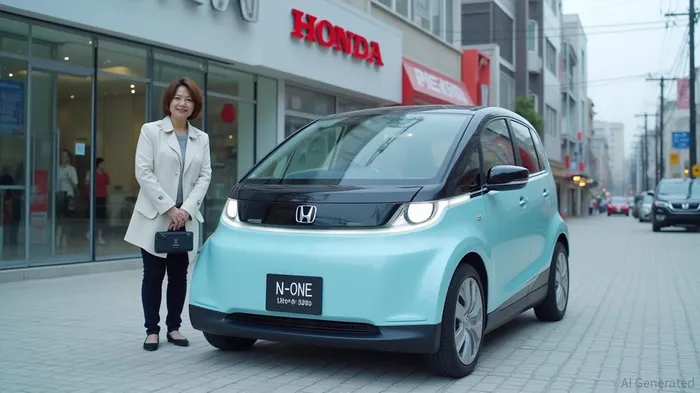
Honda Motor unveiled its $18,000 N-ONE e mini electric car in Japan. The car is part of Honda's efforts to expand its electric vehicle offerings. The N-ONE e has a range of up to 180 kilometers and is aimed at the Japanese market. Honda's entry into the electric vehicle market highlights the growing demand for eco-friendly vehicles and the company's strategy to stay competitive in the industry.
Honda Motor has expanded its electric vehicle (EV) offerings with the introduction of the N-ONE e mini electric car in Japan. The N-ONE e, priced at 2.7 million yen (approximately $18,300), was unveiled on September 10, 2025, and is aimed at the Japanese market [1]. The car, which is part of Honda's strategy to accelerate Japan's transition to electric mobility, offers a range of up to 295 kilometers on a single charge, outperforming Nissan's Sakura EV, which has a range of 180 kilometers [1].Honda's entry into the electric vehicle market underscores the growing demand for eco-friendly vehicles and the company's strategy to stay competitive in the industry. The N-ONE e is Honda's first lightweight electric car for Japan and is designed to appeal to the kei car segment, which accounts for about a third of Japan's auto market. Honda already dominates this segment with its gasoline-powered N-Box, the country's top-selling car [1].
The launch of the N-ONE e comes as rivals such as Suzuki Motor and Toyota Motor plan to introduce their own kei EVs later this year, and China's BYD is set to introduce one in 2025 [1]. Meanwhile, Nissan, which is facing its deepest crisis in a quarter century, is also under pressure to accelerate its EV offerings. The N-ONE e's introduction adds to the competitive landscape in Japan's EV market.
Honda's U.S.-listed stock has risen by 19% so far in 2025, while Nissan's U.S.-listed shares have declined by nearly 20% over the same period, reflecting the market's sentiment towards the two companies' EV strategies [1]. The retail sentiment on Stocktwits was 'bearish' for Honda and 'bullish' for Nissan, indicating differing investor views on the companies' EV strategies [1].
Honda's focus on EVs is part of a broader push towards sustainability and energy integration. The company has announced plans to unveil its vision for its electric vehicle and home energy future at RE+ 2025 in Las Vegas, highlighting technologies that aim to transform cars into mobile energy hubs [2]. The company's commitment to turning future EVs into "Virtual Power Plants" could help families trim their monthly energy bills and provide local utilities with a distributed network of small, mobile energy storage units [2].
Honda's partnership with Southern California Edison (SCE) to pilot vehicle-to-home (V2H) and vehicle-to-grid (V2G) systems further underscores the company's commitment to integrating EVs into the broader energy ecosystem [2]. The trials aim to create protocols that let owners tap their vehicles as emergency backup generators during power outages or as dynamic energy sources during high-demand periods [2].
In conclusion, Honda's introduction of the N-ONE e mini electric car in Japan marks a significant step in the company's efforts to expand its electric vehicle offerings and stay competitive in the industry. The car's range and pricing position it well to appeal to the Japanese market, while Honda's broader push towards energy integration positions the company to play a key role in the future of sustainable mobility.
Stay ahead of the market.
Get curated U.S. market news, insights and key dates delivered to your inbox.


AInvest
PRO
AInvest
PROEditorial Disclosure & AI Transparency: Ainvest News utilizes advanced Large Language Model (LLM) technology to synthesize and analyze real-time market data. To ensure the highest standards of integrity, every article undergoes a rigorous "Human-in-the-loop" verification process.
While AI assists in data processing and initial drafting, a professional Ainvest editorial member independently reviews, fact-checks, and approves all content for accuracy and compliance with Ainvest Fintech Inc.’s editorial standards. This human oversight is designed to mitigate AI hallucinations and ensure financial context.
Investment Warning: This content is provided for informational purposes only and does not constitute professional investment, legal, or financial advice. Markets involve inherent risks. Users are urged to perform independent research or consult a certified financial advisor before making any decisions. Ainvest Fintech Inc. disclaims all liability for actions taken based on this information. Found an error?Report an Issue


ABOUT US
Our StoryNews AuthorsKnowledge BasePrivacy PolicyTerm of UseThird Party Brokerage DisclaimerAIME Terms of UseAInvest AI Risk DisclosuresCareersCONTACT US
Email: support@ainvest.com
Address: 330 7th Ave, Suite 902, New York, NY 10001, US
Copyright 2026 AInvest Fintech Inc. All rights reserved.


Comments
No comments yet