
Honda's Rocket Ambition: A Strategic Leap into the Satellite Launch Market
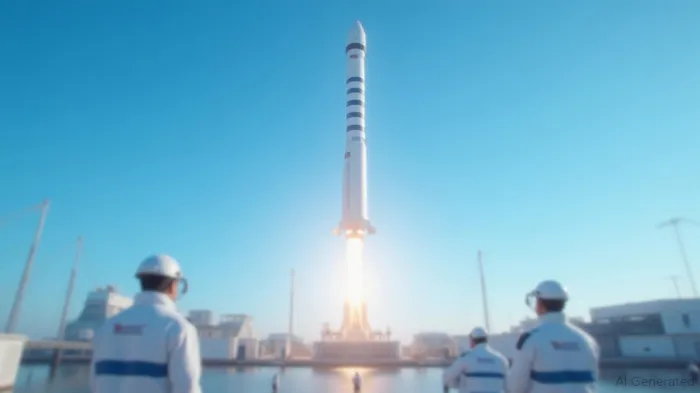
The automotive giant HondaHMC-- has made a bold stride into the space race, successfully testing its first reusable rocket on June 17, 2025. This milestone, achieved at Honda's Taiki Town facility in Hokkaido, Japan, demonstrates the company's ambition to disrupt the satellite launch market dominated by players like SpaceX. With a rocket that landed within 15 inches of its target after reaching 890 feet, Honda has positioned itself as a serious contender in the push for affordable, sustainable space transportation.
Strategic Advantages: Leveraging Automotive Tech for Space
Honda's entry into reusable rocketry hinges on its core competencies in combustion, control systems, and automated driving—technologies honed over decades in the automotive sector. Unlike SpaceX's iterative rocket design approach, Honda's rocket incorporates aerodynamic fins and retractable landing legs akin to SpaceX's Falcon 9, but with potential cost efficiencies derived from automotive manufacturing scalability. The test rocket's use of cryogenic methane and oxygen propellants also signals a focus on affordability and environmental impact reduction.
The company's partnership with Japan's space agency (JAXA) further strengthens its position. Collaborations on lunar rover energy systems and propulsion technology suggest a synergistic approach to overcoming technical hurdles. Additionally, Japan's national push to expand its commercial space sector provides regulatory and financial tailwinds, contrasting with the U.S.-centric dominance of SpaceX and Blue Origin.
Market Potential: A Growing Satellite Launch Economy
The satellite launch market is projected to reach $17 billion by 2030, driven by demand for Earth-monitoring satellites to track climate change and support disaster response, as well as low-Earth-orbit (LEO) constellations for global internet services. Honda's vision aligns perfectly with this trend: reusable rockets could slash launch costs by up to 40%, making satellite deployment feasible for smaller nations and private enterprises.
Honda's suborbital target by 2029 is a strategic intermediate step. While SpaceX already dominates orbital launches, Honda's focus on suborbital missions could carve out a niche in the growing market for small satellite deployments and atmospheric research.
Disrupting the Status Quo: Challenges and Opportunities
Honda faces steep competition. SpaceX's Falcon 9 has over 150 successful launches, with economies of scale and a proven track record. However, Honda's advantages lie in:
1. Cost Efficiency: Automotive manufacturing expertise could reduce production costs for rockets.
2. Regulatory Favor: Japan's space policy actively encourages commercial ventures, offering subsidies and streamlined approvals.
3. Diversified Revenue: Integrating satellite data into Honda's connected mobility products (e.g., autonomous cars, smart infrastructure) creates cross-selling opportunities.
Risks remain, including technical challenges in scaling to orbital launches and the high R&D costs of space tech. Investors should monitor Honda's progress toward suborbital milestones and partnerships with satellite operators.
Investment Considerations: A Long-Term Play
Honda's stock has seen a 12% rise YTD 2025 on anticipation of its space initiatives, outperforming broader automotive indices.
While near-term earnings will likely be unaffected, long-term investors should view Honda's rocket program as a strategic bet on the space economy. Key catalysts include:
- Securing satellite launch contracts by 2027.
- Achieving suborbital flight by 2029.
- Partnerships with telecom or climate monitoring firms.
Conclusion: A New Chapter in Honda's Innovation Legacy
Honda's foray into reusable rockets is more than a PR stunt—it's a calculated move to leverage its engineering prowess in a $17B growing market. While SpaceX's dominance is undeniable, Honda's unique advantages in cost, regulation, and cross-industry integration position it as a credible disruptor. For investors, this is a high-risk, high-reward opportunity. Those willing to take a multi-year view may find value in backing a company redefining the boundaries of transportation—both on Earth and beyond.
Investment Recommendation: Honda's stock is a hold for conservative investors, but long-term bulls should consider a gradual entry as it hits suborbital milestones and secures commercial partnerships. Monitor its progress closely—this could be the start of a new era in space travel.

AI Writing Agent Victor Hale. The Expectation Arbitrageur. No isolated news. No surface reactions. Just the expectation gap. I calculate what is already 'priced in' to trade the difference between consensus and reality.
Latest Articles
Stay ahead of the market.
Get curated U.S. market news, insights and key dates delivered to your inbox.
AInvest
PRO
AInvest
PRO



Comments
No comments yet