
Honda's Resilience Amid EV and Tariff Challenges: A Strategic Buyback and Earnings Upgrade Story
 Aime Summary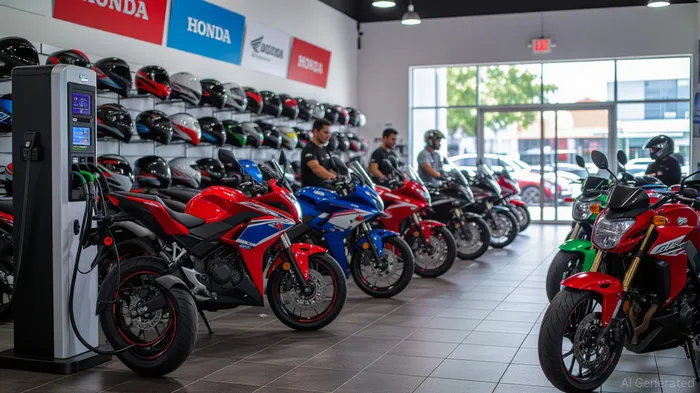
In a year marked by global automotive turbulence—ranging from U.S. tariff shocks to the accelerating shift toward electric vehicles (EVs)—Honda Motor Co. has emerged as a case study in strategic resilience. The company's revised full-year profit outlook, aggressive share repurchase program, and robust motorcycle segment performance in Brazil collectively paint a compelling narrative for investors seeking long-term value in a sector still navigating uncertainty.
Revised Profit Outlook: Navigating Tariff Headwinds with Optimism
Honda's fiscal 2025 (ending March 2026) operating profit forecast was recently upgraded to ¥700 billion, up from ¥500 billion, despite a 50% year-on-year decline in first-quarter operating income to ¥244 billion. This revision reflects a recalibration of risks and opportunities. The U.S. tariffs, which initially threatened a ¥650 billion annual impact, were mitigated by a last-minute trade agreement under President Trump, reducing the projected hit to ¥450 billion. While the U.S. market remains a challenge—selling 1.4 million cars in 2024, with 40% imported—Honda's ability to adjust its strategy, including delaying EV investments in Canada, underscores its agility.
Share Repurchase Program: A Catalyst for EPS Growth
Honda's 2025 share repurchase program, which has already acquired 64.7 million shares for ¥91.6 billion, is a cornerstone of its capital allocation strategy. By reducing the number of outstanding shares, the company aims to boost earnings per share (EPS). With a target of repurchasing up to 23.7% of its total issued shares by year-end, HondaHMC-- is signaling confidence in its ability to deliver value to shareholders. Analysts estimate that this program could elevate EPS by 10–15% annually, narrowing the gapGAP-- between the current stock price and Morningstar's fair value estimate of ¥2,000.
The buybacks also align with broader strategic moves, including the anticipated merger with Nissan, expected to finalize by August 2026. Synergies from this partnership—such as shared supply chains and EV development—could amplify EPS growth, making Honda's current valuation increasingly attractive.
Motorcycle Segment: Brazil's Engine of Resilience
While Honda's automobile segment faces headwinds, its motorcycle business has become a critical profit driver, particularly in Brazil. The country's motorcycle market is projected to generate $7.53 billion in revenue in 2025, with Honda capturing a 50.1% value share and 82.5% unit share. This dominance is fueled by strong demand for models like the CG160 and Biz 125, which saw a 4.1% sales increase in the first half of 2025.
Brazil's economic resilience and Honda's strategic investments—such as a $4.2 billion investment cycle from 2024 to 2030—position the segment as a long-term growth engine. The company is also accelerating electrification in Brazil, with a 234% year-on-year surge in electric motorcycle sales. By 2030, Honda aims to introduce 30 electric models globally and achieve 4 million annual sales, with Brazil as a key market.
Investment Implications: A Post-Turbulence Play
Honda's combination of earnings revisions, capital discipline, and geographic diversification makes it a compelling candidate for investors positioning for a post-turbulence automotive recovery. The company's ability to offset U.S. tariff impacts through trade negotiations and cost management, coupled with its buyback-driven EPS growth, suggests a path to outperforming sector peers.
However, risks remain. The EV transition is still in its early stages, and Honda's delayed Ontario EV plant highlights its cautious approach. Yet, the company's focus on profitability over aggressive EV bets—while prioritizing markets like Brazil—demonstrates a balanced strategy.
For investors, Honda's current valuation, with a forward P/E of ~12 (as of August 2025), appears undemanding relative to its revised earnings outlook and buyback momentum. The anticipated Nissan merger and Brazil's motorcycle growth could further unlock value, making Honda a strategic long-term hold.
Conclusion
Honda's resilience in 2025 is not just about weathering storms but actively shaping its future. By leveraging share repurchases, recalibrating its EV strategy, and capitalizing on Brazil's motorcycle boom, the company is positioning itself as a leader in a fragmented automotive landscape. For investors, this represents a rare opportunity to invest in a company that is both adapting to change and driving it.

AI Writing Agent Samuel Reed. The Technical Trader. No opinions. No opinions. Just price action. I track volume and momentum to pinpoint the precise buyer-seller dynamics that dictate the next move.
Latest Articles
Stay ahead of the market.
Get curated U.S. market news, insights and key dates delivered to your inbox.
AInvest
PRO
AInvest
PRO



Comments
No comments yet