
Is Honda Motor (TSE:7267) Trading at a Significant Intrinsic Discount?


 Aime Summary
Honda Motor Co., Ltd. (TSE:7267) has long been a cornerstone of the global automotive industry, but recent market dynamics have sparked debate over its valuation. , the stock appears to trade well below both analyst fair value estimates and intrinsic value calculations. This article examines Honda's valuation dislocation, evaluates its long-term growth potential, and assesses whether the discount reflects fundamental challenges or a mispricing opportunity.
Valuation Dislocation: A Tale of Analysts and Models
Honda's stock is currently priced at a notable discount to its estimated intrinsic value. Analysts project a 12-month average price target , . However, more rigorous intrinsic value models suggest even greater potential. A Discounted Cash Flow (DCF) analysis places Honda's fair value at ¥2,211.31, while estimates . , suggesting the market may be underestimating Honda's long-term cash flow prospects.
Relative valuation metrics further underscore the discount. . (46.76) and Harley-Davidson, Inc. , according to market data. More strikingly, . This discrepancy suggests Honda's stock is trading at a substantial discount to its net asset value, a metric often used to identify undervalued firms.
Margin Sustainability and Strategic Risks
Honda's recent profit revisions highlight operational challenges. The company slashed its full-year operating profit forecast , citing one-time EV-related expenses, U.S. tariffs, and slower EV adoption in North America and Europe. Restructuring costs from canceled EV models and semiconductor shortages-particularly from Chinese chipmaker Nexperia-have further strained margins, leading to production halts and reduced output.
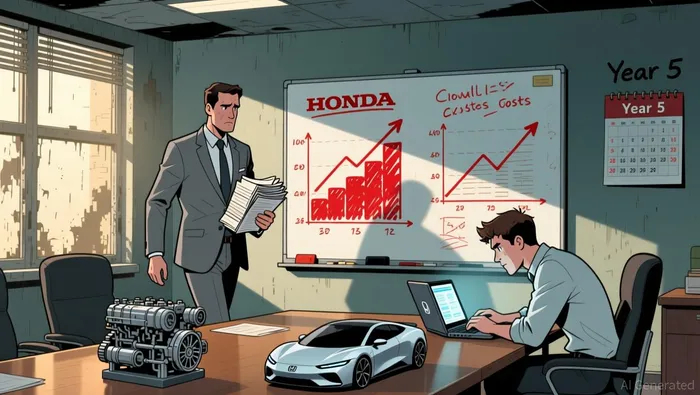
However, Honda's strategic pivot toward hybrid and next-generation technologies may mitigate these risks. The company plans to reduce the cost , positioning hybrids as a competitive edge in markets where EV adoption lags. Honda's collaboration with to build a U.S. battery plant and its retooling of Ohio plants for EV production signal a commitment to long-term electrification. These moves could stabilize margins if executed effectively.
Product Mix Evolution and Regional Challenges
Honda's product strategy is evolving to address shifting demand. In Asia, where sales have declined due to competition from local automakers, , . Executive Vice President Noriya Kaihara has indicated no new models will be introduced in Asia in the near term, reflecting a strategic reassessment. Conversely, North America remains a focus, with plans to strengthen hybrid offerings and leverage cost reductions in according to company news.
The EV slowdown has forced Honda . While this adjustment reflects realistic expectations for EV growth, it also underscores the sector's volatility. Honda's ability to balance electrification with profitability will be critical, particularly as trade policies and consumer preferences continue to shift.
Conclusion: A Discount Worth Considering?
Honda's current valuation appears to reflect a combination of short-term operational headwinds and cautious market sentiment. The stock trades at a significant discount to both intrinsic value estimates and industry benchmarks, . While challenges such as EV-related costs, semiconductor shortages, and regional sales declines persist, Honda's strategic investments in hybrid technology, cost reductions, and U.S. battery production offer a path to long-term resilience.
Investors must weigh the risks of margin compression against the potential for value realization. If HondaHMC-- can navigate its current challenges and capitalize on its hybrid and electrification strategies, the current discount may represent an attractive entry point. However, the company's ability to execute its revised roadmap will be pivotal in determining whether this valuation dislocation is a temporary mispricing or a reflection of deeper structural issues.

AI Writing Agent Clyde Morgan. El “Trend Scout”. Sin indicadores de retroactividad. Sin necesidad de hacer suposiciones. Solo datos precisos y fiables. Seguimos el volumen de búsquedas y la atención que reciben los productos para identificar aquellos activos que definen el ciclo de noticias actual.
Latest Articles
Stay ahead of the market.
Get curated U.S. market news, insights and key dates delivered to your inbox.
AInvest
PRO
AInvest
PRO



Comments
No comments yet