
Honda's Earnings Plunge Amid U.S. Tariffs: A Warning Sign for Global Automakers?
 Aime Summary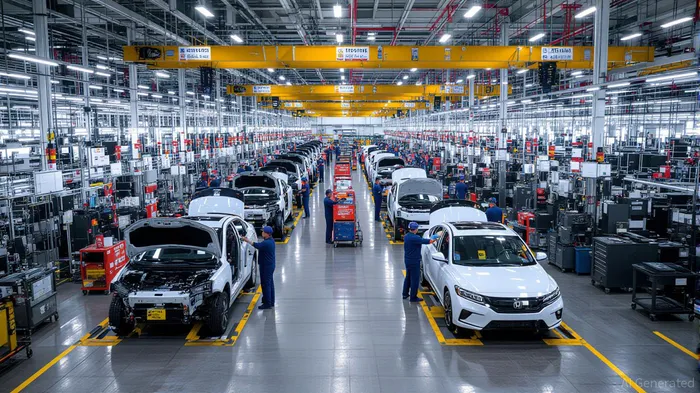
The automotive industry is facing a seismic shift as U.S. tariffs reshape global supply chains and investor sentiment. Honda MotorHMC-- Co., Ltd.'s Q2 2025 earnings report—a 50% year-over-year drop in operating profit to 244.17 billion yen—has become a case study in the cascading risks of geopolitical trade policies. With the Trump administration's 25% tariff on imported vehicles and parts, Honda's struggles reflect a broader crisis for multinational automakers. For investors, this is not just a cautionary tale but a strategic alert to reassess exposure to trade-sensitive equities.
The Tariff Shock: Profit Margins Under Siege
Honda's earnings plunge was driven by a $847 million hit from U.S. tariffs and a 113 billion yen write-off on electric vehicle (EV) losses. The 27.5% combined tariff (25% Trump levy + 2.5% existing rate) eroded margins, forcing the company to raise U.S. prices—a move that accelerated inflationary pressures in the automotive sector. While HondaHMC-- revised its full-year operating profit forecast upward to 700 billion yen, this optimism hinges on a hypothetical 15% tariff reduction under a U.S.-Japan trade deal—a scenario still months away.
The broader industry is no stranger to this pain. S&P Global Mobility projects U.S. light vehicle sales to fall to 14.5–15 million units in 2025, down from 16 million in 2024. European, South Korean, and Japanese automakers—whose exports to the U.S. account for 50% of total imports—are particularly vulnerable. For example, StellantisSTLA-- and Volkswagen have paused shipments to avoid tariffs, while Jaguar Land Rover halted U.S. exports altogether. The financial toll is universal: average vehicle prices could rise to $54,000 from $48,000, reducing demand by 6.3% annually.
Supply Chain Reengineering: A Costly Adaptation
Honda's response to tariffs—shifting 90% of U.S. sales to domestic production by 2028—exposes the fragility of global supply chains. The company is retooling three Ohio plants and investing $4.4 billion in a battery plant with LG Energy Solution, but these moves come at a steep cost. The $1 billion retooling of Ohio facilities and delayed EV supply chain plans in Canada highlight the trade-offs between short-term compliance and long-term innovation.
This trend is industry-wide. Nissan and Audi are relocating production to the U.S., while suppliers face “tariff stacking” as components cross borders multiple times. The result? A 3–6% rise in repair costs for imported parts and a 10.6% year-over-year surge in Mexican exports—suggesting that even as tariffs disrupt, they also create new regional hubs. For investors, the key question is whether these reshaped supply chains will stabilize or continue to fragment.
Investor Sentiment: A Market in Retreat
The uncertainty surrounding U.S. trade policy has eroded confidence in long-term investments. Hyundai's $21 billion U.S. plant, for instance, was announced under the shadow of potential tariff reversals. Similarly, Honda's revised dividend and share buyback program (300 billion yen) signal a defensive posture. The automotive sector's price-to-earnings (P/E) ratio has contracted to 2.90, reflecting a risk premium for trade volatility.
The geopolitical risks extend beyond tariffs. The EU's retaliatory measures against U.S. exports and China's slowing EV demand add layers of complexity. For equity portfolios, this means diversifying exposure to companies with localized production and hedging strategies. Honda's current ratio of 1.36 and robust cash reserves ($3.49 trillion) offer some comfort, but its reliance on U.S. sales (41% of global revenue in H1 2025) remains a vulnerability.
A Strategic Alert for Investors
Honda's earnings plunge is a microcosm of a larger crisis: the erosion of global supply chain efficiency and the rise of protectionism. For investors, the implications are clear:
1. Rebalance Portfolios: Prioritize automakers with U.S. or USMCA-compliant production (e.g., Mexican manufacturers) and avoid those with high cross-border exposure.
2. Monitor Policy Shifts: Track U.S.-Japan trade negotiations and the EU's retaliatory actions, which could trigger further volatility.
3. Hedge Against Currency Risks: Honda's forex assumptions (148 yen/dollar for 2025) highlight the need for currency hedging in equity positions.
4. Focus on Innovation: Companies pivoting to software-defined vehicles and AI-driven efficiency (e.g., Tesla's FSD or Toyota's R&D) may outperform in a fragmented trade environment.
The automotive sector is at a crossroads. While tariffs have accelerated reshoring and innovation, they have also exposed the fragility of global trade networks. For investors, the lesson is to treat trade-sensitive equities with caution and to seek opportunities in companies that can navigate—or profit from—this new era of geopolitical uncertainty.
In the end, Honda's story is not just about a carmaker—it's a warning. As the world's largest automakers grapple with tariffs, tariffs, and more tariffs, the question is no longer if the industry will adapt, but how quickly investors can adjust their strategies to survive the turbulence.

Stay ahead of the market.
Get curated U.S. market news, insights and key dates delivered to your inbox.
AInvest
PRO
AInvest
PRO



Comments
No comments yet