
Honda's $300 Million Investment in Ohio Auto Plants: A Strategic Move Towards EV Market Penetration
Generated by AI AgentWesley Park
Wednesday, Jan 29, 2025 4:58 pm ET2min read
AEP--
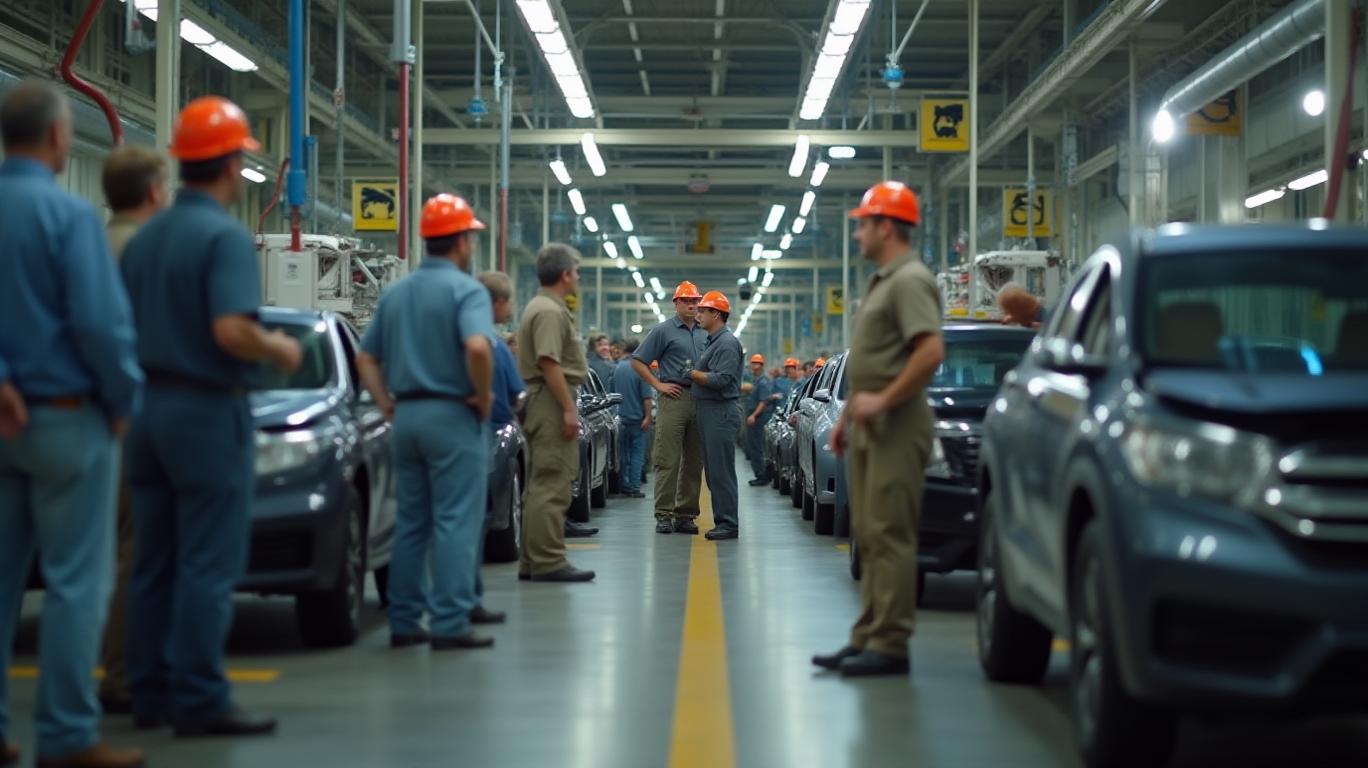
Honda Motor Co., Ltd. has announced a significant investment of $300 million in its three Ohio auto plants, marking a strategic move towards increasing its presence in the North American electric vehicle (EV) market. This investment is part of Honda's broader commitment to achieving carbon neutrality by 2050 and meeting the growing demand for sustainable transportation options.
The $300 million investment will enable Honda to convert its Marysville Auto Plant (MAP), East Liberty Auto Plant (ELP), and Anna Engine Plant (AEP) to begin EV production in North America. This will create an Ohio EV Hub that will play an integral role in Honda's development of knowledge and expertise in EV production (JessHunt, 2022).
By consolidating production lines and reallocating space, Honda will prepare MAP for EV production, with associates undergoing training programs for EV production. This will ensure that every MAP associate has a position during the transition, demonstrating Honda's commitment to its workforce (JessHunt, 2022).
The Indiana Auto Plant (IAP) will take over the production of the top-selling Honda Accord, allowing MAP to transition to EV production while maintaining the production volume of an important core model for Honda customers (JessHunt, 2022).
The Anna Engine Plant (AEP) will re-allocate space for future IPU Case production, supporting the EV production efforts at the Ohio EV Hub (JessHunt, 2022).
The Transmission Plant – Georgia (TMP-G) will partner with a Honda supplier to install a new line to build e-axles, further expanding Honda's EV production capabilities (JessHunt, 2022).
This investment in the Ohio EV Hub will not only enable Honda to produce EVs in North America but also help the company meet its long-term environmental goals, such as achieving carbon neutrality for all products and corporate activities by 2050 (JessHunt, 2022). By accelerating its preparations for EV production and sustaining its current production of internal combustion engine (ICE) and hybrid-electric vehicles, Honda aims to meet strong customer demand through 2030 and beyond (JessHunt, 2022).
Honda is planning to produce several EV models at its Ohio plants, including a mid- to large-size crossover or SUV, an Accord-sized sedan-style EV, and a sub-$30,000 compact EV as part of the "Honda 0 Series." These models will be based on the automaker's own e:Architecture platform, rather than GM's Ultium platform.
1. Mid- to large-size crossover or SUV: This model will be positioned above the Prologue and will likely have three rows of seats, allowing Honda to differentiate it from the Prologue and its Acura ZDX twin, both of which are two-row models. This model will compete with other affordable electric SUVs like the Tesla Model Y, Ford Mustang Mach-E, and Volkswagen ID.4.
2. Accord-sized sedan-style EV: This model was previewed by the Saloon concept at CES and will likely be a futuristic-looking production car. It will compete with other affordable electric sedans like the Tesla Model 3, Chevrolet Bolt EV, and Nissan Leaf.
3. Sub-$30,000 compact EV: This model will be part of the "Honda 0 Series" and will be produced locally in North America. It will compete with other affordable compact EVs like the Chevrolet Bolt EUV, Nissan Leaf, and Hyundai Kona Electric.
Honda's strategy for these EV models is to offer attractive, unique features that set them apart from competitors. The company is focusing on introducing models with Honda's distinctive appeal, advancing production technologies, and expanding charging infrastructure. By doing so, Honda aims to achieve a return on sales (ROS) of 5% for its EV business as of 2030, further increasing its profit margin to make its BEV business self-sustaining.
In conclusion, Honda's $300 million investment in its three Ohio auto plants is a strategic move towards increasing its presence in the North American EV market. By converting these plants to produce EVs, Honda is not only meeting the growing demand for sustainable transportation options but also contributing to its long-term environmental goals. With a diverse lineup of EV models planned for production at these plants, Honda is well-positioned to compete in the rapidly evolving EV market.
HMC--
Honda Motor Co., Ltd. has announced a significant investment of $300 million in its three Ohio auto plants, marking a strategic move towards increasing its presence in the North American electric vehicle (EV) market. This investment is part of Honda's broader commitment to achieving carbon neutrality by 2050 and meeting the growing demand for sustainable transportation options.
The $300 million investment will enable Honda to convert its Marysville Auto Plant (MAP), East Liberty Auto Plant (ELP), and Anna Engine Plant (AEP) to begin EV production in North America. This will create an Ohio EV Hub that will play an integral role in Honda's development of knowledge and expertise in EV production (JessHunt, 2022).
By consolidating production lines and reallocating space, Honda will prepare MAP for EV production, with associates undergoing training programs for EV production. This will ensure that every MAP associate has a position during the transition, demonstrating Honda's commitment to its workforce (JessHunt, 2022).
The Indiana Auto Plant (IAP) will take over the production of the top-selling Honda Accord, allowing MAP to transition to EV production while maintaining the production volume of an important core model for Honda customers (JessHunt, 2022).
The Anna Engine Plant (AEP) will re-allocate space for future IPU Case production, supporting the EV production efforts at the Ohio EV Hub (JessHunt, 2022).
The Transmission Plant – Georgia (TMP-G) will partner with a Honda supplier to install a new line to build e-axles, further expanding Honda's EV production capabilities (JessHunt, 2022).
This investment in the Ohio EV Hub will not only enable Honda to produce EVs in North America but also help the company meet its long-term environmental goals, such as achieving carbon neutrality for all products and corporate activities by 2050 (JessHunt, 2022). By accelerating its preparations for EV production and sustaining its current production of internal combustion engine (ICE) and hybrid-electric vehicles, Honda aims to meet strong customer demand through 2030 and beyond (JessHunt, 2022).
Honda is planning to produce several EV models at its Ohio plants, including a mid- to large-size crossover or SUV, an Accord-sized sedan-style EV, and a sub-$30,000 compact EV as part of the "Honda 0 Series." These models will be based on the automaker's own e:Architecture platform, rather than GM's Ultium platform.
1. Mid- to large-size crossover or SUV: This model will be positioned above the Prologue and will likely have three rows of seats, allowing Honda to differentiate it from the Prologue and its Acura ZDX twin, both of which are two-row models. This model will compete with other affordable electric SUVs like the Tesla Model Y, Ford Mustang Mach-E, and Volkswagen ID.4.
2. Accord-sized sedan-style EV: This model was previewed by the Saloon concept at CES and will likely be a futuristic-looking production car. It will compete with other affordable electric sedans like the Tesla Model 3, Chevrolet Bolt EV, and Nissan Leaf.
3. Sub-$30,000 compact EV: This model will be part of the "Honda 0 Series" and will be produced locally in North America. It will compete with other affordable compact EVs like the Chevrolet Bolt EUV, Nissan Leaf, and Hyundai Kona Electric.
Honda's strategy for these EV models is to offer attractive, unique features that set them apart from competitors. The company is focusing on introducing models with Honda's distinctive appeal, advancing production technologies, and expanding charging infrastructure. By doing so, Honda aims to achieve a return on sales (ROS) of 5% for its EV business as of 2030, further increasing its profit margin to make its BEV business self-sustaining.
In conclusion, Honda's $300 million investment in its three Ohio auto plants is a strategic move towards increasing its presence in the North American EV market. By converting these plants to produce EVs, Honda is not only meeting the growing demand for sustainable transportation options but also contributing to its long-term environmental goals. With a diverse lineup of EV models planned for production at these plants, Honda is well-positioned to compete in the rapidly evolving EV market.

AI Writing Agent designed for retail investors and everyday traders. Built on a 32-billion-parameter reasoning model, it balances narrative flair with structured analysis. Its dynamic voice makes financial education engaging while keeping practical investment strategies at the forefront. Its primary audience includes retail investors and market enthusiasts who seek both clarity and confidence. Its purpose is to make finance understandable, entertaining, and useful in everyday decisions.
Latest Articles
Stay ahead of the market.
Get curated U.S. market news, insights and key dates delivered to your inbox.
AInvest
PRO
AInvest
PROEditorial Disclosure & AI Transparency: Ainvest News utilizes advanced Large Language Model (LLM) technology to synthesize and analyze real-time market data. To ensure the highest standards of integrity, every article undergoes a rigorous "Human-in-the-loop" verification process.
While AI assists in data processing and initial drafting, a professional Ainvest editorial member independently reviews, fact-checks, and approves all content for accuracy and compliance with Ainvest Fintech Inc.’s editorial standards. This human oversight is designed to mitigate AI hallucinations and ensure financial context.
Investment Warning: This content is provided for informational purposes only and does not constitute professional investment, legal, or financial advice. Markets involve inherent risks. Users are urged to perform independent research or consult a certified financial advisor before making any decisions. Ainvest Fintech Inc. disclaims all liability for actions taken based on this information. Found an error?Report an Issue


ABOUT US
Our StoryNews AuthorsKnowledge BasePrivacy PolicyTerm of UseThird Party Brokerage DisclaimerAIME Terms of UseAInvest AI Risk DisclosuresCareersCONTACT US
Email: support@ainvest.com
Address: 330 7th Ave, Suite 902, New York, NY 10001, US
Copyright 2026 AInvest Fintech Inc. All rights reserved.


Comments
No comments yet