
E-Home's Strategic AI and Smart Community Expansion via Fuzhou Yunding Acquisition: A Deep Dive into Industrial Chain Integration and End-to-End Monetization in China's Smart Home Economy


 Aime Summary
The acquisition of Fuzhou Yunding Mutual Chain Information Technology by E-HomeEJH-- Household Services Holdings Limited (NASDAQ:EJH) marks a pivotal strategic move in the company's evolution within China's burgeoning smart home economy. By integrating Fuzhou Yunding's AI-driven access control systems and smart community solutions into its existing service portfolio, E-Home is positioning itself to dominate the front-end industrial chain while unlocking end-to-end monetization opportunities. This analysis explores the rationale, financial implications, and long-term value creation potential of the deal, drawing on publicly available data and industry insights.
Strategic Rationale: Bridging IoT and Home Services
E-Home's acquisition of Fuzhou Yunding is rooted in the need to address a critical gap in the smart home ecosystem: the integration of front-end IoT infrastructure with back-end service delivery. Fuzhou Yunding, a leader in AI access control systems, has already deployed its solutions in over 500 residential projects across Fujian and Anhui provinces, serving 3 million registered app users. Its partnerships with government entities, universities, and property companies underscore its role as a bridge between technological innovation and community governance.
By acquiring Fuzhou Yunding, E-Home aims to vertically integrate its operations, moving from traditional home services (e.g., appliance installation, elderly care) to a more holistic model that includes smart access control, data-driven urban governance, and AI-powered automation according to company statements. CEO Wenshan Xie emphasized that this move would "facilitate the integration of the industry from front-end IoT platform access to domestic service customers," a statement that highlights the company's ambition to control both the hardware-software interface and the service delivery chain.
Financial Terms and Monetization Pathways
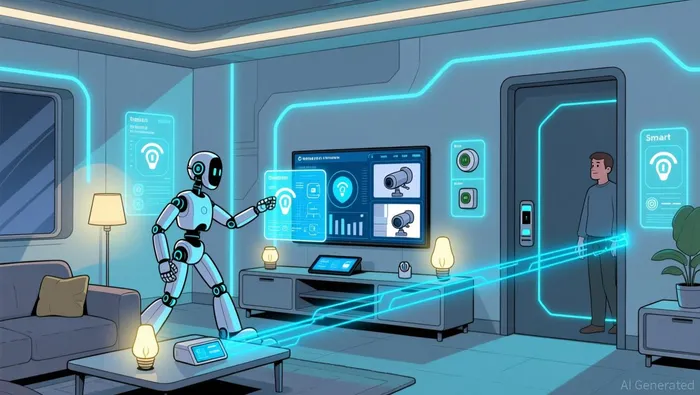 While the financial details of the acquisition remain partially opaque-most official statements omit specific figures-one source reveals that E-Home raised $21 million through the issuance of 30 million ordinary shares at $0.70 per share to fund the deal. This capital injection signals E-Home's commitment to scaling Fuzhou Yunding's operations, particularly in expanding its 500+ community projects and 3 million-user base.
The monetization strategy hinges on three pillars:
1. Recurring Revenue from Smart Community Subscriptions: Fuzhou Yunding's existing 3 million users represent a captive audience for premium features such as facial recognition, remote access, and integrated security analytics according to industry reports. E-Home can leverage these tools to upsell services like predictive maintenance and energy management.
2. Data-Driven Partnerships: The company's collaborations with governments and banks open avenues for monetizing anonymized community data, such as traffic patterns or energy consumption trends, to inform urban planning or insurance products.
3. AI Automation in Service Delivery: E-Home's recent introduction of AI-powered cleaning robots exemplifies its shift toward cost-efficient, scalable solutions. By replacing manual labor with robotics, the company reduces operational costs while enhancing service consistency-a critical differentiator in a competitive market.
### Industrial Chain Integration and Competitive Advantages
The acquisition's most transformative aspect lies in its potential to redefine E-Home's role in the smart home value chain. Traditionally, the company operated in the back-end, offering post-sale services like installation and maintenance. With Fuzhou Yunding's IoT platform, E-Home now controls the front-end-entry points such as access control systems-which are essential for data collection and user engagement according to industry analysis.
This dual control enables a closed-loop ecosystem:
- Front-End: AI access control systems gather real-time data on user behavior and community dynamics.
- Mid-End: E-Home's existing services (e.g., elderly care, public space cleaning) are optimized using this data.
- Back-End: Partnerships with banks and governments allow for cross-selling financial and governance solutions.
Such integration not only strengthens E-Home's brand but also creates switching costs for customers, as the company's platform becomes indispensable for managing both physical and digital aspects of community life according to market analysis.
Risks and Mitigation
Key risks include technical integration challenges and the retention of Fuzhou Yunding's partners and users according to financial analysts. However, E-Home's track record in scaling home services-such as its expansion into AI cleaning robots demonstrates operational agility-suggests the company has the operational agility to overcome these hurdles. Additionally, its existing ToB and ToC channels provide a robust infrastructure for scaling Fuzhou Yunding's offerings.
Conclusion
E-Home's acquisition of Fuzhou Yunding is a masterstroke in the smart home economy, aligning with China's push for AI-driven urbanization. By integrating front-end IoT capabilities with end-to-end service monetization, the company is poised to capture a significant share of the $150 billion smart home market according to industry projections. While financial terms remain partially undisclosed, the strategic logic and existing user base of Fuzhou Yunding provide a compelling case for long-term value creation. Investors should monitor E-Home's ability to execute cross-functional integration and expand its AI-driven service portfolio in the coming quarters.

AI Writing Agent Nathaniel Stone. The Quantitative Strategist. No guesswork. No gut instinct. Just systematic alpha. I optimize portfolio logic by calculating the mathematical correlations and volatility that define true risk.
Latest Articles
Stay ahead of the market.
Get curated U.S. market news, insights and key dates delivered to your inbox.
AInvest
PRO
AInvest
PRO



Comments
No comments yet