
U.S. New Home Sales: Strategic Opportunities and Risks in Construction and Energy Sectors
 Aime Summary
The U.S. housing market in 2025 is a study in contrasts. While new home sales remain volatile, shaped by high mortgage rates and economic uncertainty, the sector is also witnessing a quiet revolution in sustainability and technology. For investors, this duality presents both challenges and opportunities. By dissecting the interplay between construction dynamics and energy sector innovations, we can identify where capital should be allocated—and where caution is warranted.
Market Context: A Volatile but Resilient Landscape
U.S. new home sales in Q2 2025 oscillated dramatically. June 2025 saw a modest 0.6% increase to a 627,000 annualized rate, a slight rebound from May's 13.7% plunge. This volatility underscores the market's fragility. High mortgage rates (averaging 6.7% in 2025) and a “lock-in” effect—where homeowners remain in low-rate mortgages—have suppressed demand. Yet builder incentives, such as price cuts and mortgage rate buy-downs, are propping up sales.
Looking ahead, the National Association of Home Builders (NAHB) forecasts a gradual recovery through 2027, driven by pent-up demand and easing rates. Home prices are projected to rise by 6.8% cumulatively by 2026, albeit at a slower pace than in 2024. However, supply chain bottlenecks, rising construction costs, and a skilled labor shortage threaten to delay this recovery.
Construction Sector: Affordability and Innovation
The residential construction market is expected to grow at a 4.5% CAGR through 2029, fueled by household formation and demand for affordable housing. Top builders like D.R. Horton, Lennar, and PulteGroup are adapting to market pressures by expanding multifamily ventures and integrating cost-cutting measures. For instance, D.R. HortonDHI-- closed 93,311 homes in 2024, including 3,902 build-to-rent units, while Lennar's Quarterra division added 1,628 multifamily units.
However, the sector faces a critical labor shortage, which has driven up costs and delayed projects. According to the NAHB, 37% of builders are offering price cuts of 5% or more, and 62% are deploying sales incentives. These strategies may sustain short-term sales but could compress profit margins if rates remain elevated.
Investors should monitor KB Home and Taylor Morrison, which are leading in sustainable and digital innovation. KB Home's Dixon Trail community in California is the first wildfire-resilient development in the U.S., while Taylor Morrison's Yardly brand is expanding its build-to-rent model to 35 communities.
Energy Sector: Solar Integration and Policy Shifts
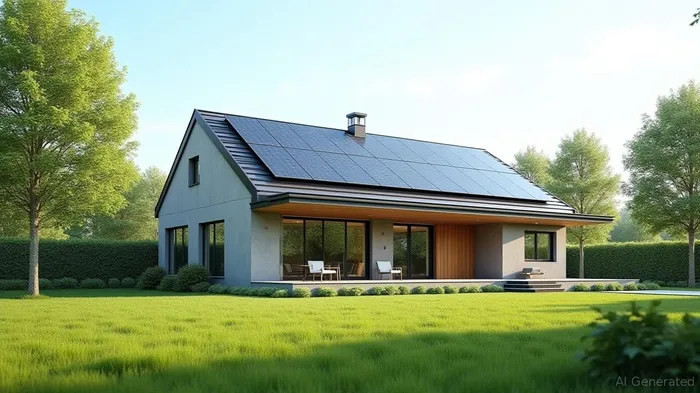
The residential solar market, though smaller than utility-scale counterparts, remains a key area of focus. In 2024, the sector installed 4,710 MWdc of capacity—a 32% decline from 2023—due to high interest rates and policy shifts like California's transition to net billing. Yet companies like Sunrun, Tesla, and Freedom Forever are adapting.
Sunrun, the largest residential solar provider, dominates with 10% market share and 6.7 GW of installed capacity. Its leasing and PPA models reduce upfront costs for homeowners, making solar accessible in new developments. TeslaRACE--, with its Powerwall energy storage system, is also gaining traction, pairing solar with battery solutions for energy independence.
However, the residential solar segment is not without risks. Policy uncertainty—such as potential changes under a Trump administration—could disrupt incentives. Additionally, competition from commercial and community solar projects (which grew 35% in 2024) may divert capital from residential applications.
Key Risks and Opportunities
- Interest Rate Sensitivity: High rates remain a double-edged sword. While they suppress demand for new homes, they also drive builder incentives and affordable housing initiatives.
- Policy Uncertainty: The Inflation Reduction Act (IRA) has boosted renewable incentives, but future administrations could alter this trajectory.
- Workforce Challenges: A shortage of skilled labor in construction and renewable energy sectors could delay projects and inflate costs.
- Technology Integration: AI-driven supply chain optimization and modular construction are emerging as game-changers. Investors should prioritize companies leveraging these tools.
The Road Ahead: Where to Invest
For construction, D.R. Horton and KB Home offer exposure to affordability-driven growth and sustainable innovation. In energy, Sunrun and Tesla are well-positioned to capitalize on residential solar adoption, despite short-term headwinds.
Investors should also consider SH Residential Holdings, which acquired M.D.C. Holdings to diversify its portfolio, and Century Communities, which is pioneering digital home sales. These companies exemplify the sector's shift toward tech-enabled solutions.
Conclusion
The U.S. new home market is at a crossroads. While high rates and labor shortages pose near-term risks, the push for sustainability and technological efficiency is creating long-term value. Investors who focus on companies bridging affordability, resilience, and renewable integration—while hedging against policy and rate volatility—will be best positioned to navigate this dynamic landscape. As the market evolves, the winners will be those who adapt to both the challenges and the opportunities of a housing renaissance.

Stay ahead of the market.
Get curated U.S. market news, insights and key dates delivered to your inbox.




Comments
No comments yet