
U.S. New Home Sales Outperform Expectations: Navigating Construction and REIT Opportunities in a Shifting Market
 Aime Summary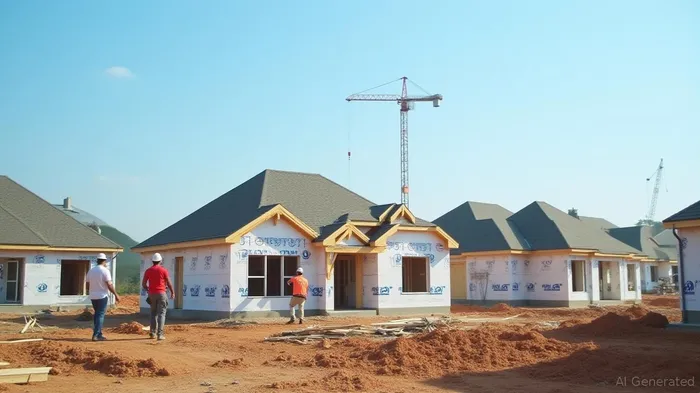
The U.S. housing market has defied expectations in July 2025, with new home sales hitting a seasonally adjusted annual rate of 652,000—a 0.6% dip from June but a 5.9% drop from July 2024. While this suggests a broader slowdown, regional pockets like Central Indiana continue to thrive, offering a stark contrast to the national trend. For investors, this divergence raises critical questions: Should capital flow into construction and engineering firms navigating a fragmented market, or into diversifiedDHC-- REITs grappling with a housing slump?
The Construction Sector: Regional Resilience Amid National Headwinds
Central Indiana's housing market has emerged as a bright spot in an otherwise muted landscape. In 2024, the region issued 10,044 single-family building permits—a 26% surge from 2023—and early 2025 data shows continued momentum. Median home prices in Indianapolis remain 42% below the national average, while job growth of 9.3% since 2019 has fueled demand. This resilience is not accidental: affordability, limited inventory, and a strong labor market have created a self-sustaining cycle of construction activity.
However, national construction firms face a more challenging environment. Elevated mortgage rates (6.5% in Indiana, 6.7% nationally), rising material costs, and labor shortages are constraining growth. For example, KB HomeKBH-- (KHC) and DR Horton (DHI) have slashed build cycles and increased incentives to offset softer demand. The National Association of Home Builders' Housing Market Index hit a 10-year low in May 2025, reflecting builders' pessimism.
Investors in construction firms must weigh regional opportunities against national risks. Firms with a strong presence in high-growth areas like Central Indiana may outperform, but those reliant on national markets could face margin compression. Strategic land acquisition and cost discipline will be critical.
Diversified REITs: A Mixed Bag in a Slowing Housing Market
Diversified REITs have underperformed in Q2 2025, with the Dow Jones US Select REIT Index down 1.7%. The housing slowdown has hit residential and industrial REITs hardest, as falling home prices and weak rental growth erode NOI. For instance, residential REITs like Equity ResidentialEQR-- (EQR) and Industrial LogisticsILPT-- REIT (PLD) have seen occupancy rates stagnate amid high interest rates and affordability crises.
Yet, not all REITs are created equal. Sectors like data centers and infrastructure have shown resilience. The demand for AI-driven computing power has pushed data center REITs like Digital RealtyDLR-- (DLR) to premium valuations, while infrastructure REITs benefit from long-term secular trends. Healthcare REITs, too, remain defensive plays, as demographic shifts and regulatory tailwinds support stable cash flows.
The key for investors lies in sector selectivity. Defensive REITs with high-quality assets and strong balance sheets—such as Federal Realty Investment TrustFRT-- (FRT) and Kilroy RealtyKRC-- (KRC)—are better positioned to weather volatility. Conversely, cyclical REITs tied to housing and industrial demand may require a longer-term horizon.
Strategic Implications for Investors
The U.S. housing market is in transition. While national new home sales remain subdued, regional disparities highlight the importance of localized fundamentals. For construction firms, the path forward hinges on adapting to a fragmented market: prioritizing high-growth regions, optimizing costs, and leveraging technology to mitigate labor shortages.
Diversified REITs, meanwhile, offer a mix of risk and reward. Investors should focus on sub-sectors insulated from housing cycles—such as data centers, healthcare, and self-storage—while avoiding overexposure to residential and industrial assets. The Federal Reserve's potential rate cuts later in 2025 could provide a tailwind, but the timing remains uncertain.
Conclusion
The July 2025 new home sales data underscores a market at a crossroads. Construction firms must navigate a landscape of regional strength and national moderation, while REITs face a bifurcated outlook. For investors, the lesson is clear: diversification and sector-specific insights will be paramount. Those who can identify undervalued construction plays in resilient markets and allocate capital to defensive REITs may find themselves well-positioned as the housing market evolves.
In a world of shifting dynamics, the winners will be those who look beyond the headlines and dig into the data—just as the market itself is doing.

Stay ahead of the market.
Get curated U.S. market news, insights and key dates delivered to your inbox.
AInvest
PRO
AInvest
PRO



Comments
No comments yet