
Home Depot's $5.5 Billion Acquisition of GMS: A Strategic Play for Supply Chain Supremacy and Long-Term Growth


 Aime Summary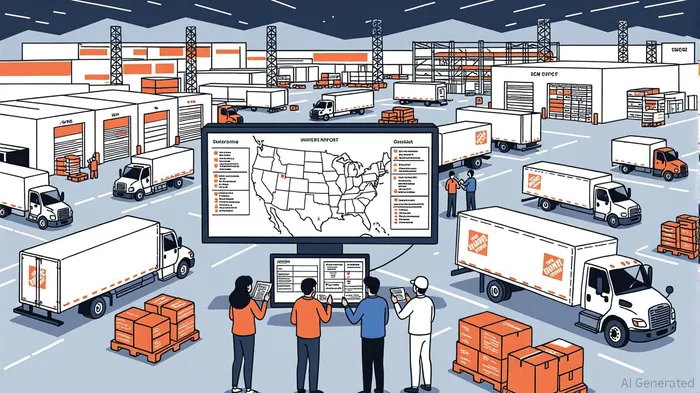
The home improvement retail sector is undergoing a seismic shift, driven by the consolidation of logistics networks and the redefinition of supply chain efficiency. , a leading distributor of specialty building materials. This move, , is not merely a transaction—it is a calculated step toward reshaping the competitive landscape for professional contractors (Pros) and redefining the economics of home improvement retail. For investors, the implications are profound: a sector once fragmented and reactive is now being restructured into a model of vertical integration, , and .
Strategic Consolidation: From Fragmentation to Dominance
Home Depot's acquisition of GMS builds on its 2024 purchase of SRS Distribution Inc., . This consolidation is a direct response to the growing demand from Pros for end-to-end solutions. GMS's expertise in drywall, ceilings, and steel framing complements SRS's strengths in roofing and exterior materials, enabling Home DepotHD-- to offer a “one-stop shop” for complex construction projects. The combined entity now serves 40,000+ professional customers, with the ability to deliver same-day or next-day fulfillment—a critical differentiator in a market where time is money.
This strategic move reflects a broader industry trend: the shift from transactional retail to integrated service platforms. By consolidating distribution networks, Home Depot is reducing coordination costs and creating cross-selling synergies. For example, a contractor sourcing drywall from GMS can now seamlessly access SRS's roofing materials or Home Depot's digital project management tools. This ecosystem approach not only enhances customer retention but also deepens Home Depot's “,” a metric that has historically lagged behind its consumer-focused peers.
Supply Chain Efficiency: The New Competitive Edge
The acquisition's most compelling value lies in its impact on supply chain efficiency. By merging GMS's localized distribution centers with SRS's national logistics infrastructure, . This is particularly impactful in high-growth markets like the U.S. SouthwestLUV-- and Canada, where GMS's presence fills gaps in SRS's footprint.
Moreover, the integration of GMS with SRS's digital systems is a game-changer. Pros can now manage projects through a unified platform with real-time inventory tracking, click-and-collect services, and omnichannel fulfillment. This digital transformation is not just about convenience—it's about solving a critical pain point: the need for reliable, timely access to materials across the entire project lifecycle. For investors, this translates to a durable . As one analyst noted, “Home Depot is turning into a profit center, not a cost center.”
Competitive Responses and Market Dynamics
The acquisition has already prompted a strong reaction from rivals. Lowe's, for instance, . These moves aim to counter Home Depot's Pro-centric expansion by targeting interior finishes and construction materials. However, Lowe's approach—while ambitious—differs in execution. While Home Depot is building a vertically integrated logistics network, Lowe's is focusing on high-margin, fragmented markets like cabinetry and flooring.
This divergence highlights a key insight: the home improvement sector is no longer a race to the bottom on pricing. Instead, it's a battle for and customer intimacy. Home Depot's ability to combine scale with digital innovation gives it a unique edge. For example, its 35% control of North American home improvement logistics capacity—post-acquisition—enables faster inventory turnover and reduced transportation costs. In contrast, Lowe's faces integration challenges with FBM, which operates 370 distribution centers but lacks the same level of digital integration.
Financial Implications and Investor Outlook
From a financial perspective, the GMS acquisition is a high-conviction bet on long-term growth. , fueled by cost savings and cross-selling. These metrics are critical for investors seeking in a sector historically prone to volatility.
However, risks remain. Rising material costs, labor shortages, and could pressure margins. Yet, . The company is also leveraging and route planning to mitigate these headwinds.
Conclusion: A Sector Reimagined
Home Depot's acquisition of GMS is more than a strategic win—it's a catalyst for industry-wide change. By redefining supply chain efficiency and Pro services, the company is setting a new standard for value creation in home improvement retail. For investors, this represents an opportunity to capitalize on a sector that is evolving from a commodity-driven market to a platform-driven ecosystem.
The question is no longer whether consolidation will continue, but how quickly it will accelerate. As Home Depot and Lowe's vie for dominance, the winner will be the one that best balances scale with agility. In this race, Home Depot's GMS acquisition is a bold first step—and a compelling case for why investors should reassess the sector's long-term trajectory.

Delivering real-time insights and analysis on emerging financial trends and market movements.
Latest Articles
Stay ahead of the market.
Get curated U.S. market news, insights and key dates delivered to your inbox.
AInvest
PRO
AInvest
PRO



Comments
No comments yet