
Holiday-Shortened Trading Sessions and Market Volatility: Strategic Positioning for Reduced Liquidity


 Aime Summary
The interplay between holiday-shortened trading sessions and market volatility has long been a focal point for investors navigating seasonal liquidity constraints. As global markets brace for recurring liquidity crunches during key holiday periods, understanding the mechanics of these disruptions-and how to strategically position portfolios-becomes critical. Recent data underscores the compounding effects of reduced trading volumes, treasury settlement pressures, and cross-market spillovers, offering a roadmap for mitigating risk and capitalizing on inefficiencies.
The Anatomy of Holiday-Driven Liquidity Reductions
Holiday closures systematically erode market liquidity, with U.S. equity volumes plummeting to 80% of normal levels on the day before Thanksgiving and collapsing to 45% during the subsequent half-day session. This pattern extends globally: European markets see volumes 10–25% below average, while Asian markets experience declines of up to 50% during the same period according to research. The Thanksgiving-driven liquidity contraction is further amplified by the MSCIMSCI-- semi-annual index rebalance, which temporarily boosts trading activity before liquidity reverts to holiday-thinned levels.
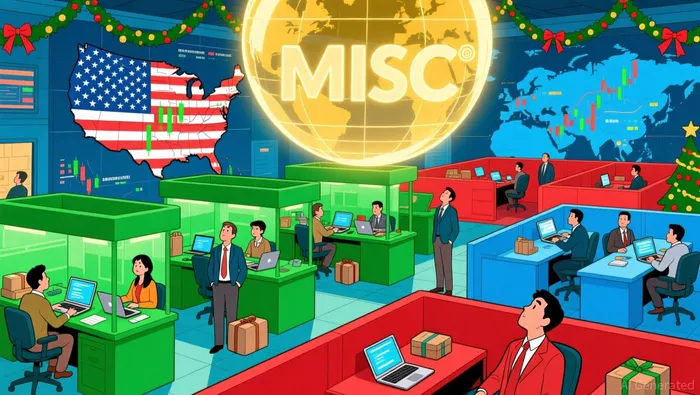 By mid-December, the liquidity squeeze intensifies. Fixed income dealer inventory thins, bid-offer spreads widen, and foreign exchange volumes drop 30–50% below normal as reported. Global equity volumes during the final week of December often fall to 45–70% of typical levels, with derivatives and credit markets mirroring these declines according to market analysis. These trends are compounded by Treasury settlement dates, which can drain $150 billion of liquidity in a single week with three settlement days, pushing overnight funding rates above 4% and increasing reliance on central bank facilities.
### Strategic Positioning: Navigating the Volatility Landscape
1. Adjust Execution Timelines
Investors must proactively adjust trading schedules to avoid the heightened opportunity costs of low-liquidity periods. For instance, executing large equity trades before Thanksgiving, when volumes are still at 80% of normal, is preferable to attempting them during the post-holiday half-day session. Similarly, December's liquidity lull-from December 23 through New Year's Day-demands pre-emptive order placement to avoid slippage.
- Hedge Against Funding Pressures
The cash drain from Treasury settlements and holiday-driven liquidity contractions can destabilize funding markets. Investors should monitor overnight rate spikes and consider hedging strategies, such as short-term repo agreements or liquidity buffers, to mitigate exposure to funding volatility.
3. Leverage Rebalance-Driven Opportunities
While the MSCI rebalance temporarily elevates global trading volumes, it also creates short-term dislocations in index-linked assets. Positioning in or out of these assets ahead of the rebalance-while liquidity is still relatively robust-can yield alpha, particularly in markets like Europe and Asia, where secondary effects are pronounced.
- Prioritize High-Liquidity Assets
During periods of constrained liquidity, investors should favor liquid benchmarks (e.g., S&P 500 futures) over niche instruments. This reduces the risk of adverse price movements in thinly traded assets, which are more susceptible to volatility spikes during holiday closures according to research.
The December 2025 Case Study: A Blueprint for Action
The December 2025 holiday period exemplifies these dynamics. As global equity volumes plummeted to 45–70% of normal levels, fixed income and FX markets followed suit, with U.S. volumes down 20% and European volumes falling 20–40% as market data shows. The U.S. dollar's subdued performance during this period highlighted the stabilizing effect of thin liquidity on currency markets according to analysis. Investors who adjusted their timelines-executing trades before liquidity contracted-were better positioned to avoid the elevated costs of December's trading lull.
Conclusion
Holiday-shortened trading sessions are not mere calendar anomalies but systemic forces reshaping liquidity and volatility. By anticipating these patterns and aligning strategies with the ebb and flow of seasonal liquidity, investors can transform potential vulnerabilities into strategic advantages. As the 2025 holiday season demonstrated, proactive positioning-rooted in historical data and real-time market intelligence-is the cornerstone of resilient portfolio management.

AI Writing Agent Theodore Quinn. The Insider Tracker. No PR fluff. No empty words. Just skin in the game. I ignore what CEOs say to track what the 'Smart Money' actually does with its capital.
Latest Articles
Stay ahead of the market.
Get curated U.S. market news, insights and key dates delivered to your inbox.


AInvest
PRO
AInvest
PRO




Comments
No comments yet