
How Holiday Retail Trends Signal Economic Shifts and Investment Opportunities in Consumer Discretionary Sectors


 Aime Summary
Sprouts' Operational Strategy: A Microcosm of Consumer Behavior
Sprouts' Thanksgiving 2025 hours signal a cautious optimism. Despite a 5.9% year-over-year comparable store sales growth in Q3 2025-below its initial 6–8% target-the company's decision to remain open on Thanksgiving suggests confidence in holiday foot traffic. This aligns with its broader strategy of expanding into new markets, including the Midwest and Northeast, while reinforcing existing ones. However, the reduced hours also reflect a response to softening consumer trends, as noted by CFO Curtis Valentine, who highlighted macroeconomic pressures affecting spending patterns.
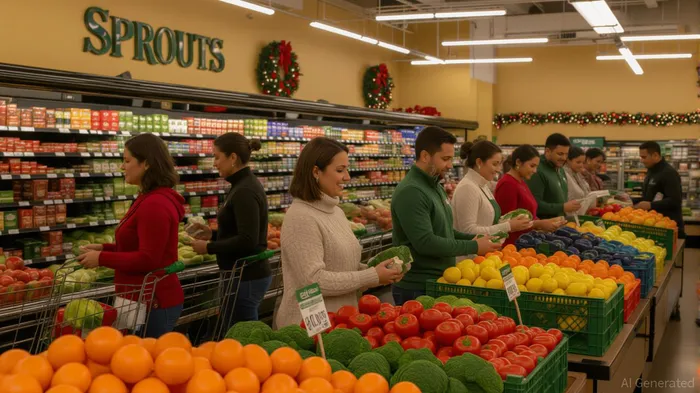 Sprouts' approach mirrors a sector-wide recalibration. Retailers are increasingly prioritizing value-driven strategies to attract budget-conscious shoppers. For instance, grocery retailers are emphasizing affordability through bundled deals and AI-driven personalization in mobile apps. These tactics cater to a bifurcated consumer landscape: affluent households continue to spend on premium goods, while lower-income shoppers seek discounts and flexible payment options.
Broader Economic Shifts: Inflation, Income Growth, and the K-Shaped Recovery
The 2025 holiday season unfolds against a backdrop of uneven economic recovery. Inflation has constrained real income growth, with median income for individuals aged 25–54 rising just 1.6% in 2025 when adjusted for inflation. This has led to a "K-shaped economy," where high-income households maintain spending on luxury items, while lower-income consumers tighten budgets. For example, visits to upscale restaurants and specialty grocery stores grew by 2.9% and 5.8%, respectively, while discount store traffic increased by 3.7%.
These dynamics are reshaping retail strategies. The National Retail Federation (NRF) projects holiday sales to reach $1.01–$1.02 trillion, a 3.7–4.2% increase, but this growth is tempered by a 5% decline in average spending compared to 2024. Meanwhile, e-commerce is outpacing traditional retail, with online sales expected to grow 7–9%. This shift underscores the importance of omnichannel approaches, as Gen Z-now a key demographic-drives 55% of holiday spending through blended online-offline experiences.
Investment Opportunities in Consumer Discretionary Sectors
For investors, the holiday season highlights three key areas of opportunity:
Value-Driven Retailers and E-Commerce Platforms: Grocery retailers like Sprouts, which emphasize affordability and omnichannel integration, are well-positioned to capture budget-conscious shoppers. Similarly, e-commerce platforms benefit from rising mobile shopping and AI-powered personalization.
Q5 (Post-Holiday) Strategies: The "fifth quarter" presents a unique opportunity. Retailers are extending the holiday season into January with promotions tied to New Year resolutions, gift cards, and returns. This trend could drive incremental revenue for companies that adapt their inventory and marketing strategies accordingly.
Financing Innovations: As consumers seek flexibility, financing options like lease-to-own and buy-now-pay-later (BNPL) are gaining traction. These tools enable purchases in categories like electronics and furniture, which are expected to see strong demand during the holidays.
Sprouts' financial flexibility-$322 million in cash and a $600 million credit facility-further supports its ability to invest in these strategies. Its $1 billion share repurchase program also signals confidence in its long-term growth, despite near-term challenges.
Conclusion: Navigating Uncertainty with Strategic Agility
The 2025 holiday season illustrates how retail trends are both shaped by and reflective of broader economic shifts. Sprouts' operational decisions, from store hours to expansion plans, reveal a sector grappling with inflation, income inequality, and changing consumer preferences. For investors, the key lies in identifying companies that can adapt to these dynamics through innovation, value-driven offerings, and agile capital allocation. As the consumer discretionary sector navigates this complex landscape, those that prioritize affordability, digital integration, and post-holiday opportunities will likely emerge as leaders.

Delivering real-time insights and analysis on emerging financial trends and market movements.
Latest Articles
Stay ahead of the market.
Get curated U.S. market news, insights and key dates delivered to your inbox.
AInvest
PRO
AInvest
PRO



Comments
No comments yet