
Holiday Retail Resilience: Can Grocery Retailers Like ShopRite Sustain Earnings Amid Shifting Consumer Behavior?


 Aime Summary
Consumer Behavior: A Bifurcated Landscape
The 2025 holiday season has been defined by a stark divide in consumer priorities. Affluent shoppers, insulated from inflationary pressures, are splurging on premium goods and experiences, while lower-income households are tightening budgets, favoring off-brand products and early promotions. According to a report by Deloitte, 76% of retailers now believe price sensitivity will outweigh brand loyalty, a shift that has accelerated the rise of discount retailers and omnichannel strategies. Meanwhile, 75% of shoppers participated in October and November promotions in 2025, a jump from 61% in 2023, as they sought to secure deals before anticipated price hikes tied to tariffs.
This bifurcation is evident in ShopRite's Thanksgiving 2025 operations. While some stores in New Jersey and Pennsylvania remained open 24 hours, others closed entirely, reflecting localized demand for extended hours among time-constrained shoppers. The company's "Free Turkey or Ham" promotion-offering a premium item to customers spending $400 with a Price Plus® club card-catered to both segments: affluent shoppers seeking convenience and budget-conscious households leveraging bulk purchases to stretch holiday budgets according to ShopRite's promotional materials.
Operational Efficiency: Flexibility as a Strategic Asset
ShopRite's decentralized model, where individual store managers set holiday hours, has proven to be a double-edged sword. While it complicates national coordination, it also allows rapid adaptation to local demand. For instance, stores in urban areas like East Orange and Rochelle Park operated 24 hours on Thanksgiving Day, while suburban locations in Medford and Netcong closed entirely. This flexibility aligns with broader retail trends: 70% of consumers in 2025 expected higher prices, prompting retailers to optimize staffing and inventory to avoid overstocking or labor shortages.
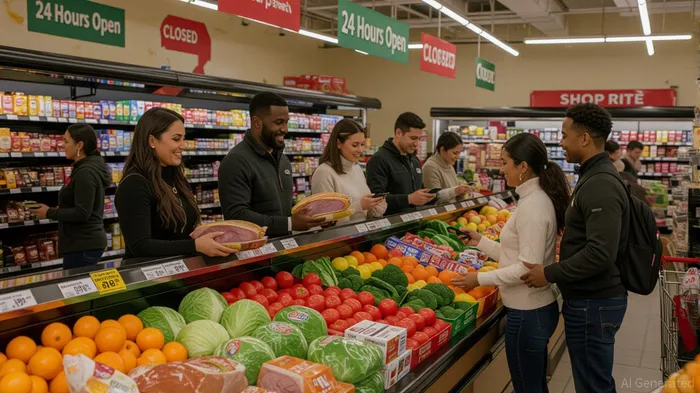
The company also extended pre-holiday hours for pickup and delivery, operating from 6 a.m. to midnight on November 24–26, a move that capitalized on the 56.1% of online sales driven by mobile commerce according to Commercial Observer data. By leveraging its digital infrastructure, ShopRite mitigated the risk of lost sales from in-store closures while catering to tech-savvy shoppers prioritizing convenience.
Financial Performance: Growth Amid Caution
Despite a cautious macroeconomic environment, ShopRite reported robust financial results in 2025. Total revenue rose 8.9% year-over-year to R252.7 billion, with trading profit increasing 16.6% to R15.0 billion. The company's Supermarkets RSA division, which accounts for 83.7% of sales, saw a 10.4% revenue increase, driven by a 4.1% rise in customer visits and a 6.1% boost in average transaction value. These figures suggest that ShopRite's focus on affordability-such as its Paperbird Blue private-label products-resonated with price-sensitive consumers without alienating higher-spending customers.
During the 2025 holiday season, ShopRite's earnings surged 15.8% year-over-year, fueled by strong demand for its Thanksgiving promotions and extended service hours. This performance contrasts with broader retail forecasts, which predict a modest 2.9–3.4% holiday sales growth, highlighting the company's ability to outperform peers through targeted operational adjustments.
Analyst Perspectives: Sustainability and Risks
Retail analysts have highlighted both strengths and vulnerabilities in ShopRite's strategy. On the positive side, the company's investment in a new POS system and two major distribution centers has enhanced transaction speed and supply chain resilience. Additionally, its sustainability initiatives-such as a 7.2% shift to renewable energy and 92.6% reusable/recyclable packaging-align with growing consumer demand for environmentally responsible practices.
However, challenges remain. The National Retail Federation notes that 34% of shoppers planned to spend less than $100 during the 2025 holidays, up from 32% in 2024, signaling continued pressure on discretionary spending. For ShopRite, this could limit the effectiveness of premium promotions like its free turkey offer unless paired with complementary discounts on staples.
Conclusion: A Model for Resilience?
ShopRite's 2025 holiday performance demonstrates that grocery retailers can sustain earnings amid shifting consumer behavior by embracing operational flexibility, omnichannel innovation, and value-driven promotions. Its ability to balance localized store hours with national promotional campaigns, while investing in sustainability and digital infrastructure, positions it as a case study in retail resilience. Yet, as economic uncertainties persist, the company's long-term success will depend on its capacity to further refine its strategies to address the diverging needs of its customer base.
For investors, the key takeaway is clear: retailers that prioritize agility and affordability-without sacrificing quality or convenience-will be best positioned to weather the volatile retail landscape of the 2020s.

Delivering real-time insights and analysis on emerging financial trends and market movements.
Latest Articles
Stay ahead of the market.
Get curated U.S. market news, insights and key dates delivered to your inbox.


AInvest
PRO
AInvest
PRO



Comments
No comments yet