
The Holiday Playbook: How Predictable Demand and ESG Alignment Power Retail Resilience


 Aime Summary
The holiday season has long been a litmus test for retail resilience, separating the well-prepared from the unprepared. For investors, the key lies in identifying companies that not only thrive during these peak periods but also embed operational consistency and ESG (Environmental, Social, and Governance) alignment into their DNA. Chick-fil-A, though private, offers a masterclass in this regard, and its playbook-when applied to publicly traded peers-reveals undervalued investment themes that could redefine long-term returns.
Predictible Demand: The Chick-fil-A Model
Chick-fil-A's holiday sales performance underscores the power of predictable demand. In 2024, the chain
reported systemwide sales of $22.746 billion, with average unit volumes (AUVs) for freestanding drive-thrus hitting $9.227 million. This consistency is no accident. The brand's operational rigor-think three-day block scheduling, drone-based traffic analysis, and
a 98% overall satisfaction score-ensures it can scale efficiently during high-traffic periods. For instance, its "Elevated Drive Thru" concept
reduced wait times while maintaining food safety standards, a critical factor in retaining customers during the chaotic holiday rush.
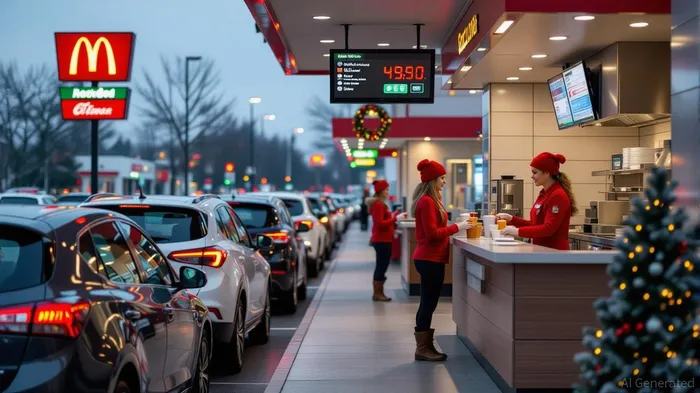
Publicly traded chains like McDonald'sMCD-- and StarbucksSBUX-- are now racing to replicate this model. McDonald's, for example,
leveraged its $5 Meal Deal to drive consistent holiday traffic in 2024, even amid a short-term dip in same-store sales following an E. coli outbreak. Starbucks, meanwhile,
has invested in labor and store redesigns to restore its customer experience, aligning with its "craft and connection" ethos. These moves highlight a broader trend: operational resilience isn't just about surviving the holidays-it's about turning them into a competitive moat.
ESG as a Profitability Catalyst
Chick-fil-A's ESG initiatives further illustrate how sustainability and social responsibility can drive long-term value. In 2024, the chain
diverted 19 million pounds of food waste and recycled used cooking oil into renewable diesel at 85% of its locations. Its Shared Table program alone
created 9.9 million meals from surplus food donations, addressing food insecurity while enhancing brand loyalty. These efforts aren't just feel-good stories-they're strategic investments in operational efficiency and community trust.
For publicly traded peers, the correlation between ESG and stock resilience is becoming harder to ignore. While
direct data on Chick-fil-A's stock performance is unavailable, academic studies show that companies with robust ESG practices tend to outperform during economic volatility
according to research. McDonald's, for instance,
has committed $100 million to address public health concerns, a move that likely mitigated reputational damage and stabilized investor confidence. Similarly, Walmart's collaboration with Chick-fil-A on food waste reduction-part of the U.S. Food Waste Pact
according to industry reports-demonstrates how cross-industry ESG partnerships can create scalable impact.
The Investment Thesis: Undervalued Resilience
The market often underappreciates the interplay between operational resilience and ESG alignment. Chick-fil-A's success during the holidays-driven by predictable demand and a culture of community engagement-provides a blueprint for publicly traded retailers. Consider Taco Bell, which
reported strong 2024 same-store sales growth. Or Starbucks, which
is tying executive compensation to ESG metrics. These companies are not just chasing ESG trends; they're embedding them into their operational frameworks, a strategy that could insulate them from market shocks.
For investors, the lesson is clear: prioritize companies that treat ESG as a core competency, not a compliance checkbox. Chick-fil-A's ability to balance holiday demand with sustainability-while
maintaining a 93% friendliness rating-proves that operational excellence and ethical practices are not mutually exclusive. As regulatory scrutiny intensifies
according to industry analysis), firms that align with these principles will likely see stronger investor support and stock resilience.
Conclusion
The holidays are more than a sales event-they're a stress test for retail operations. Chick-fil-A's playbook, characterized by predictable demand, technological innovation, and ESG-driven community engagement, offers a roadmap for publicly traded peers. While the market may not yet fully price in the long-term value of these strategies, forward-looking investors who recognize the link between operational resilience and ESG alignment are poised to capitalize on undervalued opportunities. In an era of economic uncertainty, the brands that thrive will be those that treat every holiday as a chance to build a better, more sustainable business.

Stay ahead of the market.
Get curated U.S. market news, insights and key dates delivered to your inbox.




Comments
No comments yet