
Holiday Market Schedules and Investor Behavior: How Reduced Trading Volumes Around Thanksgiving and Black Friday Impact Short-Term Volatility and Liquidity


 Aime Summary
Market Closures and Adjusted Hours: A Structural Overview
The U.S. stock market closes entirely on Thanksgiving Day, which fell on Thursday, November 27, 2025, for both the New York Stock Exchange (NYSE) and NASDAQ according to NYSE hours. Trading resumes the following day, Black Friday, but with shortened hours: markets open at 9:30 a.m. Eastern Time (ET) and close at 1:00 p.m. ET as reported by Economic Times. This pattern is consistent with historical precedents and reflects a broader effort to accommodate reduced liquidity during the holiday week according to Bloomberg. The U.S. bond market follows a similar schedule, closing on Thanksgiving and ending early on Black Friday according to Economic Times.
Historical Trading Volume Trends and Their Implications
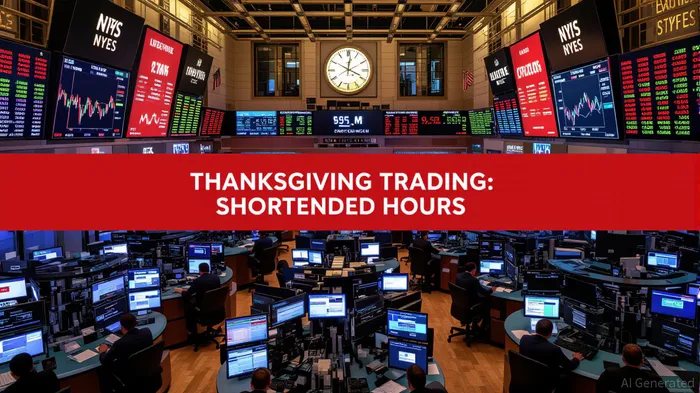
Historically, trading volumes during Thanksgiving and Black Friday are significantly lower than average. For instance, in 2022, the NYSE's average daily trading volume during Thanksgiving week was approximately 3 billion shares, compared to a monthly average of 3.9 billion shares according to Medium. Black Friday, in particular, sees a sharp decline, with volume often dropping 46% below the 30-day average as reported by Bloomberg. In 2019, Black Friday volume fell below one billion shares according to Bloomberg. While 2022 saw an anomaly with Black Friday volume being the highest in five years, the overall trend underscores the holiday week's role in thinning market participation according to Bloomberg.
The Volatility-Liquidity Nexus During Holiday Periods
Reduced trading volumes directly impact liquidity and volatility. With fewer shares exchanged, individual trades can disproportionately influence price movements. According to Bloomberg, Black Friday trading sessions often see liquidity drop to as low as 45% of normal levels, amplifying volatility in thinly traded securities. This dynamic is compounded by the early closure of markets, which limits the time available for price discovery and order execution as reported by Economic Times.
Expert commentary from Verified Investing highlights that institutional traders typically step away during this period, leaving retail investors to drive market direction. This shift can create short-term anomalies and momentum shifts, as retail-driven demand or panic may temporarily distort asset prices according to Verified Investing. For example, during the 2024-2025 holiday week, the Cboe Volatility Index (VIX) spiked to 27.8 on November 21, 2025, reflecting heightened uncertainty amid thin liquidity as reported by Fortune.
Empirical Evidence from 2024-2025: A Case Study
Recent data from the 2024-2025 holiday period illustrates these dynamics. The shortened trading week, combined with multiple Treasury settlement dates and coupon issuances, drained approximately $150 billion of liquidity from the market according to Investing.com. This liquidity drain coincided with elevated VIX levels, peaking at 27.8, as investors grappled with concerns over U.S. tech valuations and Federal Reserve policy according to Fortune. The NYSE's daily liquidity statistics further revealed distorted bid-ask spreads and order book depths during the holiday week, underscoring the fragility of market conditions according to NYSE data.
Strategic Considerations for Investors
For investors, the holiday period demands caution. Position sizing should be adjusted to account for potential volatility spikes, and liquidity constraints should be factored into execution strategies. Historical patterns, such as the "Thanksgiving Rally" where the S&P 500 has historically delivered modest gains, offer some guidance, but these trends are not immune to macroeconomic shocks. For instance, rising Japanese 10-Year Yields in late 2025 introduced bearish pressures that could override seasonal tendencies according to Verified Investing.
Conclusion
The interplay between holiday market schedules and investor behavior creates a unique microcosm of liquidity and volatility. While reduced trading volumes during Thanksgiving and Black Friday historically lead to thinner markets and amplified price swings, recent data from 2024-2025 reaffirms these patterns. Investors must remain vigilant, balancing historical insights with real-time macroeconomic signals to navigate this volatile period effectively.

Delivering real-time insights and analysis on emerging financial trends and market movements.
Latest Articles
Stay ahead of the market.
Get curated U.S. market news, insights and key dates delivered to your inbox.


AInvest
PRO
AInvest
PRO



Comments
No comments yet