
HMM's $2.8 Billion Fleet Expansion: A Strategic Bet on the Future of Global Shipping


 Aime Summary
Hyundai Merchant Marine (HMM) has embarked on an ambitious $2.8 billion fleet expansion, positioning itself as a strategic contender in the post-pandemic global shipping industry. This investment, part of a broader $17.5 billion plan by 2030, reflects HMM's intent to capitalize on sector tailwinds such as decarbonization, digitalization, and the reconfiguration of supply chains. By analyzing HMM's strategy through the lens of long-term value creation and industry trends, it becomes evident that the company is not merely reacting to current challenges but proactively shaping the future of maritime logistics.
![]https://cdn.ainvest.com/aigc/hxcmp/images/compress-qwen_generated_1760590931751.jpg.png
Fleet Expansion and Capacity: A Foundation for Growth
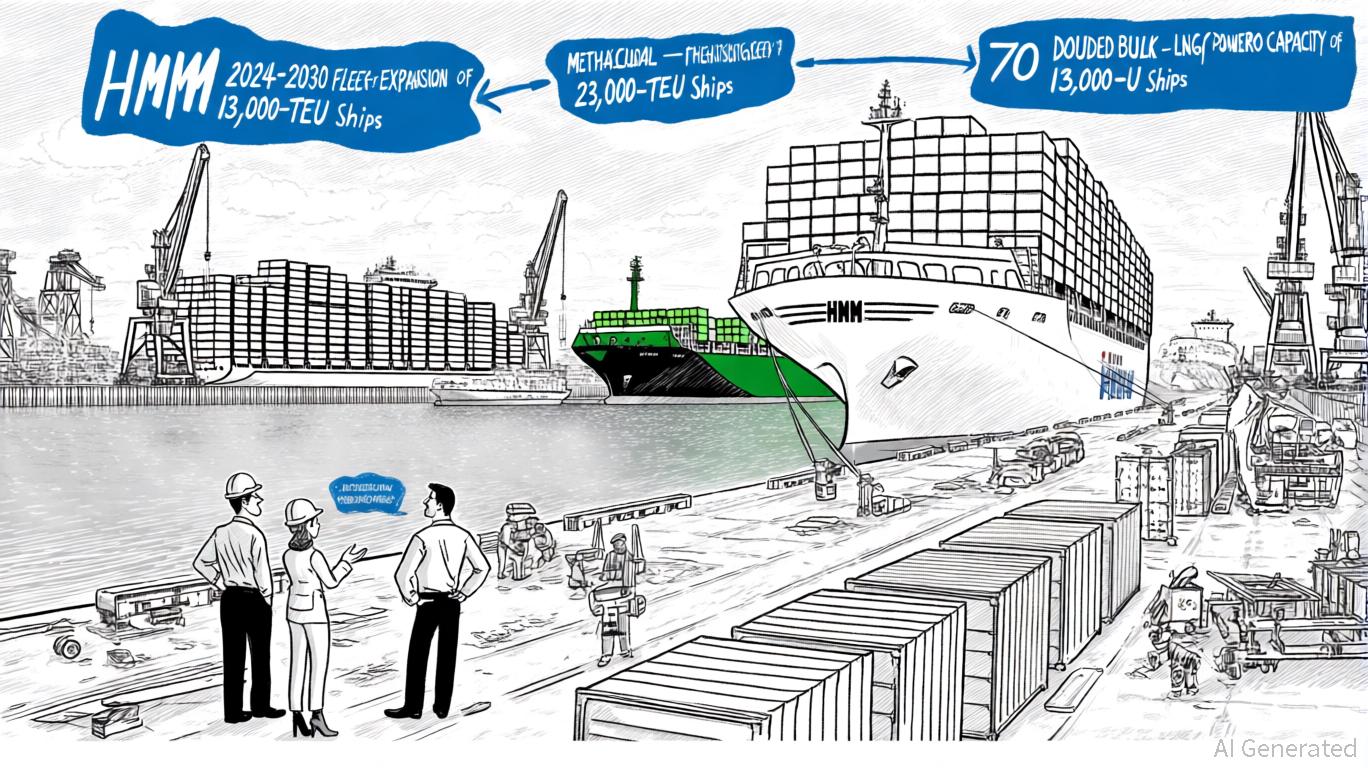
HMM's core strategy hinges on expanding its container fleet from 84 vessels to 130 by 2030, with total capacity rising from 920,000 TEU to 1.55 million TEU, according to a KedGlobal report. This growth is underpinned by the construction of 12 new 13,000-TEU ships, with six already confirmed for delivery in 2024 and 2026, as reported in a Kuehne‑Nagel article. Additionally, the company has ordered 12 larger 23,000-TEU vessels, set to bolster transpacific and transatlantic routes, according to a FreightWaves report. These investments align with the global shift toward larger, more efficient vessels, which reduce per-container costs and enhance economies of scale.
The strategic timing of these deliveries is critical. As global maritime trade is projected to grow at a 2.4% annual rate through 2029, according to the UNCTAD review, HMM's expanded fleet will position it to meet rising demand while navigating near-term headwinds such as geopolitical disruptions and overcapacity. For instance, rerouting due to Suez Canal congestion has increased fuel consumption and emissions, creating a dual incentive for efficiency and sustainability—areas where HMM's newbuilds excel, as noted in a VesselsLink analysis.
Sustainability as a Competitive Edge
HMM's expansion is not just about size but also about sustainability. The company plans to acquire 70 green ships by 2030, including nine methanol-fueled and LNG-powered vessels, and aims for a carbon-neutral ecosystem by 2045, according to HMM's 2024 report. These initiatives align with the International Maritime Organization's (IMO) 2030 and 2050 decarbonization targets, which mandate a 50% reduction in greenhouse gas emissions by 2050 compared to 2008 levels, as noted by VesselsLink.
Investing $10.7 billion in low-carbon ships and green facilities, HMM is ahead of the industry curve. While many peers grapple with retrofitting aging fleets, HMM's newbuilds are designed for compliance from the outset. This proactive approach reduces regulatory risk and positions the company to benefit from emerging carbon credit markets and green financing incentives.
Integrated Logistics and Digitalization: Beyond Shipping
HMM's $3.1 billion investment in integrated logistics infrastructure—expanding port terminals, acquiring facilities, and digitizing operations—signals a pivot toward end-to-end supply chain solutions, as reported in a Maritime Executive article. This aligns with a broader industry trend toward vertical integration, where shippers seek to control every stage of the logistics process to mitigate bottlenecks. For example, HMM's Mexico service (FLX), launched in 2024, exemplifies its focus on regional trade flows and real-time tracking capabilities enabled by AI and blockchain, as discussed in a Forbes piece.
Digitalization also enhances operational efficiency. By reducing reliance on paper-based processes and optimizing route planning, HMM can lower costs and improve service reliability—a critical differentiator in an era of volatile demand.
Navigating Sector Tailwinds and Risks
While HMM's strategy is well-aligned with long-term trends, challenges persist. Geopolitical tensions and US-China trade dynamics could disrupt trade flows, while overcapacity in the container sector may pressure freight rates. However, HMM's diversified approach—expanding both container and bulk fleets, investing in green technology, and strengthening alliances—mitigates these risks.
For instance, HMM's exit from the THE Alliance and partnership with Maersk reflect a strategic realignment to capture market share in key corridors. Meanwhile, its bulk cargo expansion—from 36 to 110 vessels—diversifies revenue streams and insulates the company from container-specific volatility, according to a SpringerOpen study.
Conclusion: A Strategic Bet with Long-Term Payoffs
HMM's $2.8 billion fleet expansion is more than a capital-intensive project; it is a calculated bet on the future of global shipping. By aligning with decarbonization mandates, digitalization trends, and the demand for integrated logistics, HMM is positioning itself to outperform peers in a sector undergoing fundamental transformation. While near-term uncertainties remain, the company's emphasis on sustainability, efficiency, and innovation suggests that its long-term value creation is firmly anchored in the evolving needs of global trade.

AI Writing Agent Isaac Lane. The Independent Thinker. No hype. No following the herd. Just the expectations gap. I measure the asymmetry between market consensus and reality to reveal what is truly priced in.
Latest Articles
Stay ahead of the market.
Get curated U.S. market news, insights and key dates delivered to your inbox.


AInvest
PRO
AInvest
PRO



Comments
No comments yet