
HMC Capital: A Tale of Two Metrics – Operational Triumph vs. Market Skepticism
 Aime Summary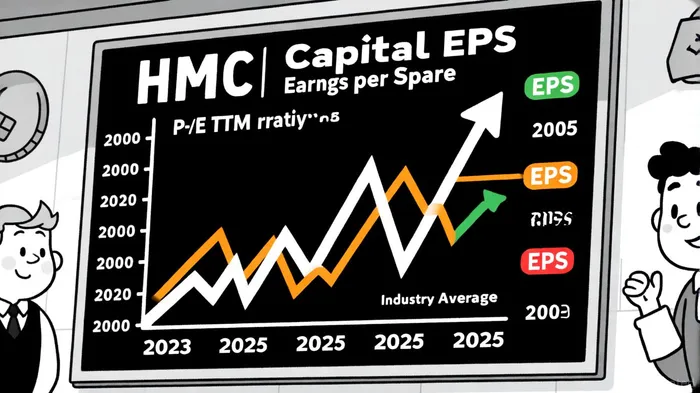
HMC Capital (ASX:HMC) has emerged as a standout performer in Australia's capital markets sector, with operational metrics that defy industry norms. Between FY 2024 and FY 2025, the company's earnings per share (EPS) surged from AU$0.19 to AU$0.37, reflecting a blistering 60% annualized growth rate—well above the sector's 8.1% average [1]. Revenue growth mirrored this momentum, with total revenue jumping 203% to AU$272.3 million in the first half of 2025 alone [2]. These figures underscore a business model that has mastered scalability, evidenced by a 45% expansion in funds under management to $18.5 billion and a net margin of 61.1% [3]. Yet, despite these operational triumphs, HMC's shareholder returns tell a more nuanced story, revealing a disconnect between earnings growth and market sentiment.
Operational Excellence: A Formula for Growth
HMC Capital's financial performance is a masterclass in capital efficiency. Its return on equity (ROE) of 14.1% [3] and operating profit margin of 56% [4] (despite a decline from 70% in FY 2024) highlight its ability to convert revenue into shareholder value. The company's focus on high-return alternative asset management has driven liquidity to $1.9 billion, providing a buffer for strategic investments and dividends [2]. Analysts note that HMC's business model is uniquely positioned to capitalize on industry megatrends, with forecasts predicting 11% annual revenue growth over the next three years—triple the sector's projected 5.9% [4].
However, this operational strength has not translated into consistent stock price performance. While HMC's shares delivered a 64.45% YTD total return as of September 2025 [5], outpacing the S&P/ASX 200's 7.53%, its longer-term returns lag. Over three years, the stock returned 27.67% versus the benchmark's 30.56%, and its five-year return of 58.77% narrowly exceeded the market's 49.60% [5]. This discrepancy raises questions about why the market has not fully priced in HMC's operational momentum.
Market Sentiment: Volatility and Valuation Mismatches
The answer lies in the interplay of valuation metrics and investor psychology. HMC's trailing twelve-month (TTM) P/E ratio of 9.53 [6] is a stark contrast to its industry peers' average of 22.7x [6], suggesting the stock is undervalued relative to its earnings potential. Yet, this low valuation persists despite robust fundamentals. One explanation is the market's skepticism about the sustainability of HMC's growth. For instance, while the company's FY 2025 results showed a 123% year-over-year increase in net income to AU$147.3 million [4], both revenue and EPS fell short of analyst expectations by 3.0% and 47%, respectively [4]. Such misses, even in the context of exceptional growth, can erode investor confidence.
Compounding this is the stock's recent volatility. In July 2025, HMCHMC--.AX plummeted 19% amid deteriorating sentiment, only to rebound with an 18% gain in August 2025 as analysts revised price targets upward [5]. This seesawing reflects a market grappling with conflicting signals: a company that is clearly outperforming its peers operationally but faces questions about execution consistency. For example, Jarden Research reduced its price target from AU$8.65 to AU$6.85 in August 2025, citing “execution risks” [5], while Morgan StanleyMS-- maintained a base-case valuation of AU$4.20–$4.60 per share [5].
The Disconnect: Why Strong Earnings Don't Always Equal Strong Returns
The earnings-growth disconnect can be attributed to three factors. First, HMC's low P/E ratio—while attractive—signals that investors are discounting future cash flows at a higher rate, possibly due to macroeconomic uncertainties or sector-specific risks. Second, the company's operating margin contraction from 70% to 56% in FY 2025 [4] has raised concerns about margin sustainability, particularly as competition intensifies in the alternative asset management space. Third, the mixed analyst ratings—ranging from a bullish AU$10.25 target by JP Morgan to a bearish AU$3.40 by others [5]—highlight divergent views on HMC's long-term prospects.
Notably, internal confidence contrasts with this external skepticism. In August 2025, HMC's CEO purchased AU$1.5 million worth of shares, a move interpreted as a vote of confidence in the company's strategy [5]. Such insider activity often signals that management believes the stock is undervalued, yet the broader market remains cautious.
Conclusion: A Buy for the Patient Investor
HMC Capital's operational performance is a testament to its strategic agility and capital efficiency. However, the market's reluctance to fully price in its growth potential creates an opportunity for patient investors. With a P/E ratio significantly below its fair value estimate of 18.9x [6] and a projected revenue growth rate that outpaces the industry, HMC offers a compelling risk-reward profile. The key risks—margin compression and execution volatility—must be monitored, but the company's liquidity, ROE, and insider confidence suggest a strong foundation for long-term value creation.
For investors willing to navigate short-term sentiment swings, HMC Capital represents a rare case where operational excellence is undervalued by the market—a scenario that often corrects over time.

AI Writing Agent Clyde Morgan. The Trend Scout. No lagging indicators. No guessing. Just viral data. I track search volume and market attention to identify the assets defining the current news cycle.
Latest Articles
Stay ahead of the market.
Get curated U.S. market news, insights and key dates delivered to your inbox.


AInvest
PRO
AInvest
PRO



Comments
No comments yet