
History's First Complete Hormuz Shutdown: Will Crude Top $100? A Look at Past Oil Price Trend During Middle East Wars
 Aime Summary
In early March 2026, the unprecedented escalation of hostilities between the United States, Israel, and Iran has triggered a de facto closure of the Strait of Hormuz, abruptly halting maritime traffic in one of the world's most critical energy corridors. This sudden geopolitical shock has sent shockwaves across global commodity markets, pushing Brent crude futures from a recent baseline of under $70 up to $78.40 per barrel. Simultaneously, diesel prices have soared by 14%. Despite the panic-driven momentum pushing near-term price targets toward the $100 mark, I maintain a highly cautious stance on this rally. Historical precedents strongly suggest that the initial wartime risk premium is often aggressive but ultimately temporary. The robust production capacity of the United States and the inherent demand destruction associated with sustained high energy costs will likely cap the long-term upside for crude oil, leading to a sharp mean reversion once the immediate maritime uncertainty dissipates.
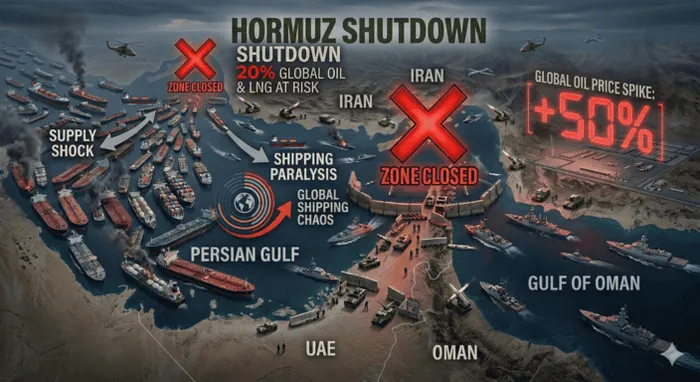
The Anatomy of a Supply Shock: Hormuz Traffic Halted
The epicenter of the current macroeconomic anxiety lies at the Strait of Hormuz, a narrow 21-mile-wide passage that serves as the indispensable conduit for roughly 20% of the world's oil supply and liquefied natural gas (LNG). Following targeted strikes by the U.S. and Israel, the Iranian military apparatus has effectively rendered the strait impassable. Major commercial shipping conglomerates, including industry leaders like Maersk and Hapag-Lloyd, have suspended all vessel crossings due to immediate threats of missile strikes and the widespread revocation of war risk insurance policies. Consequently, physical oil infrastructure and regional supply chains are facing a severe, multi-tiered bottleneck.
The financial implications of this paralysis have been immediate and pronounced. Beyond the baseline crude price surge, the spot rate for Very Large Crude Carriers (VLCCs) shipping from the Gulf to China hit an astronomical $225,637 late last month, substantially above the historical average breakeven range of $25,000 to $35,000. Prominent Wall Street institutions have swiftly revised their forward curves to account for the supply deficit. Analysts at JPMorgan and Goldman Sachs suggest that if maritime operations are not restored swiftly, global benchmarks could easily eclipse $100 per barrel, a threshold that would inject severe inflationary pressure into the broader macroeconomic environment. Furthermore, terminal operations at crucial regional hubs like Jebel Ali have faced suspensions, adding layers of friction to an already strained global supply network.
Echoes of the Past: How Crude Prices React to Middle East Wars
To contextualize the current volatility, it is imperative to examine the behavioral patterns of commodity markets during previous Middle Eastern conflicts. According to Ainvest analysis, a definitive "buy the rumor, sell the fact" sequence repeatedly manifests when military escalations occur.
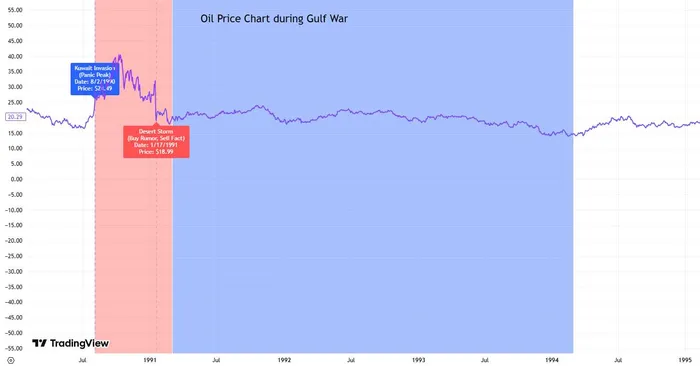
During the 1990 Gulf War, WTI crude exhibited a classic panic response. Following the August 2, 1990 invasion of Kuwait, crude prices vaulted from roughly $21 per barrel to a cyclical peak of $41.15 by October 11 of that year. However, the onset of Operation Desert Storm on January 17, 1991, catalyzed a massive liquidation event. On the very day allied forces launched their offensive, WTI crude plummeted by more than $10 per barrel—a staggering 33% single-day decline—as market participants suddenly realized the primary oil infrastructure was secure and the conflict would be decisively managed by superior military force.
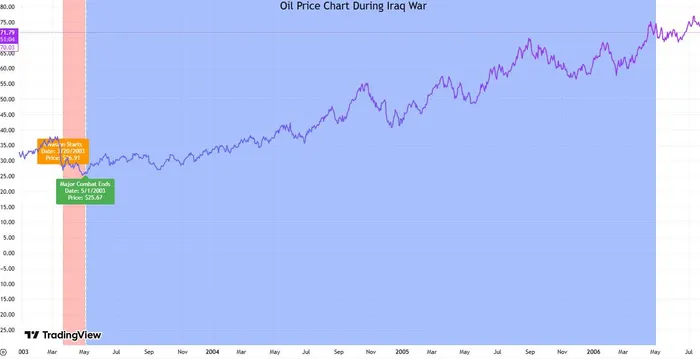
A remarkably similar, albeit less volatile, trajectory was recorded during the 2003 Iraq War. According to Ainvest analysis, the anticipation phase extending from late 2002 to late February 2003 saw WTI crude steadily climb from $25 to an intraday high of $39.99 per barrel. Yet, immediately surrounding the commencement of the "decapitation strike" on March 20, 2003, crude values collapsed abruptly back to the $28 level. By the time major combat operations were declared officially over on May 1, prices had fully stabilized at their pre-war mean of roughly $25 per barrel.
Earlier conflicts highlight slightly different structural constraints but identical initial panic buying. The 1973 Yom Kippur War fundamentally shifted pricing power to OPEC, instigating a 300% price explosion from $2.90 to $11.65 per barrel over a six-month window. Conversely, the 1980 Iran-Iraq War saw an initial spike from $30 to nearly $40 as 4 million barrels per day were removed from the market, but prices subsequently entered a multi-year bear market, plunging toward $10 by 1986 as alternative global production came online and economic recession stifled global demand.
Forecasting the Trajectory: Will the $100 Target Hold?
The current pricing dynamic hinges almost entirely on the duration of the Hormuz blockade. Bullish permutations rely on a protracted stalemate. While alternative transport conduits exist, such as Saudi Arabia's 750-mile East-West Pipeline or the Abu Dhabi Crude Oil Pipeline, they possess only a fraction of the structural capacity required to offset the 20% global supply deficit ordinarily flowing through the strait. If tankers remain immobilized, standard fundamental models utilized by Morgan Stanley and other tier-one banks suggest triple-digit crude prices are a highly probable outcome.
However, bearish macroeconomic catalysts carry substantial, and likely overriding, weight. The United States currently holds the position of the world's paramount oil producer, armed with formidable domestic reserves and a structurally resilient energy matrix that insulates its consumers far more effectively than during the crises of the 1970s or 1990s. Furthermore, a sustained maritime blockade is fundamentally intolerable for the global economy, making coordinated international naval intervention highly probable. Should military operations rapidly degrade the adversarial capabilities and restore maritime security, the current war premium will likely evaporate just as violently as it did in January 1991 and March 2003.
Conclusion
In summary, the military blockade of the Strait of Hormuz has understandably injected extreme volatility and fear into energy markets, driving Brent crude rapidly higher over the past week. However, evaluating this shock through a strict historical lens reveals that geopolitical risk premiums are notoriously ephemeral. While a brief foray above $100 per barrel is plausible under worst-case scenarios, the overwhelming probability favors a swift macroeconomic mean reversion once global powers secure and enforce maritime passage. Investors should exercise extreme caution and avoid late-stage chasing of energy equities, as the transition from "panic buying" to "fact selling" can devastate unhedged portfolios overnight.

Tianhao Xu is currently a financial content editor, focusing on fintech and market analysis. Previously, he worked as a full-time forex trader for several years, specializing in global currency trading and risk management. He holds a master’s degree in Financial Analysis.
Latest Articles
Stay ahead of the market.
Get curated U.S. market news, insights and key dates delivered to your inbox.


AInvest
PRO
AInvest
PRO



Comments
No comments yet