
Historically Rare: Musk Rewrites the IPO Playbook With SpaceX’s 30% Retail Allocation
Elon Musk is systematically orchestrating a structural shift in equity capital markets. As of late March 2026, SpaceX is reportedly in discussions to allocate up to 30% of its initial public offering to individual retail investors. This proposed quota dramatically exceeds the standard 5% to 10% retail slice traditionally observed in Wall Street debuts. With a projected company valuation potentially reaching $1.75 trillion, this capitalization event is positioned to become one of the most heavily scrutinized IPOs in market history. From an analytical perspective, this structural shift is fundamentally positive for capital democratization but introduces complex short-term liquidity dynamics. This development is not merely a technical financing arrangement; it represents a profound evolution in issuance logic, wherein a founder is actively dictating the shareholder base rather than ceding placement control to institutional underwriters.
Mechanism Breakdown and Strategic Bank Allocations
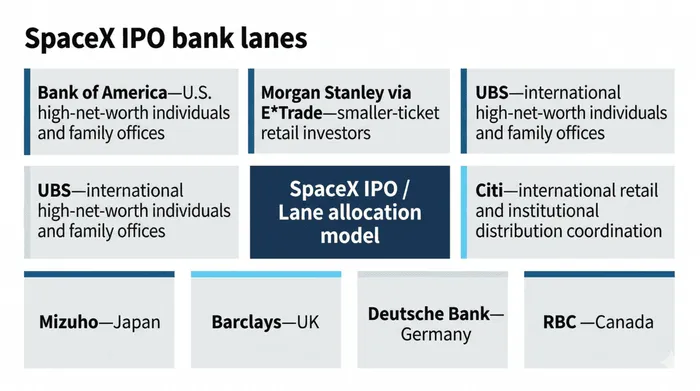
The execution of this IPO mechanism fundamentally alters the traditional role of investment banks. Rather than allowing banks to compete broadly for institutional order books across the entire deal, SpaceX is implementing a strict "lane" structure. Financial institutions are assigned narrowly defined distribution mandates based on specific relationship networks and geographic expertise.
- Bank of America has been exclusively handpicked to manage domestic high-net-worth individuals and family offices within the United States.
- Morgan Stanley is expected to manage smaller-ticket retail investor flows, heavily leveraging its retail-facing E*Trade platform.
- UBS is tasked with targeting international high-net-worth individuals and family offices.
- Citi is acting as the primary coordinator for broader international retail and institutional distribution.
- Regional distribution lanes have been distinctly allocated, with Mizuho covering Japan, Barclays handling the United Kingdom, Deutsche Bank managing Germany, and the Royal Bank of Canada overseeing the Canadian market.
According to Ainvest analysis, as visualized in the structural breakdown below, this framework treats tier-one investment banks as targeted distribution channels rather than traditional market-making underwriters. By executing this model, SpaceX directly engineers its own capitalization table.
The Strategic Rationale Behind the Structure
Understanding why Musk is pushing for this unorthodox distribution model requires analyzing his historical interaction with public equity markets. This specific allocation strategy operates on three distinct operational layers.
The primary objective is to stabilize post-IPO equity pricing. By heavily weighting the allocation toward loyal, long-term retail believers and wealthy family offices, SpaceX aims to mitigate the influence of institutional capital that typically chases Day 1 "pop-and-dump" trading yields.
Furthermore, the strategy centralizes narrative control. Musk has a proven track record of utilizing capital markets as organic brand extension tools; the operational histories of both TeslaTSLA-- and Starlink validate his specific methodology that treats investors as users, and users as primary brand evangelists.
Ultimately, this distribution framework structurally weakens traditional Wall Street pricing power. By taking an active, granular role in retail placement design, the power to determine the final company ownership shifts away from underwriter syndicate desks back to the founder. For Musk, this initial public offering is not strictly a capital-raising mechanism; it functions as a definitive shareholder screening process and a broad mobilization of public market sentiment.
Contextualizing the $1.75 Trillion Valuation
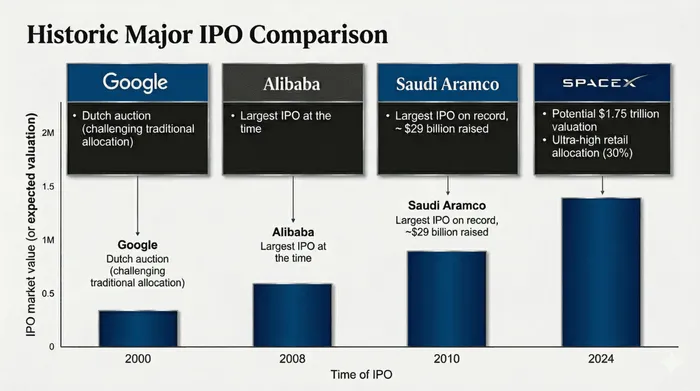
To accurately assess the magnitude of the proposed $1.75 trillion valuation, we must measure it against landmark historical market precedents. According to Ainvest analysis, as illustrated in the historical comparison chart below, this upcoming offering competes on three different axes against past generational listings.
- Saudi Aramco: Saudi Aramco currently holds the absolute record for the largest global IPO, having raised approximately $29 billion during its 2019 debut. A $1.75 trillion SpaceX valuation would naturally require a massive absolute capital raise, placing its transaction volume firmly in the same historical tier.
- Alibaba: Alibaba's historical IPO served as the defining global financing benchmark for Chinese corporate expansion. Similarly, SpaceX's market debut is distinctly positioned to become the defining equity milestone for hardware-based, deep-tech super-platforms.
- Google: Over two decades ago, Google actively challenged the standard Wall Street allocation playbook by utilizing an unorthodox Dutch auction format. While SpaceX is generating comparable retail hype, it is challenging the established institutional system through an ultra-high retail concentration ratio. Furthermore, market speculation suggests the sheer market capitalization may trigger rapid inclusion into major indices, potentially challenging standard NASDAQ 100 seasoning rules.
Forward Price Action and Retail Trading Scenarios
As the secondary market prepares to digest this unprecedented supply dynamic, retail participants must establish a rigid trading framework based on potential post-IPO pricing outcomes.
Scenario 1: High Pricing and Immediate Premium If the final offering price is aggressive and retail demand remains explosive, the stock will likely experience a massive Day 1 premium. In this outcome, short-term market capitalization will surge rapidly, but the asset becomes highly vulnerable to sharp profit-taking. Extreme first-day rallies frequently indicate overly emotional secondary markets rather than structural pricing success.
Scenario 2: Restrained Pricing and Steady Appreciation If SpaceX deliberately leaves valuation room on the table to prioritize long-term stability, allocating heavily to loyal investors, the equity will likely avoid extreme initial volatility. This scenario usually results in a slower, sustained upward pricing trajectory. For a super-cap equity, baseline stability ultimately holds more value than aggressive single-day momentum.
Scenario 3: Valuation Contraction If public financial disclosures ultimately fail to support the fundamental assumptions underlying a $1.75 trillion valuation, the equity will face a severe downward re-rating. When institutional coverage shifts from the "Musk narrative" toward standard discounted cash flow models, revenue, margins, and free cash flow metrics will dictate a potentially harsh price correction.
Retail Trading Strategy Overview :For individual market participants, the most significant risk is chasing peak sentiment on the initial day of trading. The highest probability of capital loss in a mega-cap IPO occurs when the broader market consensus assumes the asset will only appreciate. Instead of maximizing day-one exposure, investors must analyze three critical metrics: the final offering size, the actual free float percentage available for trading, and the specific institutional lock-up agreements. True mid-term equity valuation will not rely on aerospace press coverage, but on hard commercial data regarding Starlink subscriber growth, government contract margins, orbital launch frequencies, and overarching capital expenditures.
The optimal retail strategy involves scaling into the position gradually in tranches, strictly avoiding margin leverage, and waiting for the first public earnings report to establish a concrete fundamental valuation anchor.

Tianhao Xu is currently a financial content editor, focusing on fintech and market analysis. Previously, he worked as a full-time forex trader for several years, specializing in global currency trading and risk management. He holds a master’s degree in Financial Analysis.
Latest Articles
Stay ahead of the market.
Get curated U.S. market news, insights and key dates delivered to your inbox.
AInvest
PRO
AInvest
PRO



Comments
No comments yet