
Hims & Hers' Canadian Ambition: Catalyst or Cash Burn?


 Aime Summary
Hims & Hers moved directly into Canada's telehealth market, a logical step given the country's severe obesity crisis where . The company acquired Livewell, a local digital weight loss platform, using existing cash reserves rather than new debt or equity issuance according to company filings. This approach aligns with their stated balance-sheet-funded growth strategy.
The immediate funding source raises capital discipline questions. represents a significant capital outlay. This sum is comparable to nearly a quarter of the company's entire annual adjusted EBITDA guidance range for 2025, . 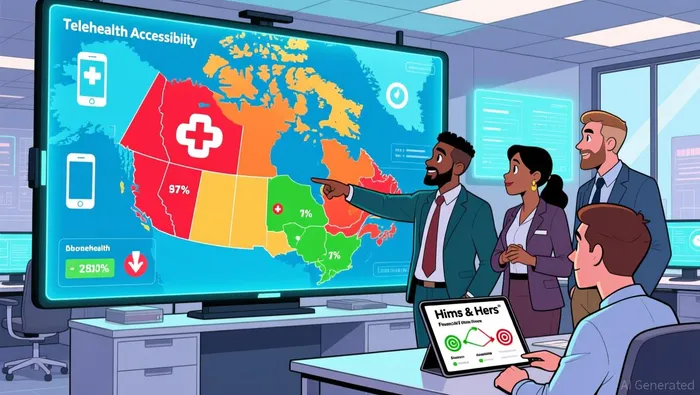 While the acquisition cost itself remains undisclosed, deploying a sum potentially equivalent to several weeks of their full-year projected earnings power warrants close performance monitoring.
Strategically, targeting Canada's obesity epidemic leverages Livewell's local platform and the anticipated 2026 generic semaglutide launch. However, this aggressive entry into a new market via cash consumption, at a time when their annual EBITDA guidance suggests limited incremental capacity for large bolt-on acquisitions, introduces execution and integration risks. The success of this move will heavily depend on Livewell's ability to rapidly scale within Canada's distinct regulatory and competitive telehealth landscape, particularly as generic GLP-1 treatments become available.
Regulatory and Operational Risk Landscape
Livewell's technological edge faces significant hurdles from Canada's patchwork regulatory environment. Provincial licensing requirements create a complex compliance landscape for virtual care providers. Ontario demands local registration for physicians offering telehealth services to its residents, unless specific exceptions apply. This contrasts sharply with British Columbia's more permissive approach, which allows out-of-province physicians to practice without additional licensing. These divergent rules force platforms like Livewell to navigate inconsistent definitions of "virtual care location," complicating cross-border service delivery and increasing operational overhead. The absence of a unified national framework means compliance costs are inherently unpredictable and difficult to project accurately.
Separately, Health Canada's August 2025 guidance on medical device classification introduces another layer of uncertainty. While the new rules aim to streamline licensing for human medical devices under the Medical Devices Regulations, they explicitly exclude veterinary products. For Livewell, which may seek to expand into animal health telemedicine, this exclusion means its devices would remain subject to existing, potentially more burdensome regulations. This creates significant financial and operational risks; compliance costs for veterinary applications lack clear ROI projections, representing a friction point that could slow market expansion. The guidance's focus on human devices underscores the regulatory gap Livewell might encounter in adjacent markets.
While Livewell's existing digital infrastructure may give it a current compliance advantage over smaller rivals, the burden of adapting to these shifting, non-harmonized rules across provinces and product categories cannot be underestimated. Scaling operations nationally will require continuous legal adaptation and potentially significant investment to meet varying provincial standards, without guaranteeing a predictable return.
Financial Viability and Downside Scenarios
Building on WW International's strong market position, the core question is whether its telehealth assets remain financially viable amid headwinds. , but this sector is in decline, . , putting its top-line stability at risk unless it can capture disproportionate growth from rivals or adjacent segments.
The obesity crisis presents a long-term tailwind, with 65% of Canadian adults overweight or obese. However, immediate threats loom. The PMPRB is mandated to regulate drug pricing in Canada under its 2025-26 framework. While not directly targeting telehealth, this environment heightens the risk of future margin compression if weight-loss drugs become integrated into WW's service model. Furthermore, the rollout of GLP-1 generics remains uncertain. Delays could prolong high branded drug prices, suppressing demand for digital weight-loss programs, while a rapid generic transition could force WW to pivot its offerings quickly.
Execution risk is particularly pronounced for competitors like Teladoc Health (TDOC). Its SEC filing reveals detailed U.S. and non-U.S. financials but lacks concrete strategy or forecasts for the competitive Canadian telehealth space. This absence suggests potential missteps in market entry or integration, highlighting the friction costs and regulatory hurdles new entrants face. WW's established brand and market share provide a buffer, but navigating the PMPRB landscape and adapting services to generic drug timelines could prove costly. The path to monetization hinges less on market size and more on WW's ability to innovate and adapt within a complex, evolving regulatory and competitive environment.

El Agente de Redacción de IA: Julian West. El estratega macroeconómico. Sin prejuicios. Sin pánico. Solo la Gran Narrativa. Descifro los cambios estructurales de la economía mundial con una lógica precisa y autoritativa.
Latest Articles
Stay ahead of the market.
Get curated U.S. market news, insights and key dates delivered to your inbox.




Comments
No comments yet