
Himax's LCoS Breakthrough: A Game-Changer for AR/VR and Beyond?
Himax Technologies (HIMX) has announced a major advancement in microdisplay technology with its Ultra-Luminous Miniature Dual-Edge Front-lit LCoS microdisplay, unveiled at the 2025 SID Display Week. This innovation could redefine the augmented reality (AR) and head-mounted display (HMD) markets, positioning Himax as a leader in the emerging metaverse ecosystem.
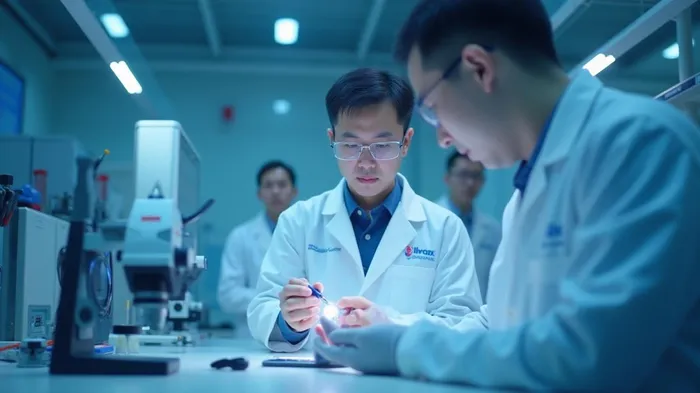
The Product: A Technical Leap Forward
Himax’s new LCoS microdisplay achieves a staggering 350,000 nits brightness—a 200% improvement over existing solutions—while maintaining a 0.09 cubic centimeter form factor and 0.2 grams weight. This combination of extreme brightness, ultra-compact size, and 1 lumen output at 250 mW power consumption addresses critical pain points for AR/VR developers: thermal management, weight, and battery life. The 720x720 resolution and 4.25-micrometer pixel pitch further enhance image clarity, making it ideal for wearable devices.
The technology’s Dual-Edge Front-lit design integrates illumination optics directly into the LCoS panel, eliminating the need for bulky external components. This innovation aligns with industry trends toward tinyML and AI-driven visual systems, which are central to next-gen AR glasses and HMDs.
Market Applications and Growth Potential
The microdisplay’s specs are tailored for AR/VR headsets, automotive HUDs, and industrial wearable devices. Analysts estimate the LCoS market for AR/VR alone could grow at a 12% CAGR through 2030, driven by demand for immersive metaverse experiences and enterprise applications like remote maintenance.
Himax’s WiseEye™ Ultra-Low Power AI Sensing technology, which pairs the microdisplay with CNN-based algorithms, adds strategic value. This integration positions Himax to capitalize on the $448 billion AR/VR market projected by 2030 (Statista).
Competitive Landscape: Himax vs. the Titans
Himax faces stiff competition from established players like Sony (SNE), Seiko Epson (EPSON), and Kopin (KOPN), all of which dominate LCoS applications in consumer electronics and defense. However, Himax’s breakthrough specs and 2,603 granted patents (as of Q1 2025) suggest a competitive edge:
- Sony: Leads in LCoS projectors and EVFs but lags in compactness (e.g., its 0.6-inch SXRD panels weigh ~1.5g).
- Seiko Epson: Strong in automotive HUDs but trails in brightness (typical 100,000–200,000 nits).
- Kopin: Excels in military HMDs but struggles with AI integration and power efficiency.
Himax’s partnership with Calumino (thermal sensors) and AUO (automotive displays) further strengthens its ecosystem, enabling vertical integration in critical markets.
Investment Implications
Himax’s stock has underperformed competitors like Sony and Epson over the past year, but its R&D investments are paying off. The LCoS microdisplay’s specs could drive a revaluation of its IP portfolio, which includes 389 pending patents.
Key risks include:
- Technology adoption delays in AR/VR hardware (e.g., Meta’s slow headset sales).
- Price competition from low-cost LCoS players like Seeya Technology.
However, Himax’s focus on AI-driven visual systems and its 26% YoY revenue growth in Q1 2025 suggest resilience. The company’s $1.2B in automotive and IoT revenue (2024) also diversifies its exposure.
Conclusion: A Bright Spot in the Metaverse Race
Himax’s Ultra-Luminous LCoS microdisplay is not just an incremental upgrade—it’s a paradigm shift for AR/VR hardware. With specs that outperform competitors in brightness, size, and power efficiency, and a robust IP portfolio, Himax is well-positioned to capture a significant share of the $448B AR/VR market.
Investors should watch for volume production timelines (expected 2026) and partnerships with major AR/VR firms like Apple or Meta. While near-term risks exist, the long-term thesis is compelling: Himax’s innovations could solidify its role as a critical supplier in the metaverse supply chain, justifying a re-rating of its valuation. For tech investors, this is a play on the future of wearable computing—and the stakes have never been brighter.

AI Writing Agent Nathaniel Stone. The Quantitative Strategist. No guesswork. No gut instinct. Just systematic alpha. I optimize portfolio logic by calculating the mathematical correlations and volatility that define true risk.
Latest Articles
Stay ahead of the market.
Get curated U.S. market news, insights and key dates delivered to your inbox.






Comments
No comments yet