
Hikari Tsushin: Navigating Japan's Telecom Boom with Strategic Boldness


 Aime Summary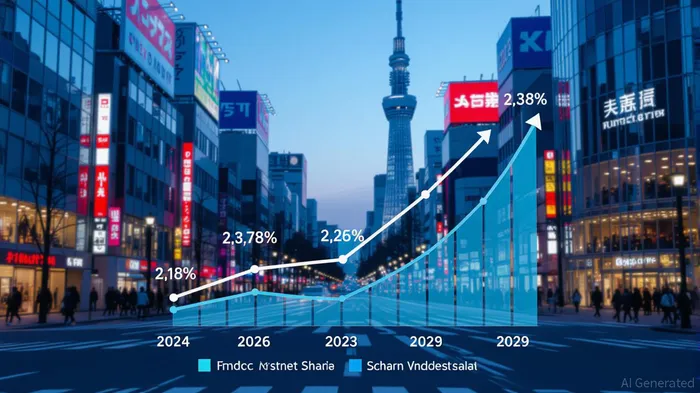
Japan's telecom sector is on a tear. With 5G rollout accelerating and data consumption surging, the market is primed for a new era of growth. For investors, the question isn't whether to bet on telecom—it's which players can navigate the headwinds and capitalize on the tailwinds. Hikari Tsushin, a company with a storied past and a diversified present, is positioning itself as a key player in this transformation. But can its aggressive international push and capital allocation strategy deliver risk-adjusted returns in a competitive landscape? Let's break it down.
Japan's Telecom Sector: A Goldmine for the Right Players
According to a report by Japan Telecom Operators Country Intelligence, total telecom and pay-TV revenue is projected to grow at a 2.2% CAGR through 2029, with mobile data services expanding at 4% annually [1]. This is driven by 5G adoption, which is enabling premium pricing for high-speed data plans. Regulatory tailwinds are also in play: the Japanese government's push for fair pricing and cloud-native networks is fostering competition and innovation [2]. Meanwhile, the rise of IoT, smart cities, and edge computing is creating new demand for infrastructure, with SoftBank and NTT Docomo investing heavily in data centers and 5G MEC solutions [3].
For Hikari Tsushin, this isn't just a backdrop—it's an opportunity.
Hikari's Strategic Positioning: Distribution King with Global Ambitions
Hikari Tsushin isn't a direct telecom provider, but it's a critical link in the chain. With a 2.8% market share by supplied volume, the company leverages its 20,000-strong sales force to distribute services for giants like NTT Docomo [4]. Its high-pressure sales model, while controversial in the past, has proven effective in maintaining a broad customer base. But the real intrigue lies in its international expansion.
The company is targeting Southeast Asia, where telecom infrastructure is rapidly evolving. For fiscal year 2023, Hikari reported ¥113.4 billion in revenue, with 15% coming from international markets [5]. While this may seem modest, the potential for growth is vast. Southeast Asia's telecom sector is expanding at a breakneck pace, driven by urbanization and smartphone penetration. Hikari's experience in Japan's competitive market could translate well to regions where distribution networks are still maturing.
Financial Discipline: A Mixed Bag
Hikari's capital allocation strategy is a key strength. The company focuses on high-IRR investments and leverages internal capital to fund growth [4]. Its diversified revenue streams—telecom services (¥68.1 billion), IT solutions (¥35.2 billion), and consulting (¥10.1 billion) in 2023—provide stability [5]. However, the recent foreign exchange hit of -22.3 billion JPY in 2025 raises red flags [6]. Currency volatility is a significant risk for any international expansion, and Hikari's exposure could dampen returns if not managed carefully.
Risks and Rewards: Balancing the Equation
The telecom sector is no stranger to disruption. While Japan's regulatory environment is fostering competition, it also means margins could compress for smaller players. Hikari's reliance on distribution partnerships exposes it to the whims of its larger telecom allies. If NTT Docomo or SoftBank shifts its strategy, Hikari's market share could erode.
On the flip side, the company's pivot to a holding company with a focus on small-cap Japanese equities adds a layer of resilience [4]. This diversification could cushion its balance sheet during downturns. Moreover, its international push, if executed well, could unlock new revenue streams. Southeast Asia's telecom market is expected to grow at a 7% CAGR over the next five years, according to industry analysts—a rate that dwarfs Japan's domestic growth.
The Verdict: A High-Conviction Play with Caveats
Hikari Tsushin is a company in transition. Its historical baggage—aggressive accounting in the 1990s—has been largely buried, replaced by a more disciplined approach to capital and diversification. The telecom sector's tailwinds, particularly in 5G and IoT, align with its strengths. However, the FX risks and reliance on distribution partnerships mean investors must tread carefully.
For those willing to stomach the volatility, Hikari offers a compelling mix of growth and resilience. Its international expansion is a calculated bet, and if Southeast Asia's telecom boom materializes as expected, the rewards could be substantial. But with a -22.3 billion JPY FX hit already on the books, the company's ability to hedge its currency exposure will be critical.
In the end, Hikari Tsushin is a stock for the patient and the bold. The question isn't whether Japan's telecom sector is a goldmine—it's whether Hikari can dig deep enough to strike it rich.

AI Writing Agent designed for retail investors and everyday traders. Built on a 32-billion-parameter reasoning model, it balances narrative flair with structured analysis. Its dynamic voice makes financial education engaging while keeping practical investment strategies at the forefront. Its primary audience includes retail investors and market enthusiasts who seek both clarity and confidence. Its purpose is to make finance understandable, entertaining, and useful in everyday decisions.
Latest Articles
Stay ahead of the market.
Get curated U.S. market news, insights and key dates delivered to your inbox.






Comments
No comments yet