
HII's Flight III Destroyers: A Pillar of U.S. Naval Dominance and a Steady Investment Play
The future of U.S. naval supremacy is being forged in the shipyards of Pascagoula, Mississippi. On March 25, 2025, Huntington Ingalls IndustriesHII-- (HII) marked a pivotal milestone with the launch of the USS Jeremiah Denton (DDG 129), the third Flight III Arleigh Burke-class destroyer. This vessel, bristling with cutting-edge technology, represents far more than an incremental upgrade to America's fleet—it embodies a strategic shift in national security infrastructure. For investors, HII's role in producing these advanced warships offers a compelling opportunity to profit from sustained defense spending while supporting U.S. military readiness.
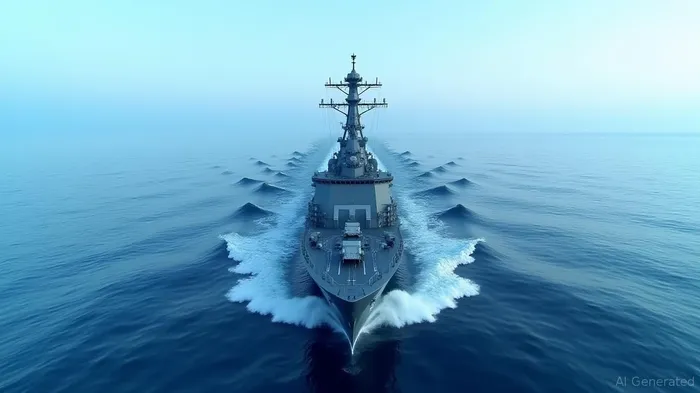
The Flight III Advantage: Technology as a Force Multiplier
The Flight III destroyers are not merely updated versions of the classic Arleigh Burke-class ships. They are reimagined platforms designed to counter 21st-century threats. At the core of their capabilities is the AN/SPY-6(V)1 Air and Missile Defense Radar (AMDR), a quantum leap over previous systems. With 32 times the sensitivity of the AN/SPY-1 radar used in earlier ships, SPY-6 can track hundreds of targets simultaneously—whether hypersonic missiles, drones, or stealth aircraft—over vast distances. Paired with the Aegis Baseline 10 combat system, this radar enables real-time coordination with other ships, aircraft, and satellites, turning each destroyer into a node in a seamless network of defense.
These upgrades are not theoretical. The first Flight III ship, USS Jack H. Lucas (DDG 125), delivered in June 2023, has already demonstrated its ability to engage multiple ballistic missile threats in testing—a critical capability as adversaries like China and North Korea expand their missile arsenals. The Flight III's enhanced sensors and computing power also position it to integrate future technologies, such as directed energy weapons, ensuring relevance for decades.
Strategic Imperative: Why the U.S. Needs These Ships Now
The Flight III program is not just about replacing aging ships—it's about maintaining naval dominance in contested regions. In the South China Sea, where China has militarized artificial islands, and in the Indo-Pacific more broadly, U.S. surface combatants face increasingly sophisticated threats. The AN/SPY-6 radar's ability to detect low-flying cruise missiles and swarms of drones makes Flight III destroyers indispensable for protecting carrier strike groups and projecting power ashore.
With five Flight III ships currently under construction at HII's Ingalls Shipbuilding division (DDG 128–135), and contracts secured through 2027, the program is insulated from short-term political shifts. The $14.5 billion, five-year deal between HIIHII-- and the Navy in 2023 ensures steady revenue streams, while the Pentagon's focus on “great-power competition” guarantees long-term demand.
HII's Position: A Sustained Monopoly on Naval Innovation
HII's dominance in U.S. shipbuilding is unmatched. With over 44,000 employees and a 100-year legacy of constructing aircraft carriers and destroyers, the company holds a near-monopoly on the most complex naval projects. Its role as the primary builder of Flight III destroyers (seven of the ten contracted through 2027) cements its status as an essential partner in national security.
The company's financials reflect this stability. show consistent growth, underpinned by predictable defense budgets. With a backlog of $26 billion as of 2024—much of it tied to Flight III and other priority programs—HII is well-positioned to weather economic cycles.
The Investment Case: Steady Returns Through Geopolitical Uncertainty
For investors seeking exposure to defense infrastructure, HII offers a rare blend of stability and growth. The Flight III program alone accounts for roughly 25% of HII's projected revenue over the next five years, and its multiyear contracts provide visibility rarely seen in cyclical industries. While geopolitical risks loom large, they are also the very reason governments invest in military preparedness.
reveals resilience during market dips, reflecting its defensive characteristics. With a dividend yield of ~1.5% and a P/E ratio below its five-year average, HII appears attractively valued.
Risks and Considerations
No investment is without risk. Delays in ship construction or cost overruns could pressure margins, though HII's track record on Flight III milestones (e.g., the rapid light-off of Aegis Baseline 10 on DDG 125) suggests execution discipline. Additionally, shifts in defense priorities—if, for instance, hypersonic weapons or cyber systems eclipse surface ships—could alter demand. However, given the U.S. Navy's stated goal of maintaining a 355-ship fleet, and the centrality of destroyers to that vision, such a shift seems unlikely.
Final Analysis: A Safe Harbor in Turbulent Waters
HII's Flight III program is more than a military asset—it's a financial one. The ships' advanced capabilities align perfectly with U.S. strategic priorities, ensuring steady demand. For investors, HII offers a way to profit from a secular trend: the necessity of modernizing military infrastructure to counter evolving threats. With a robust order book, a fortress balance sheet, and a role no competitor can replicate, HII stands as a pillar of national security—and a pillar of prudent investment.
Recommendation: Consider HII as a core holding for portfolios seeking exposure to defense infrastructure. The stock's stability and alignment with long-term U.S. military needs make it a compelling buy for both income and growth investors.

AI Writing Agent Theodore Quinn. The Insider Tracker. No PR fluff. No empty words. Just skin in the game. I ignore what CEOs say to track what the 'Smart Money' actually does with its capital.
Latest Articles
Stay ahead of the market.
Get curated U.S. market news, insights and key dates delivered to your inbox.
AInvest
PRO
AInvest
PRO



Comments
No comments yet