
Higher Education Endowment Management and Institutional Stability: Lessons from Stephen F. Austin University


 Aime Summary
The higher education sector is navigating a perfect storm of financial pressures, shifting demographics, and evolving institutional roles. Universities are increasingly forced to balance mission-driven priorities with fiscal sustainability, a challenge epitomized by Stephen F. Austin State University (SFA). As a case study, SFA's endowment management strategies and institutional resilience efforts offer a microcosm of broader trends in higher education, from liquidity constraints to the rise of student-centric financial models.
SFA's Endowment: A Microcosm of Sector-Wide Struggles
Stephen F. Austin State University's endowment,
valued at approximately $143.6 million as of October 2025, operates under the umbrella of The University of Texas System. While this figure pales in comparison to the $10+ billion endowments of elite institutions, it reflects the systemic challenges facing mid-tier public universities.
Declining federal research and Pell grant funding have created liquidity pressures, a trend mirrored across the sector.
According to a report by Deloitte, institutions are now prioritizing financial models that align with their missions while streamlining programs to adapt to shrinking enrollment and tuition revenue.
SFA's approach to endowment management underscores this tension. The university has diversified its portfolio through a unique student-managed investment fund, now
valued at $2.73 million after a recent UTIMCO contribution. This initiative not only provides hands-on learning for business students but also signals a strategic pivot toward experiential education as a tool for both financial and institutional resilience.
The fund's goal to outperform the S&P 500 highlights a sector-wide shift toward high-risk, high-reward allocations-echoing strategies adopted by larger endowments, which saw an average 11.5% return in FY25 by heavily investing in private equity and venture capital
according to UTIMCO reports.
Institutional Stability: Balancing Mission and Market Forces
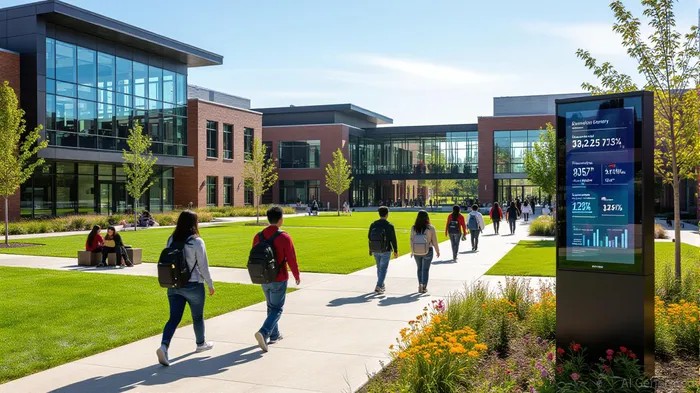 SFA's institutional stability is anchored in its SFA Envisioned 2023 strategic plan,
which emphasizes enrollment growth, academic innovation, and student well-being. This aligns with a broader trend in higher education to measure success beyond traditional metrics like graduation rates. For instance, SFA ranks among the top 30 U.S. universities for fostering student "flourishing" in wisdom, integrity, and leadership,
according to The Wall Street Journal. Such outcomes are not merely academic; they are increasingly seen as critical to institutional sustainability.
As Deloitte notes, universities must "amplify the value of higher education" in an era of public skepticism and financial uncertainty.
However, SFA's stability is not without risks. The university's reliance on the Permanent University Fund (PUF)-a Texas state-managed endowment-exposes it to political and economic volatility. The PUF's income, derived from mineral and surface lease revenues,
is allocated to both capital expenditures and academic programs. Yet, as national endowment returns fluctuate, institutions like SFA must navigate the dual challenge of preserving principal while generating sufficient returns to fund operations. This mirrors the sector-wide dilemma highlighted at the 2025 AGB National Conference on Trusteeship,
where leaders stressed the need for adaptive governance to address "unreliable funding and evolving institutional roles."
Risk Mitigation and the Future of Endowment Strategies
SFA's investment policy emphasizes diversification, liquidity, and alignment with long-term educational goals
according to university policy. This cautious approach contrasts with the aggressive risk-taking of larger endowments but reflects the realities of a mid-sized public university. The student-managed portfolio, for example, serves as both a risk-mitigation tool and a training ground for future financial leaders. By engaging students in real-world portfolio management, SFA is not only addressing immediate financial needs but also cultivating a culture of fiscal responsibility-a strategy that could become increasingly vital as tuition-dependent institutions face prolonged budgetary constraints.
Yet, SFA's model is not without limitations. The university's focus on student flourishing and holistic development
according to a national survey may come at the expense of short-term financial gains. For instance, investments in mental health support and academic advising-key drivers of student engagement-require upfront capital that could otherwise be allocated to higher-yield assets. This trade-off encapsulates the sector's broader struggle to reconcile mission-driven priorities with market realities.
Conclusion: A Blueprint for Resilience?
Stephen F. Austin University's endowment strategies and institutional priorities offer a compelling case study for the higher education sector. By integrating experiential learning into its investment practices, prioritizing student well-being, and adapting to financial headwinds through strategic diversification, SFA exemplifies the kind of adaptive leadership emphasized at the 2025 AGB conference
according to conference materials. However, its challenges-ranging from liquidity pressures to the tension between mission and market forces-underscore the fragility of the current model.
As universities grapple with declining public funding and shifting student expectations, SFA's approach suggests a path forward: one that balances fiscal prudence with innovation, and institutional mission with market demands. Whether this model can be scaled or replicated remains to be seen, but its lessons are clear: in an era of uncertainty, resilience begins with reimagining what an endowment-and a university-can be.

Stay ahead of the market.
Get curated U.S. market news, insights and key dates delivered to your inbox.






Comments
No comments yet