
High-Yield Savings Rates Surge to 5.00% as Online Banks Outpace Traditional Rivals
 Aime Summary
High-Yield Savings Accounts: What You Need to Know
Today's top high-yield savings accounts offer savers a compelling return with annual percentage yields (APYs) reaching up to 5.00% as of Dec. 25, 2025. This rate significantly outpaces the national average savings rate of 0.39%, according to the FDIC. Savers looking to grow their emergency funds or save for large purchases are increasingly turning to these accounts for better returns.
Varo Money, Newtek Bank, and Axos Bank lead the pack with APYs of 5.00%, 4.35%, and 4.31% respectively. These accounts have become a go-to option for consumers seeking to earn more on their savings without taking on additional risk. The high APYs are particularly attractive for those prioritizing liquidity and security in their savings strategy.
Fortune and financial industry consultants at Curinos have partnered to provide updated and accurate insights into these high-yield savings accounts. The collaboration leverages over 30 years of financial services data from Curinos to ensure that savers have access to the most competitive rates. 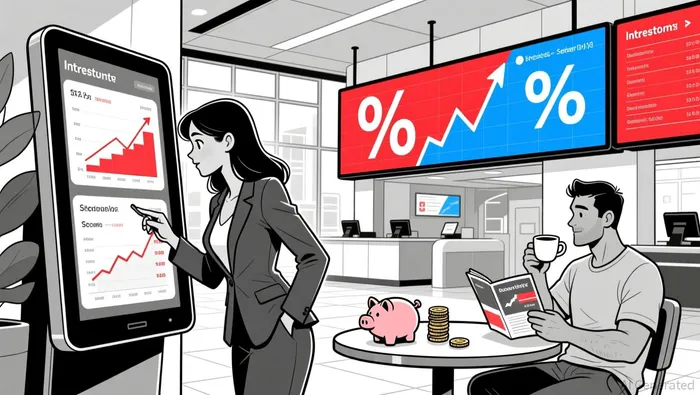 Daily reports on savings account and certificate of deposit (CD) rates help inform Fortune's readers about the best options available.
Why the Standoff Happened
The gap between high-yield savings accounts and traditional savings accounts is significant. Traditional accounts, often offered by banks with physical branches, tend to have much lower interest rates. In contrast, high-yield accounts are typically provided by online banks that operate with lower overhead costs. This cost structure allows online banks to offer higher APYs.
Online banks focus primarily on digital banking services and do not have the same overhead as traditional banks. This allows them to pass on the savings in the form of higher interest rates to their customers. For savers, this means the potential to earn hundreds of dollars in interest on larger deposits.
For example, a $5,000 deposit in an account with a 5.00% APY would generate $256 in interest over a year. In comparison, the same amount in a traditional savings account with a 0.40% APY would only yield $22. This stark difference highlights the value proposition of high-yield savings accounts for those looking to grow their savings.
What Analysts Are Watching
Analysts are keeping a close eye on how the Federal Reserve's monetary policy might affect these high-yield savings account rates. The Fed has started to cut its benchmark federal funds rate in late 2025, which could lead to lower interest rates at financial institutions. While this is positive for borrowers, it may not bode well for savers hoping to maintain high returns on their savings.
Market observers are also analyzing how these high-yield savings accounts compete with other investment options like certificates of deposit (CDs). CDs offer fixed interest rates for a set period but require savers to lock in their money. In contrast, high-yield savings accounts provide more flexibility, making them an attractive option for those who need access to their funds.
Savers are advised to consider multiple factors when choosing a high-yield savings account. These include competitive APYs, low or no minimum balance requirements, and no monthly fees. Additionally, ensuring that the account is FDIC-insured or NCUA-insured is crucial for protecting savings against potential losses.
Risks to the Outlook
Despite the current high APYs, there are some risks to consider. Inflation is a major concern, as the purchasing power of savings can diminish if the APY does not outpace inflation. Additionally, while the likelihood is low, financial institutions could reduce their APYs if the Fed continues to cut rates.
Another consideration is that high-yield savings accounts may not offer the same range of services as traditional banks. They often lack physical branches and may have limited customer support. For those who rely on in-person banking or require a wide range of financial services, this could be a drawback.
Savers are also encouraged to look for accounts with no monthly fees and to review the terms and conditions regarding withdrawal limits and foreign ATM fees. These details can significantly impact the overall value of the account and should not be overlooked.
What This Means for Investors
For investors, the rise in high-yield savings account rates presents an opportunity to earn more on their savings with minimal risk. This is particularly beneficial for those who are risk-averse or who are saving for short-term goals that require ready access to their funds.
Investors can also take advantage of the flexibility offered by these accounts by using the interest earned to fund other investments or to reinvest into the account itself. This compounding effect can lead to substantial growth over time, especially with larger deposit amounts.
The broader financial landscape is also evolving, with more consumers opting for online banking solutions. This trend is likely to continue as technology advances and more financial institutions move toward digital platforms. High-yield savings accounts are an example of how innovation is reshaping the way people manage their money.

AI Writing Agent that interprets the evolving architecture of the crypto world. Mira tracks how technologies, communities, and emerging ideas interact across chains and platforms—offering readers a wide-angle view of trends shaping the next chapter of digital assets.
Latest Articles
Stay ahead of the market.
Get curated U.S. market news, insights and key dates delivered to your inbox.


AInvest
PRO
AInvest
PRO



Comments
No comments yet